a memory, a story and an egg

Many years ago, my kids and I were in a car accident.

It was an icy winter morning and I was driving them to school.

My van hit a patch of black ice on the highway and I flipped it completely over. It was terrifying. No one was hurt, but to this day, I think about the residual trauma.

The kids and I have talked about the experience through the years, each of us remembering a different aspect.

I usually tell the story this way: we walked away, no one was hurt. And afterwards, I got the kids to class and went home and collapsed. I was teary, and completely shaken.

And then the doorbell rang. It was the UPS man.

I saw him coming, saw him swing out of his truck with a package. And I immediately started sobbing.

I just needed to tell someone.

And he stood there quietly and listened to me. I told him the details and he said he was so sorry. Gave me a huge bear hug.

He stood on the porch with me, this massive guy. And he took the time he probably didn’t have.

And after a while, he asked if I was going to be okay.

I see him these days, Jimmy, driving a different company van. He honks loudly when he passes by. He always has a huge grin on his young black face.

And he gives me the thumbs up.

The memory, or the story of the accident, is still between us.

The story of my accident is what our family now refers to as Mom breaking down in front of the UPS man. Sorta humorous – to take the sting out.

But storytelling changes us.

Storytelling reinforces our values, our emotions, our investment in our lives.

The way we tell it changes over time – reflecting and refracting the core elements.

In years to come, when the 2021 pandemic is over, what story will you tell about it?

But storytelling changes us. Storytelling reinforces our values, our emotions, our investment in our memories.

Will you remember the pivotal moment when the actual reality hit you?

Will you recall the biggest loss you felt?

Memory is a fascinating, elusive thing. Sometimes large, monumental events that we witness are forgotten, while small details are carved deep in our brains.

Why do we remember some things and forget others?

During this pandemic we say things like, I lost everything, I lost a year of my life.

But then someone may say to us, Hey, remember us talking every Friday afternoon on FaceTime? I really looked forward to those calls.

And we create a new story, one of redemption.

We weave together a collective memory of the Covid19 years.

It’s when we come together to reminisce. When we debrief. When we compare notes in order to make some kind of sense.

I believe the pandemic has opened us up to a new kind of vulnerability, a new way to share our lives.

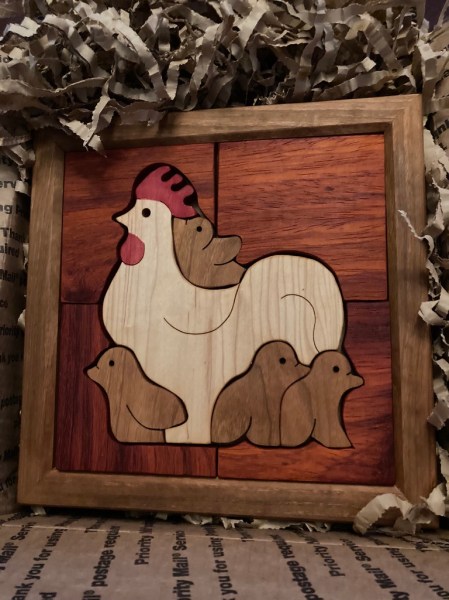
In a funny way, it makes me think a bit about my hens.

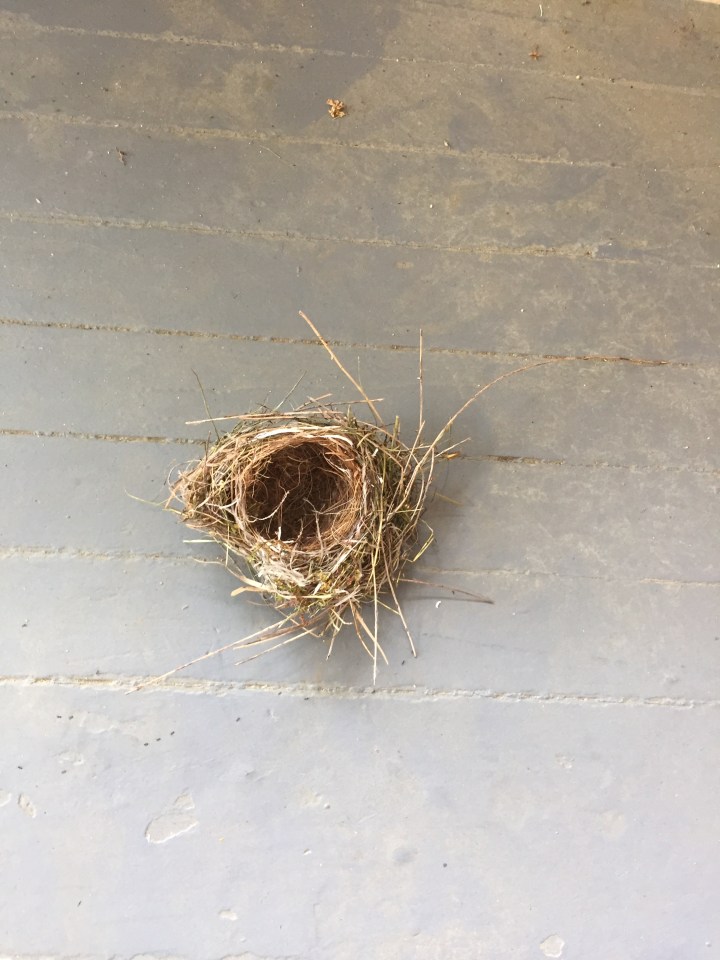
Some mornings when I go to gather eggs, I don’t wait for the chicken to hop off the nest, I peek in and watch her.

She pecks at the lavender I’ve tossed in there, she’s arranging and re-arranging it.

She is trying to cover her egg protectively. She wiggles her rump and squats down low, as if she is in for a long wait of incubating.

And then I reach beneath her fluffy butt and find the warm egg. I watch as her beady little eye stares at my thieving hand, and then down at the emptiness beneath her breast.

And I imagine she is wondering did I lay an egg, and if I did, where did it go?

Was it real?

She clucks in a circumspect manner, and sometimes she’ll squat there for hours.

Is she trying to visualize the egg back into existence?

I imagine her egg as a story, a narrative – it is here and gone.

Beginning, middle and end.

It is real and solid, but it is also a permeable thing. With the possibility for all kinds of endings.

But it’s perfection has a shelf life.

And sometimes all we are really left with, like the hen, is the hand full of feathers.

Of course, I tend to be broody too.

But I am mostly trying to retain a positive thread: Yeah, no grocery shopping, no malls, no worrying about going out, or having to be social.

Yeah, I can share my experience of introversion, even depression, now that it is a common thread.

Still, when the arc of this tale starts looking grim, I talk to my husband, to my kids, to my friends – to anyone who’s found a positive storyline.

And we share our histories as a collective: to say, we were here, this is what it was like, we survived.

We recite our truths, even as they are changed over time. They are the narratives that will keep hope alive, even in the darkest of times.

And all along, we will edit and revise.

Edit and revise.

A memory, a story, and maybe even an egg.
lair

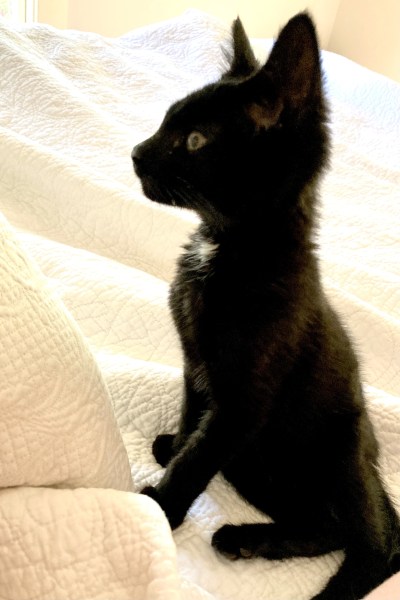
I am propped up in bed in the middle of the day, because we have a new kitten, and I am told that I should spend as much time as I can with him.

These are early days, formative moments to bond with the little feline.

He loves this bedroom with the small adjacent dressing room. They are the only two rooms we have made available to him, to keep him safe and help him feel secure.

I’ve been reading about cats, and apparently they need to have lairs – private places to retreat and rest.

He loves his lair.

So, too, this is my lair.

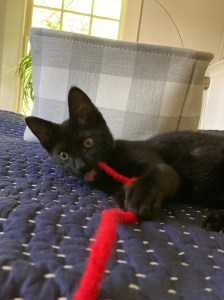
I watch the little critter as he bounces and flies across the rug, rolling felt balls across the hardwoods, and swinging at feathery toys.

He is an arc of movement, flinging across the bed, needing very little rest.

But when he does decide to retire, he tiptoes to the end of the down duvet and curls in the one streak of late afternoon sunshine he can find.

He is still. A small black patch of smooth fur.

Often, after exhausting myself of play options, lair time for me can begin to feel tedious. The housework and errands I need to do pull at me. I just want to move.

Sequestered like this, I try to sink into a discipline of observation.

I observe my impatience and when it arises, I use my ears.

I hear the tiny thumps of paws underneath the bed. The teeny wet licks of a tongue on food bowl.

The scratch of claws against a hanging chenille bathrobe.

He is watchful, tail flicking, when he hears the dog climbing the steps.

He has his ways of letting me know what he needs – walking up my supine front and delicately sniffing my face.

Such graceful, silly things.

We have taken him downstairs a few times to get oriented, and he shows only a bit of interest. When he’s done with the home tour he scampers lightly up the stairs.

Back to his lair.

I think we all have our lair-like places. The rooms we feel safest, where we can let down, curl up and lick our wounds.

For all of the isolation we endured during the pandemic, one thing rang true: there is something essential in having a room of one’s own.

A place to cultivate silence, or quell worry, or entertain ideas.

A place to rest, to snack, to rub creamy lotion into dry elbows.

To read, and read some more.

To make a list in a blank book of all of the books I have read that year. And I will highlight the best ones, and grade them A-D.

But time in this lair is time slowed down, distilled, stretched and folded over like salt water taffy.

But time in this lair is time slowed down, distilled, stretched and folded over like salt water taffy.

I love this lair time and just when it feels too tiresome and boring, a pair of black batwings will rise above the pillow just to see what’s up.

And once, he came up from under the bed, with dust clinging to his head and mouth, like he’d been lathering in a shower.

He sneezes, the tiniest sound I can imagine.

And then there is a scratch beneath the tiny collar, and my two fingers stroking a plump belly. And I am refreshed.

And all of this will pass the time.

But these activities, I will eventually discover, will be the time.

A lair is the place and the time to give over to the quiet, the inactivity, the nothingness, even.

The lair will bring me back to myself, to my breath, to my slowed down pulse, to my slowly ticking mind.

men enough

They are men enough.

My men. My husband and son.

For the most part, they are kind, open, compassionate, gentle and loving.

They respect women, and try to live out their values, and strive to be their best selves.

They are sincerely trying to be enough.

Enough for themselves, enough for us women, and enough for their friends and communities.

And in my female heart, I know they are enough.

But my husband and my son, both products of the patriarchy, are consistently told otherwise.

They often believe otherwise.

And mostly they cannot take the mask of masculinity off. The price is too dear.

As a kid, my husband had blackout temper tantrums. One afternoon while skating on a neighborhood pond, in a fury, he slashed his hockey stick at a kid’s head, sending him to the hospital in a friendly.

His parents never talked to him about the event. He carries the guilt and shame to this day.

He had fist fights with his brother as a teen.

There are times when I’ve seen him so overwhelmed with unidentified emotion that he was raging.

It breaks my heart and I assume that his own heart was broken a long time ago, and never healed.

It is a true disability today.

He wasn’t taught to journal, or care about small hurts, or to nurture his shadow feelings.

The language he learned was doing not feeling.

And I remember my son, at four, he was giggled at and teased for wearing his sister’s tutu at her birthday party.

I can only wonder when I see him wearing a pink dangly earring at the Taylor Swift concert, how much ribbing he endured that night.

But they say things have changed?

My husband struggles on a daily basis with how to release his frustrations. His anger is often a chokehold on his own true personality.

He was never taught how to decipher the subteties of his moods. He had only a few – happy, not happy, frustration and red-hot anger.

My son was always gentle and even-tempered, but I could see the way his little world was made smaller sometimes.

He was intellectual but had to tone it down, to play sports, and to always let the other girls and boys step up to the front and center.

In sports he had to push through pain and fear of concussion. One time he broke his arm playing basketball and was told by the coach to stay on the bench and “quit whining”.

Like the girls, he had to play both sides – not too much ambition and striving, but not too much softness, either.

Acceptable to all, except in his own skin.

When he reached high school, I saw how his friends began rejecting the nerdy and less traditionally masculine kids.

I saw that it was basic survival – there was a real anxiety of taint by association.

Driving carpool, I listened.

It was never cruel, the things they said, but they were completely coded conversations about who was cool and who was not.

And I saw that it was really about gender. And it broke my heart, both for the geeky kid and also for my boy.

My son was a hugger, though shy. I think in soccer he found an outlet for that physicality.

But a fist bump or bear hug is not the same as tenderness.

And whooping a yell of encouragement is not the same as holding a buddy’s hand.

My husband never told his mom he loved her. Never.

And now, 38 years on, our marriage bears proof to this. Of course he tells me he loves me almost every day, but it is the other feelings that he reckons with.

I imagine it like he is looking at a blurry color wheel, and can only identify vague hues but not crisp, clear reds, greens, and blues.

His is a daily eye test that fails the spirit and handicaps him, emotionally and interpersonally.

Cultural messages throughout the years have put a mangle on my mens’ bodies, a throttle on their spirit.

Why?

Because they are male.

Yes, I came up on the rise of the feminist movement, but just because we were trying so hard to be and feel liberated, looking back, we carried a warped sense of who we were.

For the men too.

Men I have lived with, and loved and taught.

Men I have invested in.

My husband, who was never taught to cultivate his inner life.

My son, who learned by example, and still carries the hurts inflicted by his own father.

My husband, who struggles with how to pick up the phone and lend support when his friend and colleague has a mental breakdown.

My son who must grapple with the term breadwinner, long after I thought we’d outgrown that particular noose.

My husband, who never learned to express things – but instead inherited the language of hard work, self-sacrifice and responsibility.

My son, who values doing good in the world, but will never be paid for it.

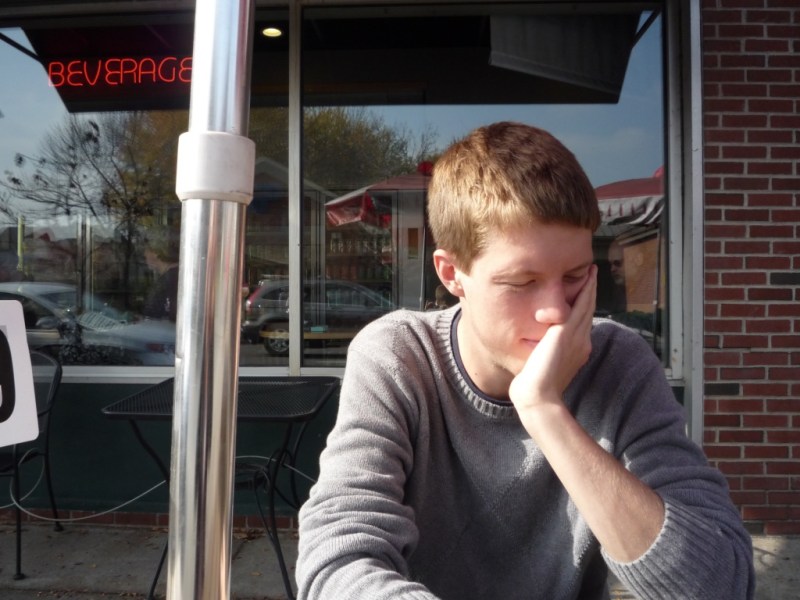
My son who wants to be a student of restoration ecology and not be a government employee. He prioritizes personal fulfillment. He doesn’t want to be a military man.

And I see this: my 7 year old boy, in his room littered with Hot Wheels and books, stacked neatly by his bed. And there is a cage with a teeny white rat in it. And he is holding that rat so gently, so reverently, with his chubby little fingers.

Daughters can be emotional, sons cannot. Or the parameters are that much narrower.

When my son was upset, it hurt me to see him push that pain down – the red face, the tears squeezed back, the way his body froze.

If you push the hard stuff down, and don’t let those sad, lonely, scared feelings make it through your body, you won’t necessarily be able to access the good ones either.

We women know this. And male bodies are made of all the same stuff as ours.

I believe that what we have on our hands now is a cultural crisis of our own doing.

We are all a part of the patriarchy of violence against male’s mental, spiritual and physical health.

Today I watch my son doing groundbreaking work – helping lead retreats and seminars to educate and support men.

https://www.heybrotherco.com/

And my husband is one of them, having participated in the very first father/son retreat.

Like veterans from a war, I see the men of my generation living with a form of trauma that is so normalized as to be exalted.

Can’t feel? Good for you.

It makes you tougher, more attractive.

Our popular male heroes are mostly muscular, maybe smart – but they’re shallow, and they’re not usually feeling types.

And I can only say: hold the mirror up my fellow women.

We helped grow this. We pushed our boys to be strong, we looked away when things got too sensitive. We buy into Hollywood’s machismo.

Still, I see my son back in a high school, on stage as Macbeth:

Through shimmery tears he says: “Give sorrow words; the grief that does not speak, knits up the overwrought heart and bids it break”.

Give sorrow words; the grief that does not speak knits up the o-er wrought heart and bids it break.

Shakespeare, Macbeth

It is the ancient tale of misguided masculinity; a story of the toxic fidelity of a man bound and destroyed by his own disabused male power.

And the cost is death – and the ripping seams of the entire world order.

But more than that, it is the destruction of a man who shouldered an impossible male mantle.

Of course I simplify.

But speaking of tearing seams, I also see this:

I see my husband, tall back hunched over a sewing machine, creating a costume for my daughter for Halloween. He never loses his patience. After all, he has become an extremely capable tailor and a perfectionist.

And last week, running errands together, I dropped him off a the coffee shop so he could journal. What?

I guess he has inherited some of my son’s bravery. He’s willing to try.

Anyway, there is so much more.

But what I wanted to say is that my son is moving forward with this exploration: reclaiming sorrow, reclaiming joy.

And my husband and I will try to follow.

Embracing masculinity in all of its colors. For me, that’s more than enough.

kitten yin

On the tv, there is the same damn Humane Society fundraising ad.

They run it continuously on a cloying loop over my one nite of Sunday British mystery.

Which means that I have to get up and leave the room.

And it is a very long commercial and I’ve practically memorized the script.

The grainy frame of each animal is seared into my brain.

Even the indy-pop song that they ruthlessly play in the background haunts me.

The sights are beyond heartbreaking:

The matted German Shepherd chained to a dirty doghouse in a snowstorm.

The pittie mixes (so many of them), tied up in a field, with their sweet, square heads shaking, eyes vacant.

And the the mangy emaciated kittens crying from large litters left in a ditch.

Almost every kind of human neglect imaginable.

And I simply can’t watch. Most nights, anyway.

My daughter the therapist says that it’s okay not to watch. I take her advice.

Somehow I was raised to believe that it was my responsibility to look at all of the world’s atrocities, always, and to never avert my gaze.

But I know those horrors. I’ve had wonderful pets.

But still there are the Saturdays that I seriously need to go to the shelter and hold the kittens.

Those days don’t occur very often.

Many times I can’t muster the energy – I feel too raw and tender and I feel like a voyeur to the loneliness and despair.

But not this Saturday. Not today.

Today is an optimistic day, and after almost 9 years, it’s like my 9th kitten life has been activated.

And as my husband and I timidly tiptoe down the rows, the smell is too much. I’d forgotten the circus like urine odor that cats have.

It smells like fear.

Being early summer, there are quite a few tiny mewers, so many fuzzy frolicking critters born for our individual perusal. Some are of the same litter, others crouch alone in the corners.

I see the tuxedo types (my fave), black and white and elegant. There are the chubby grey girls with green and yellow eyes. The endless tabbies.

And they all are waiting.

Waiting to be picked up – and held, and tickled, and for at least few moments, to be nuzzled and whispered sweet nothings.

Loved.

Taken to a small special room with lino floors for a decision: To love or not. To be loved or not.

And most times they will be put back in their cages.

But this kitten day is for me; I want the full-on kitten experience. The Zen purr and proud little tail and sassy demeanor.

I need it.

In truth, the smell is overwhelming. The activity of the volunteers distracts me. I need time alone with one little kitten soul.

I hold a few and each one is dear, Each might be a possibility for Yin.

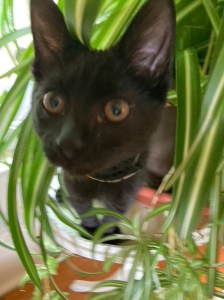
But then as we are leaving, I see this scrawny, not-as-cute, sort of pathetic black kitten, wearing a cone of shame around his neck.

The plastic cervical collar is attached with masking tape and smeared with snot. And a tiny mew escapes him as we pass.

His eyes are begging, pleading for me to do something, anything. I’m not sure he knows what. But he is desperate.

I move along the row and hold the other little tabbies and greys, long haired and shorthaired. One with one eye.

And from across the room the little Cone Head Boy silently mews in his cellblock.

He sees me.

And I see him.

I’ve long thought that a dog is a buddy, one to play with and walk and get all athletic with. He teaches me loyalty and fidelity and to believe in the big, bad world, even when it has had its way with us.

A kitten is a friend. A kitten shows you how to be in the world. He shows you how to inhabit your body, to hold the beauty, even as the grace is capricious.

A kitten will teach you to listen to your senses – to trust your intuition. To take care of your own needs, no matter the inconvenience.

To nap. To snack.

To stretch as high as the body will elongate, and then beyond.

And to snap the body back, like elastic, and come down ready-freddy.

A kitten will teach you that you may not be greeted at the front door, but behind another door, you will be appreciated for whatever mood you’re in.

Not only that, he will show you that there is grace in those moods, not forced, but small and real, like his tiny spine.

Not only that, he will show you that there is grace in those moods, not forced, but small and real, like his tiny spine.

A kitten will tread across the plain of my shirt to reach my neck where he will make himself a kitty boa.

And oh the ecstacy of a purr. Even that word!

His heart thrumming softly, a silken thing threaded loosely around my neck. He is better than any weighted blanket and he sure beats any yoga eye bag.

He is the Yin. The breath and the pause. The inhale and the exhale. The full body release.

Embodiment of distilled spirit.

His sandpaper tongue that wants to kiss with the only tool he has.

The tiny, black fruitleather paws, so perfectly constructed for traction and poise.

And the claws; the remnants of jungle evolution. He is a worthy adversary for my boy Huckleberry, given time.

In a male world, a cat teaches that strength lies in cunning and quick thinking, and flexibility, not all muscle.

He is the tiger that remembers that jungle. And he wants to whisper to you about the birds that nested in the mangrove trees, and the elephants that roamed across the green plains.

He is my reminder to slow down, to breathe.

To connect to the animal self I inhabit. The part that gets forgotten in the digital, distant, no-touch world.

The kitten knows this: the yarn ball. The feathery bird that is pulled on a string and so difficult to nail down.

It is the lick of yogurt on the funnel tongue. The scratch of the rough sisal that feels like ecstacy.

It is the trippy mixture of catnip that has been marinated especially for him.

My dog is my Yang, and I am in deep need of a Yin.

Aren’t we all?

Anyway, that Saturday night, after my visit to the shelter, I thought about that gruesome commercial on tv.

And I reckoned that there were hundreds of little cone-headed black kittens in our county, and thousands across the state.

And yet, there was one named Pippin.

Pip for short.

And he was dropped off on Weaver Dairy Road.

And now he is mine.

Pip the Yin.

*we took the cone off as soon as we left the building

melancholy baby

Transitions always seem to trip me up.

When I was young, I was fairly precocious; I walked early and learned to read before kindergarten.

I skipped a grade in school. I loved going to school, but I struggled leaving my mom and dad. I felt torn in two; off-balance.

Yes, I wanted to read and make new friends, but I also wanted to be at home with my dolls, near my mommy, away from what I already sensed was a treadmill.

A place that would exterminate my fantasies and daydreams, and immaturity, really.

I felt more emotional, more prone to homesickness, than my friends. I constantly weighed the losses vs the gains and feeling secure usually trumped being adventurous or daring.

I dreaded having a babysitter when our parents went out, sleepovers made me anxious.

I felt out of step socially, more vulnerable. I had trouble putting small setbacks behind me, like the other kids seemed able to do.

And when my family moved to another city, it was hard to feel settled in the new home – not really – the nostalgia for the old home always bled through.

This melancholy thing was a thing even up until college. I remember feeling my gut drop and an ache inside as I watched my mom’s car pull away when she dropped me off freshman year.

And every year after that.

It happened at every goodbye, every tiny transition.

Even driving away from our wedding reception, I remember crying.

From joy and sheer exhaustion, but also because I didn’t want to leave my family – my old life, the old me, the homesick kid.

Today, I ran past the old high school where my kids went, and I felt it, that familiar tug. The passage of time. A tightening in my chest. The memories that come up.

The little moments – dropping off my son’s forgotten lunch, an anxious parent teacher conference with my daughter.

How much I cared. God those endless, labile days – up and down with each kid on a different emotion.

The endless soccer games, the striving to be present through it all.

My friend and I talk about melancholy vs. depression. I think melancholy can very easily slide into depression.

They share the same capricious nature – the sadness can come on for no discerneble reason.

And it can hang on, believe me.

The term melancholy has gotten a romantic tag – but I think it’s really just a grey-tinted wistfulness that can border on obsession and can snowball downhill quickly.

But for me, melancholy is a feeling, whereas depression is a lack of feeling.

As with all of this, I am grateful to watch my little family change, expand and move on, in various configurations.

I think maybe melancholy is a special flavor reserved for the old.

And I am annoyed at the world’s insistence that we move so quickly through things, that we stuff down the tenderness that pulls at the seams, sometimes with a rendering that is traumatic.

But the melancholy serves a purpose. It reminds me of the pain that makes me alive. Complex and incomprehensable, it is life.

It is the big love that can’t stay contained in one small thing.

Middle age and after is a reckoning with the folly of a youth that insists we must love simply, without heartache, or regret or any residue of pain or mess.

At 60, I know that the broken shards, spilled cups, and forgetting and screwing up are the whole of it, not the edges.

Anyway, these days I still miss my kids, who aren’t kids anymore. Maybe I miss my marriage too, the way it was 35 years ago.

But only with the melancholy.

If I really look at it, I see that what looks like leaving is really coming home a different route.

And what seems like growing distant is actually a seasoning into a deeper kind of intimacy.

Nowadays there is this complicated longing inside me when I love my family.

I think it’s my friend melancholy at work and it feels just as it should, like melancholy.