Falling

Does a leaf fall?

No.

Today, it seems to float and flit and lilt and loft and list and waft and finally, very delicately, wend its way slowly and softly to the ground.

And it takes only a few seconds.

Yet for the leaf, does it feel like forever?

And is the landing an anticlimactic thing?

A dead ending?

Or something else?

Yes, the leaves will busily compost and recycle themselves in the soil.

And for me, I am turning over my own labile spirit.


I love the Fall with all the falling.

To me it is as ripe as Summer.

The two are not as much opposites, but they are overlapping, a blending of energies.


The dried grasses surprise with color.

Cinnamon ferns thrive.

Hard, bright red berries peek out from beneath the glossy magnolia leaves.

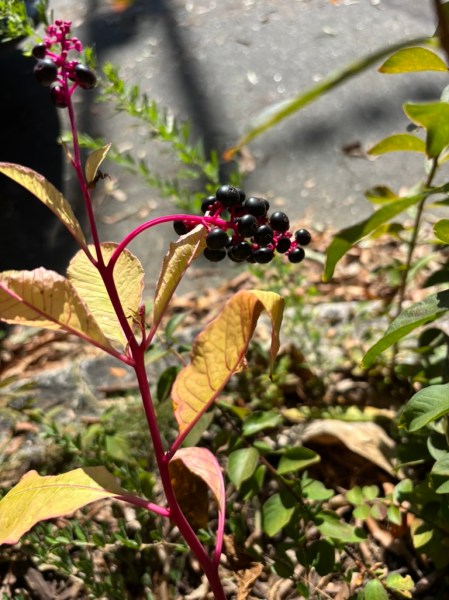
The pokeweed bulges with deep magenta fruit, ready to drop.

When I was little, my friend Megan and I used to line them up in the cracks of the sidewalk in some sort of game we made up. The berries stained our hands purple for days.

Idle days.

But rich in imagination and purpose.


Today, the last of the hummingbirds sip from the plastic feeder, procrastinating.

And the monarchs and other butterflies lazily drift from one bush to another.

Small clumps of light yellow ones criss-cross the grass like they are playing.

They are in no hurry, and neither am I.

How fast the seasons fly.


I’m feeling better now and I know that I am because I can articulate these things.

I can take pleasure in the mundane.

But my health is always in the balance, an alchemy of grounded-ness mixed with levity.

And the majority of the time, it all works, and I am fine.


But the lessons of Fall are many for me:

Fall shows me that the world is not bipolar, black and white. But rather multicolored, textured and bright.

Circular, orbital, or elliptical.

And Fall may be a study in life and death, but all things come round.

Fall is also a reminder for me to pay attention to the falling leaf, and to reflect on purpose and imagination.

Not to mourn their loss, but to anticipate their revival.


Because depression doesn’t last forever.

It is like a season – one season – and taken by itself it can always be endured.

And if it feels like I am back at the exact same place, over and over again – I am and I’m not.

Even though it is my body’s repetitive natural cycle, every season is distinctly new.

I have to see it that way.

Imagination and purpose:

Like the sweet smoke from the neighbor’s crackling, burning leaf pile,

I will always rise.


Sea Monkeys

Up ahead on the trail I spot a red plastic milk crate.

It’s flipped upside down and has a laminated message secured to the top:

“Turtle eggs. Do not disturb. The female box turtle lays her eggs and will leave to return to her nest up to 3 months after laying”.

I peer through the slats and see absolutely nothing – not even a small mound of dirt or a wee bit of disturbed earth.

Hmm.


Over the next three months or so, I will interrupt my walk and look through the little plastic holes, and I will continue to see nothing. Not a hint of egg.

Nothing at all.

But, knowing me, I’ll keep up the vigil every single day until the crate is carted away buy the volunteers, with no evidence of surviving eggs.

Because I want to believe that the mother turtle will crawl through the dense woods and find her way back to her babies. I want to believe that they will be reunited and all will be well.

Don’t we all want a happy ending?


Don’t we all crave something good, even transformative, to unfold in our daily round?

Especially when the odds are low?

I am absolutely guilty of being a champion of small possibiities.


Like the tiny feral kittens skittering underneath an abandoned house over by the liquor store. If I just approached them slowly I might rescue them. But they flee under the house. It’s too dark to see them – I can’t save them.

But someone else will rescue them, right? They’ll end up in good homes, right?

You might call this magical thinking.

Maybe it is.


When I was a little girl I saved up my money and sent it away to buy “Sea Monkeys”.

Remember those?

The pictures advertised these tiny otherworldly creatures that you could grow at home in a jar of water. Pink families with smiling faces. They were royals. They were wearing crowns and one even held a scepter.

And when they came in the mail, I sprinkled the dry powder into a large glass and held my breath.

It was days before they hatched.

And then nothing.

Nothing but little flecks.

I guess they eventually dissolved. But it was such a disappointment that they weren’t what I believed they would be.

They were nothing.

And later I found out that they were common brine shrimp.

But I was that kid – embarasingly gulible – and always anticipating the unlikely.

And I still believe in magical things even now.


So my son works for Riverkeeper, a non-profit in NYC that is cleaning up the Hudson River.

Because of progressive policy and the work of organizations like his, a whole slew of threatened species has come back to these waters. Sturgeon, seals, even dolphins and whales.

Whales in the NYC harbor – how unbelievable.

And he recently sent me a video of them breeching in the waters and I just couldn’t believe it.

It was unreal.

In the polluted New York City harbor?

It was an impossible sight, a miraculous one, really.

And I still can’t believe it.


And of course I know we live in a time of huge disappointments, in things big and small.

But I still cling to a belief in that the overlooked things matter most, simply because they are small or unlikely or unexpected.

And if the small things don’t matter, than nothing matters.


And so I just want to be that person who can keep looking to find them – the turtle eggs and the kittens and even the brine shrimp floating in a bowl.

It’s called hope.

What else is there?

And I want to spy the dolphins and the seals and the sturgeon.

The whales in the city!

The struggling bits of life. The things that say yes in the face of so much no.

Don’t you?


New Old House

After dinner, my husband and I have established a new summer ritual.

When the day has cooled down, we walk down the block to check on the renovations to our house.

The house is an unassuming 1920s Southern cottage – charming but needing an overhaul.

And fresh new landscaping.

And so tonight we uncoil the garden hose and water. I soak the young saplings and sprinkle the leaves – the oak and magnolia are especially parched from the incessant drought.

The dry mulch glugs down the water.

We will tend these trees, but we’ll never see the expanse of their potential. Isn’t that a lesson in humility?

We bought this place as a downsize, but then felt like we needed to upsize just a little (master bedroom, bath) because it was a tiny bit too tight.

And it’s been over two years of planning and construction.

This is a new beginning for us, like a nascent bed nestled into a larger grove of time that will outlive our old bodies.

A new beginning for us, a nascent bed nestled into a bigger grove of time that will outlive our old bodies.

Our contractor says it will be like we are stepping into a brand new house at the end of July. This excites me, but I know better.

I know we’ll bring everything along with us – we are laden with years.

The memories of our first home in North Carolina:

Being pregnant and wanting to fill every inch of space with life. Our daughter coming and then our son.

And then we outgrew it. So there was a move to Durham, to a bigger, old pink house.

And filling it with friends and family.

And ticking off the milestones – growth spurts and birthdays and Christmases with huge trees. And beloved new pets who were with us for awhile and then gone.

Traditions, old and new.

All of this will be unpacked.


I think about that expansion of growth and now this contraction of getting older.

And how, in many ways, our needs have downsized too.

Yet I’ve never downsized the need to fill the nooks around us with safety and comfort and joy, and beautiful things.


So, after watering the trees, I go inside and try to visualize where different pieces of furniture will go. The old couch, recovered several times. My mom’s marble-topped antique washstand.

And my husband’s sleek new lounger that will fit perfectly in the corner.

And then my mind drifts to my dad.

One of the last pieces of furniture that he used was his old recliner. His little apartment got smaller and smaller until it was just the chair and the bed, and that was all.

How little we actually need as physical bodies.


Our next house will have all of the assists – hand bars in the shower, no second story steps and metal railings leading up to the porch.

True, there is a new cedar hot tub, but it is scaled down. Gone are the days of our son’s late night after-soccer parties.

It’s just me and my husband, a hot tub party of two.

We’ll climb in carefully; we don’t want to risk it.


One thing I am super excited about is the fact that I will finally have an office/study. My only fear is that now that I have a room of my own I will dry up and never write again.

Sigh.

When the architect asked me about my dreams for the new space, they pencilled in a library, without me even telling them about my writing.

I guess some of my seams (or books) were showing that day.

At any rate, I’m thrilled.


But mainly, I find myself worrying about balancing our new smaller reality with our actual needs as a whole family.

Will Thomas have his own spot to play? Will Lewis and Laura feel at home?

Or will it be too small for me and Mac, once he’s retired and home (underfoot) full time?

And for myself – will I miss the larger pieces of furniture that used to anchor me in the present?

The desk stuffed with the children’s school projects? The closets of old calendars and journals and Halloween costumes?

Can abundance be found in small spaces?


Anyway, I salvage what I can and pitch the rest. Similar to what my sisters and I did in my father’s apartment after he died.

And I wonder if my writing desk will be one of my last possessions in the end? Doubtful.

But life is a series of parsing and whittling and curating.

And letting go. Always letting go.


And I believe, in our lifetimes, our souls inhabit many houses. And we drift between them in memory.

I remember talking to my Dad over the last years, and how articulated his memory was of events from long ago.

It was like his brain was opening up and strewing petals from the flowers of his past. And it felt normal and natural to speak of these things that had never seen the light of day but here they were.


But today, as I write, I know that I’m simply living here, now, in this cruddy, run-down rental home.

Impatient, stressed about the actual move, and just itching to get on with the packing.

And waiting, with these random thoughts and daydreams – until the new house is ready at the end of the month.

We’ve planned meticulously for this transition, but who can predict the future?

Because after the move – then what?

Summer Heat

This oppressive heat makes us feel prickly and wild.

We are edgy, and our tempers flare.

We try to limit ourselves to cool spaces. Driving in our air conditioned cars rather than walking a few blocks.

Our dogs lie stretched across the hardwood floors all day, trying to absorb the coolness from the night before.


And outside there are empty cicada husks clinging to the underside of my birdbath.

It’s as if they abandoned hope halfway up and then gave up the ghost. Screaming skeletons in the night.

And then today I saw several live ones struggling on the pavement. They were belly up, like they had lost their minds and just given up on the trip.

And at night, the white owls stay silent while the young foxes scream.


To me, Summer often feels like this kind of fevered dream. Something to be gotten through.

It’s just the way it is in the South.

And tonight, I think of my Dad, and this enduring sadness that settles like the humid air.

The grief feels less sharp now, but his presence hovers in the ether.


I remember summers from the 1970s.

The fireflies every night at dusk, no fail.

The cool sidewalks under bare feet while taking a late night walk down to the corner store.

The frigid water in the city swimming pool. Getting goosebumps coming out – wrapping a thick towel around my sunburned shoulders. Snack bar ice cream sandwiches and Sun-In.

Riding to Dairy Queen on the family station wagon’s tailgate, swinging our dusty legs, loving the illicit freedom.

No air conditioning, but shades drawn in the bedroom during the day to keep a bit of cool.

Nighttime was a reprieve from the sun, nature quietly exhaling, and the dusky shadows whisking away the afternoon’s sticky air.

And memories of entire days surrendered to reading in my bedroom when I was twelve. Reading all of Agatha Christie’s mysteries and To Kill A Mockingbird.

I would stay in there all day, marinating, ruminating – in an incubator that lives within me still.

The heat slayed us sisters but we had the sense to give in. We knew to stop racing around and to just lie on our beds slurping popsicles and playing endless rounds of Rack-O.

But the days were too long – there was just too much time to think about things.

Wondering about my old friends left behind. Fretting about moving to a new town, with a new school – and who would be my new best friend?


My dad is such a star in this slideshow:

The summer of 1974 vacationing at Wrightsville Beach, North Carolina. We had the entire three months to swim and bake on the beach before we moved to the city.

He was so relaxed and fun.

He would go into town and buy dozens of blue crabs to crack open and pick apart – served with corn on the cob dripping with butter. All of us around that splintery picnic table on the wide front porch.

And wading out into the Pamlico sound, digging with our feet down into the mucky sand, extracting the prized clams.

Later, Mom steaming them for dinner, served up with homemade cocktail sauce.

Dad was busy during the day writing his book in the upstairs attic, and man it was hot up there. I think Mom wanted him out from under foot during the day, and so she sequestered him.

And as I write, I think of him there, writing.

Sweating in that heat, in a fervor of creativity.


That summer sandbagged us, and held us pinned in stasis until the fall when school would start up.

By then, my sisters would quit playing with Barbies. And I had learned how to use a pink electric razor.

Like the cicadas, we were ready for new bodies.

And hopefully, when school started, our summer wildness would tamp down and we’d be civilized enough to sit indoors at a desk all day.

No doubt, that last summer was the end of our childhoods, but those younger selves remained baked into us forever.


Today I catch these moments and hold them like an insect in golden amber.

Because Dad is still here.

And if I go upstairs and close the blinds and lie down, I can recall so much more.

Past summers of joy, and all of the times he wanted us to have fun – waffle cones on the boardwalk, trips to the local bookstore, ghost stories in a thunderstorm.

And now this summer of sadness.


I can bear it because I have these memories. They are like a cool washcloth laid across the forehead.

They sooth me as I lie in bed, fighting sleep, scratching at chigger bites under the covers.

But still, like the old adolescent me, I fret about so many things.

And then, late into the night, I let the cooler air slowly settle around me, and I think about those summers.


So much of the world I didn’t understand back then, and that I don’t understand even now, after all these years.

But the one thing that remains constant is change.

Aging bodies, the years moving on – summer to summer.

The world spins, the planet burns, and here I am, remembering my dad and letting that be enough.

I have changed so much, all of us have, and yet we are also the same.

And I think: can these things that are temporal also be eternal?
Blue on Blue

Embrace your grief, for there your soul will grow.
Carl Jung

It has been nearly two months since my dad died.

Two months of settling back into the routine, two months of picking up the threads of my life. Two months of letting the silt sift to the bottom.

Some days I live in a fog, caught up in my thoughts of him, unable to pull myself away from his final days.

On my walk this morning, the gardenias and laurel and carolina jasmine permeate the air. But the scents are almost too much, the display a bit too showy.

It is a riot of color that feel slightly overblown to me.

But the hydrangeas, I concede, are dazzling.

When looked at closely, they reveal a multitude of shades of blue. From dusky pale to blueberry to almost navy.

And there is a whole world within these tiny petals of blue.

Bright, deep, deeper.


And I look at them and think that I will always see blue against blue.

I will always feel the everyday sadnesses against the heavier grief for my dad.

When he died, it was a holy time. My sisters and I sat with him and saw him move from life into death. Everything was stripped down to a final exhale. We were moving through moments that felt gilded by eternity. Nothing felt as essential as this.

Because he was dying, he was leaving us.

And now here, in the everyday, how does that scene fit in with anything?

So I go through my days in a fugue state, questioning, unable to let go of the images, but also forced to move on.


People say that you need to process grief, or that there is a formula that takes you through the whole thing. But I’m not so sure about that.

I think this grief walks with me.

This grief overlays all of my days.

The memories of him stick beneath my eyelids as I squint against the sun.

I don’t want to lose them.

It is important to honor them, to not let them go. If I push them down or try to forget, I am losing a part of the relationship with Dad.

Sorrow, remembrance, getting on with my life, yes, but still holding him close.


And I can’t help but think that he would have wanted it this way – me waxing poetic like crazy and always keeping him close.

Writing it down, but being grateful in the present.

Grief and gratitude.


Dad didn’t live to see this Summer, but I know that if he had, he would have described to me the splendor of the colorful mountain vista from his gazebo.

We would have shared the hydrangea view.

And here it is Friday, the day I always spoke with him on the phone.

And so I will sink down into the blue, without him – into the deepest, truest shade. And I’ll meditate on the alchemy of hydrangea and heartbreak.

And I will grow, and I will learn to heal, and I won’t ever forget.

Untold Stories

I grab the hanger and ease it into the shoulder of the soft periwinkle blue dress.

I wish I had taken the time to hem it up a few inches, but no.

I hang it up and kick the black pumps to the back of the closet. They proved to be a tight pinch throughout the entire funeral.

And when I look at photos from the service the outfit looks all wrong anyway.

More importantly, my eulogy felt wrong. I never articulated what I wanted to say. And I mumbled throughout the reading.

I wish I’d practiced.

Oh well, it’s too late now.


We’re home now and all that’s left are memories, some regrets and much sadness.

From my dad’s apartment, my sisters and I divided up some of the plastic bins that housed memorabilia – mounds of letters and clippings, the draft of a book. Bits and pieces.

I thought I’d gotten off easy because the contents of my bin were small – an accordian file of old letters that my parents exchanged during their college years. From their first date up until his deployment in the Marine Corps.

I guess these things could just get get tossed.

Each thick monogrammed fold of stationery from Sweet Briar College, each eggshell thin blue Air Mail letter from Japan.

Who wants to read these?

Turns out I do.


Over the next few days, I attempt to sort them out chronologically and then try to read through a half a dozen at a time.

It’s all I can handle.


There are fervent love letters after a chance meeting freshman year.

The pledges to stay in touch over the school breaks.

The thrill of Mom being “pinned” (fraternity) by Dad, and then the excitement of a secret engagement.

And then, after the wedding, shipping out from California to Japan.


They were trying to somehow bridge the distance in a world before cell phones, or even before land lines that could connect reliably across the ocean.

All they had were radio calls that usually wouldn’t patch through successfully.

After one such attempt my father writes, I think I heard you say I love you.

That was the extent of the short call – his wondering if the words existed at all.


It’s hard to imagine a world where communication had to wait for days.

How much of life was held between the long pauses.

And my mom’s optimism for the future is heartbreaking. How did she assume that he would return?

But he did.

And then the letters stopped.

My Dad’s scrawl went on to grace other letters and sermons as the years went by.

But these old ones feel so important. They show me the different sides to him.

The fresh college boy obsessed with his girl.

The young father eager to meet his newborn son after long months away.

The lieutenant (!) running around Okinawa trying to find special silk fabric for his wife to sew into a classy suit.


Over the years my father would occasionally express regret that he hadn’t followed through with his writing. He quit maybe 15-20 years ago and I know it plagued him.

But as I read these old letters, it occurs to me that he did a lot more writing in his lifetime than he remembered.

His letters, no matter how trivial, are a snapshot in an album that I’m privileged to read.

And I know he would have loved to elaborate on these stories on one of our Friday calls. He would remember the events down to the last detail.


But I never asked.

They were stories I never knew to ask about.

I could make myself crazy thinking about all the things I never asked him.


But no wonder he wished he’d carried on with his writing. There is so much material here. He was such a natural writer.

And I can relate to this need to keep writing, to keep chronicling, to keep striving to articulate the thoughts in his head.

Because, after all, what else is there?

It’s the stories.


We need the stories to transpose ideas as a way of putting a stamp on a life.

A remembrance, a memory told.

A letter for a daughter, like a gateway to another time.

And for me, my writing, while just a blog, is also like a snapshot.

The stories that I’ve been writing for ten years, they tell a life.

None of these things disappear after death, we just have to keep looking to remember them.

They exist in the universe side-by-side with our present day.


And so the dress, the high heels, even the eulogy – none of that really matters, I think.

It’s Dad’s stories – his words – that hold meaning.

And I want to think that it’s my voice too, even mumbling, that might also have something to add.

For today, or for another day, and even for someone in another generation.

The stories simply want to be told.

Eulogy

This Spring it has been hard for me to let go.

Last week in NC, the rain was teeming down in the yard as I plucked the bright daffodils to bring inside.

All around me Nature seemed to mirror my dad’s presence.

The surprising perennials planted by a previous renter, the resilient white clematis.

The bluebird.


And grieving my father’s death that day made me want to do this inconsequential thing:

To tug at the glaucous necks of the green stems one by one. To see the silky serum squeezed out of the stalks.

To yank the tender throats and clutch them. To place them in a bulging bouquet – something that would last forever.

But the bounty of Spring doesn’t last forever, you can’t hold onto it –

Just as I couldn’t hold onto my father.

And yet in my bones I will always feel his love.


I think many people looked at our family and saw a perfect thing. But of course this wasn’t true.

Being Jim Lewis’s daughter was not uncomplicated.

But I always felt Dad’s love for me as fierce and constant, even though at times it would seem that the church came first.

Someone else’s needs often pushed mine to the side.

I had to share time with God.

But over 3 years ago, Dad and I started to FaceTime each other, every Friday without fail. What we called our “Friday afternoon dates.”

I would call him before dinnertime at Edgewood Summit and we would talk about a host of things:

Politics of course. Family memories. Books. My chickens.

The gossip at Edgewood Summit. His great-grandson Thomas.


But what was curious was how he insisted on the Face Time format. And I came to realize that he loved the fact that we could actually look into one another’s eyes.

A simple thing – but each week I always experienced such uncomplicated joy and adoration.

Such love that bore deep down into my core.

And during the call, if I stayed long enough in the warmth of that gaze, I felt seen and known.

And I knew he loved me, deeply. And that I came first, with no waiting in line.

It was like a meditation of love. A mirror of new possibility, the more I looked the more I could absorb.


And so I do need to let go,

But I want the reassurance of the withered, spent little daffodil bulb curling back down into the black earth –

waiting, waiting in the dark, faithfully, for next year’s sun.


And next Friday afternoon I will walk out into the backyard, and daydream about new chickens, and bluebird nests.

And I’ll look for the yellow butterflies and think of Dad. Because they were his motif – he loved all things about butterflies.

And I’ll watch them flutter and fly as they go on their way,

And I’ll try to let go.

Daffodil

Today the rain is teeming down on me as I pluck the bright daffodils to bring inside.

Some previous renter has gifted us with mounds of planted bulbs – striking shots of color all over this scruffy, overgrown yard.

In this place of neglect someone who lived here before me saw the potential for a little beauty.


And hearing the news that our country is at war makes me want to do this inconsequential thing.

To tug at the glaucous necks of the tender stems one by one. To see the silky serum squeezed out of the stalks.

But as I look across the brown grass there are hundreds of tender shoots that have no buds.

Will they eventually emerge?

Because I want to bring a riot, a thousand of these sunny faces into the house and put them into one giant, bulging vase.

I want to yank the yellow and hold it forever.

I want to keep the sunny-ness and not think about tomorrow’s news or the next day or the next,

I want distraction. I want my sadness and worry tamped down, no despair.

Yet there is so much unsteadiness, so much uncertainty about the future.

Still there is something in the sluice of rain that snakes down under my collar that steadies me.

The cold that reminds me that I am grounded right here, right now, deep breath.

I just want to see wholeness, but I’m afraid.


There are no daffodils here in Minneapolis. No crocus, no pansies, no snowdrops.

The lawns are brown and ache for color.

I am here visiting my sister. It’s a chance to be together and for me to catch up on her life.

She has taken me to the sites where they murdered George Floyd, and also to the place where Renee Nicole Good was shot, point blank, in the middle of the day.

I follow her as she points out places that ICE has surged and where they have been plotting and hiding in their unmarked cars.

I accompany her as she shops and delivers food to a family of immigrants who are scared to death to leave their home. Too afraid to even pick up our bag of groceries at the front door.

We could be killers.

There is so much to this city – this metropolitan area – it is a tortured, complex and scary place.

But there are slight beams of yellow, even without the perennials.


Sunday morning. A church basement.

I haven’t been in one of these reception halls in a long time.

It’s after the church service, and I’m waiting for my sister to come down from the sanctuary to introduce our speaker, Tony.

Tony was the leader of the Wales pilgrimage and he has come today to present a Lenten forum: Thoughts on Celtic Christianity.

In this group of midwesterners I suddenly feel very Southern. Why? I don’t know. Something about how I’m dressed in bright periwinkle without any heavy layers.

But on the round tables I spy bright, buttery daffodils in little pots – forced to bloom for the congregation in this wintry climate.

Rising for this occasion.

Just seeing them brings me ease and focus.

But there is the ongoing theme in my head that I’m not doing enough, or anything, to help out.

K’s witness and hard work push me to confront my apathy.

I don’t go to church.

I hardly go to the protests.


This weekend has been a lot, but I am making my way through this labyrinth of events, and it will come clear.

I leave simply hollowed out, but with my eyes open.


Finally, I was so tired when I got home late last night. Lying in bed, I couldn’t shut down the stimulation – the bright yellow energy of Minneapolis, and of my incredible sister.

And then this morning, funny thing, I sat down at my desk, coffee in hand, and looked down – it was a little sketch that my daughter had left for me over the weekend.

Maybe hope is here for the taking.

When they rage, I will calm
When they deny, I will affirm
I will simply be who I am: for that is what the Spirit created me to be.
–
Bishop Steven Charleston
Citizen of the Chocotaw Nation,
and a Native American Elder

flyer from the George Floyd memorial

Golden

In the harshest conditions, peace still finds a way. In the coldest moments, hearts still warm with compassion – Walk For Peace USA

Squatting, with my jeans pulled down, I tried to relieve myself on the edge of the slippery culvert off Interstate 64 in Apex, North Carolina.

But suddenly I felt my knees buckle and I went down head first into the grass (I was trying to protect my new hip).

For privacy, I’d been attempting to hide myself between a parked car and my husband’s large down vest.

He quickly grabbed the collar of my jacket and yanked me up. Mission accomplished.

Because I just couldn’t hold it any longer.

We had been huddling in the cold for almost 4 hours.


We were standing in a line of thousands of people who had pulled their cars off of both sides of the highway’s shoulders, and here we waited.

Waiting, waiting for the Buddhist monks.


I had heard they were on a Walk for Peace that was traveling from Fort Worth, Texas to Washington, D.C.

On foot, some of them even barefoot.

I was there to witness and pay respect and to simply be in their presence. Just to get a glimpse as they passed through North Carolina.

We had no idea there would be throngs of people wanting to do the same thing.

An assortment of them- children and old folks, Black, Brown, Indian. Some held signs. Some waved flowers. Some came to be healed. I’m not sure what most people wanted.

But their faces seemed to me to be happy and expectant.

Many were radiant.


We had been instructed to stay quiet and only to bring our hands together and bow in prayer. And we were not to reach out to them or get in front of them. But we could follow along behind them and walk.

Throughout the day I felt the warmth and respect from those around me.

I’ve never been a part of a group like this. I’ve been to protests, but this was a different thing.

The air felt thick with promise. There was a restrained joy.

But mostly, there was a yearning. There was a hunger to see these men.

And finally the police escort lights were visible through the trees of the state park and the tiny figures moved closer.

Their saffron gold and brown robes moved along at a clip – they walked pretty fast.

I was holding my breath.


My nerves had been so jangled.

Throughout the long afternoon of waiting I had also been endlessly scrolling my text messages to get word about my sister.

She was being arrested in Minneapolis at that very same time.

She, along with other clergy, were protesting at the airport.


Later, I watched the media footage of them as they kneeled in the freezing cold, praying. They were bundled up, covered in ice and snow. Palms open to the sky.

And across the sidewalk a large group of fellow protesters chanted Let them pray /Let them pray.

And then one by one they were calmly taken away by the police, hands zip-tied and then put in a school bus.

This was all going on while I was waiting on the highway.


My sister is so beautiful anyway, but seeing her like that took my breath.

She had a glow like an aura around her face – like the saints in those medieval paintings. I was transfixed.

Her breath came out in icy puffs but you could see that she was praying. Eyes closed, her face was simply luminous.


Witnessing that scene was akin to receiving the beatific smile from the lively little monk who reached out to me and handed me flowers.

I couldn’t breathe, time slowed down and I felt golden warmth spread through my whole body.

As they passed, the glow went with them but a tiny bit, like holy pollen, brushed across my being.

I felt warm from the inside out and everything was shining.


My husband and I could barely speak the rest of the way home and into the evening. Something had changed and we didn’t want to disturb that.

And even now, remembering the event makes me tear up.

In this world that feels so broken, there are these beautiful things.


In these moments I feel hope. I no longer automatically default to that cynical vibe that believes that evil cannot be defeated.

Because I witnessed that mighty force that came walking bravely down the highway, undaunted and free.

A walk that embodied the hope that I’ve been searching for. The monks showed me what peace looks like.

I needed that because I’d forgotten.


Courage and hope in one day. It was a lot.

And now I’m trying to keep those smiling men with bare feet in my mind, front and center as I go about my ordinary day.

And of my sister kneeling and praying on the curb at the airport, both of these images interlace.

I want to hold the light of these holy people in my heart.

As a reminder of hope –

for joy, for peace and for love.

A procession of Buddhist monks walks along U.S. Highway 64 near Wilsonville on Friday, Jan. 23, 2026, as thousands of onlookers line the highway to welcome them. The monks are making a 2,300-mile pilgrimage from Texas to Washington, D.C., as part of the Walk for Peace, an effort to promote peace, compassion and national unity.
photos Travis Long

January light

These days the sun slowly inches higher in the sky. The morning air seems brighter, crisper, in sharp contrast against the brown lawn.

The bluebirds are scoping out the nesting box (it has a new camera). They peek inside the hole and cock their little heads. Is this a home?

At the end of February or so they will start a family.


In January the world feels new.

And here in the kitchen a luminous softness radiates from my UV lightbox.

It almost feels like summer sun!

My desk is cleared off and I feel energized.


On New Year’s Eve my annual ritual is to light all of the candles in the house – Christmas pillars, tapers, votives, old tea lights, all of it.

I strike the matches to the wicks to burn away the old year.

On the fireplace mantle, in the kitchen, in the bedroom.

And I let them burn all the way down to hard disks.

And when they are all spent I bring out a slim bayberry taper that my sister gave me.

When lit, it’s fresh green balsam scent fills the whole house.

I pause and breathe deeply.

And meditate on what is real and true for me in the moment.

And I let go of last year’s energy.

Or I try to.


Back before Christmas I went into our attic storage area and dragged out a huge blue Rubbermaid container.

Inside were spiral notebooks of various sizes, some bound journals and some stacks of yellowed looseleaf papers.

Two of the tiny books had fake gold locks and keys.

My journals.

I drug them out mostly out of curiosity.

Should I sort out the “good stuff” and preserve it? Or just toss it all?

The lined pages were scrawls starting from my grade school years up until I was in my 30s.

Sigh.


What was important enough to write about?

Did I write well or was it (the dreaded word) trite?

I was curious to read and trepid at the same time.

Mostly I was just afraid of looking backwards.

I didn’t want to re-live some of that stuff.

Most of that stuff.

Let the past stay in the past.


So I had to steel myself before I started.

But after a quick taste from grade school 1975 (Robert Redford crazy), I deliberately left the bin open on the floor so I could dip into it at random.

For some reason it felt important to keep going.

Still it was kind of cool that things weren’t boxed up in chronological order.

It seemed easier to process the material this way: the heavy stuff alongside the ridiculous.

The sadness of my brother leaving home to go into the Navy.

The excitement of getting my first pet rat named Nicky.

The thrill of Halloween and riding our bikes all over town after dark.

Depression in high school after a huge breakup with my first crush.

The endless screeds about my weight.

And the tender entries from the days (and nights) after my kids were born.

The petty grievances against my sisters.

The blowsy love poems I wrote to my husband in college (gag).

And the running, always the running [see hip replacement].

The heartache with the sweet.

And of course the trite.

Anyway, I felt kind of brave for reading.


Turns out that the young diarest from the past was pretty great.

A lot of the time she was self-indulgent and silly and reactive.

And boy could she brood.

And most of the writing was lousy – boring observations and saccharine poetry.

But she was scrappy.


Because it wasn’t just that I had muscled through some challenging times, it was the fact that I wrote it all down.

When I was excited, hopeful and happy, yes.

But also when I was down and out and really struggling to see patches of light.

I was faithful to it.

That was me then.

And that is me now.


And it gives me a little boost now to see the grace in the simple continuity of writing.

Yeah just a bin in the attic, but still.

I was a writer.


So I’m looking forward to this coming New Year and having some days of inspiration.

At least I’m hopeful.

I have no doubt there will be writer’s block, inertia and plain old laziness.

And bad poetry.

But this morning as I flip on my lightbox and shuffle across the kitchen to brew my coffee, I can feel the warmth of the day’s possibility.

It fills up the room.


My dusty journals are stowed away – all the old angst is buttoned down.

But what I hold front and center are the journals’ intermittent words of bright optimism.

Because as a whole, those actually eclipsed all the rest.

Joy and discovery in the mundane minutia of the day-to-day blah.

Kind of a hodgepodge mess – hardly a linear black and white enterprise.

Seasonally disordered at best, like me.


So a new candle, a New Year and a new box to fill.

Today I will write.