Life is not hurrying
on to a receding future, nor hankering after
an imagined past. It is the turning
aside like Moses to the miracle
of the lit bush, to a brightness
that seemed as transitory as your youth
once, but is the eternity that awaits you.

R. S. Thomas, The Bright Field
My last post was the final travel entry from the trip to Wales.
Today, I look over the notes, and I see just how much I’ve left out.
How many memories that couldn’t make it to the page.
The small things:
E. wearing a bright smile every single day, as big as her sun hat.
Quiet, all-knowing M.
Talks with R. on the bus – about Catholicism, inclusive language and music.
D’s compassionate nursing of my ailments.
S’s birds-eye view: spotting the commonplace as well as the rare, and sometimes even the magical.
The resilience of P, after a rough walk.
H’s violin.
C’s gentle hands blessing my forehead at the well.
Being a part of a church community, for just a while.
The nuns waving goodbye with such hopeful expressions on their faces.
Feeling uplifted about the world for the first time in so long.
Our leader Tony, the way he circled among us for private talks by the bus, as we set out on the next pilgrimage.
And his leadership during morning devotions with Celtic poetry and personal thoughts.
His expert planning and then his flexibility when needed.
Being guided and cared for.
Sidling up to the hotel bar in St. David’s town, waiting for a few others to chuck their backpacks and join us.
My sister over her martini, so classy and smooth, reviewing the day.
Being included.
The ancient chapel where our guide walked us through the riotous gardens, beckoning us to pick stalks of overgrown rosemary and sweet bay leaves.
Rosemary for remembrance ~ Bay leaf for wisdom, peace and protection.
And once inside, scattering them in the aisles then crushing them with our shoes.
Adding to the thick layers of herbal compost from previous pilgrims who had also traveled there.
Each had carried their own joys, hopes, and sadnesses, like me.
And the sweet aroma mixing with old incense and damp, inviting me to pause, to take it all in – to find worship.
The smell of the humus on top of the old flagstones welcoming me in some deep, earthy way.
To be my whole self.
To be an organic element of that timeworn chapel – my body, my doubting heart, all of it.
Sensing the humble presence of God.
So many little gifts, and now I just have to say goodbye.
To each pilgrim, to both leaders, and especially to my sister, who invited me on this adventure –
Thank you.
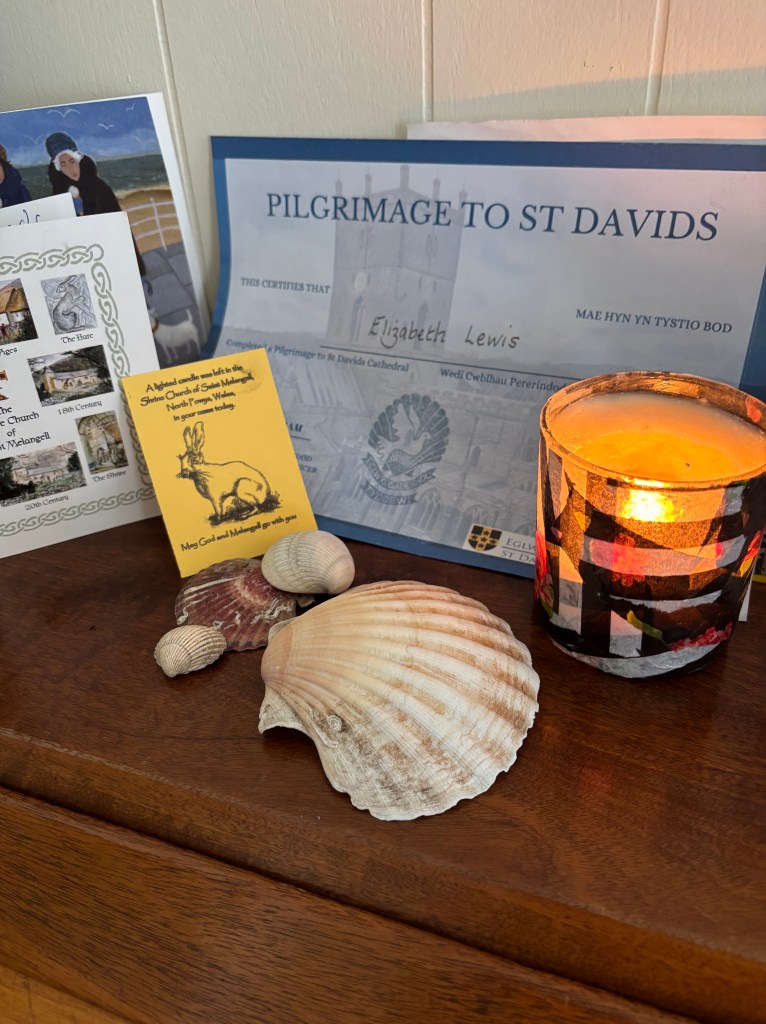
I hold my shell and countless memories from our journey together.
Here is holy water
Old stone and a sky
that is limitless.

R. S. Thomas
This morning, a group of us rise a little bit early, eat breakfast, and meet up with our leader, Tony, in the lobby of the hotel.
He has told us about a sacred well nearby, and I’m eager to go explore.
St. Non’s Well lies two miles south of St. David’s Cathedral, one of the most beautiful stretches of the Pembrokeshire coast in West Wales.
It is another thin place where the spiritual world is tangibly present in the physical landscape.
And according to legend it is where St. Non, a young noblewoman who had been raped by a local prince, gave birth to St. David in a thunderstorm; it is said that she clutched so hard on a rock during her labour that the rock split in two, revealing a well with fresh water for her to drink.(1)
Our small group, made up of mostly women, walks quietly down the coastal trail.
Surrounding us is lush, green pasture, with buttery yellow gorse popping up here and there, everywhere.
It is a fertile May in North Wales.
And the backdrop, as always, is the ocean with its otherworldly blue and an immense clear sky.
There’s just something about a well.
You come upon it and it just naturally feels so mystifying, even cryptic.
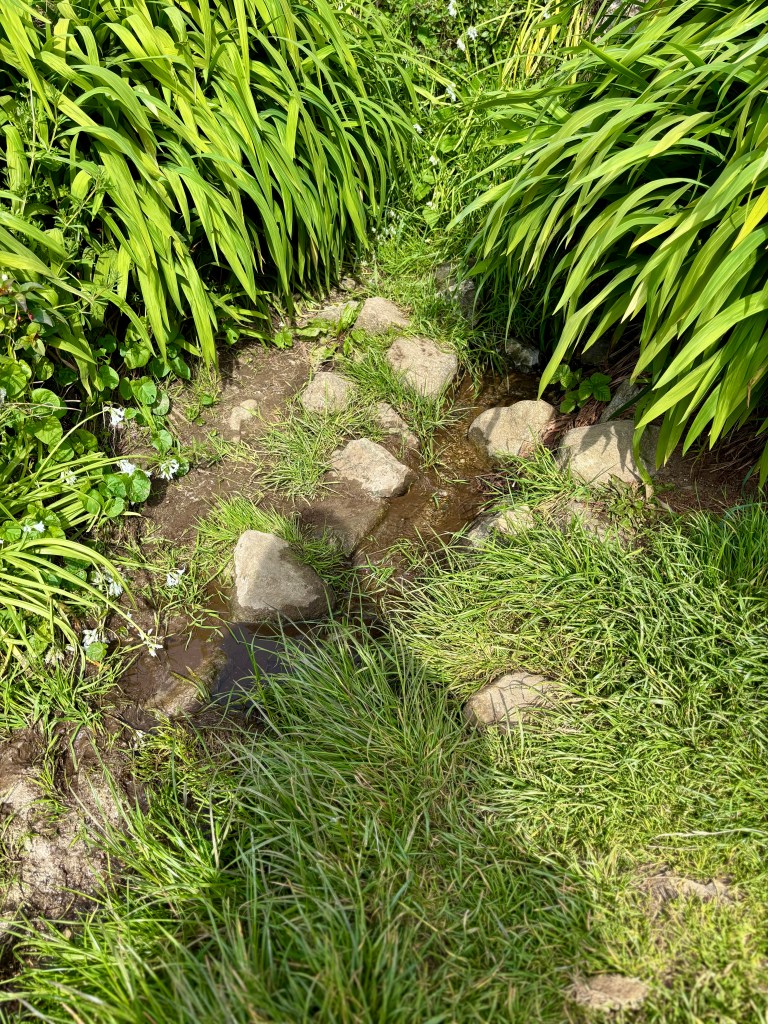
Right there in the pasture, hidden by the thick grasses it sits, down a gully, quiet and dark.
These waters are said to be among the most sacred in all of Wales, and believed to have healing properties to cure sore eyes – perhaps referring to the deeper reference of insight and wisdom. (2)
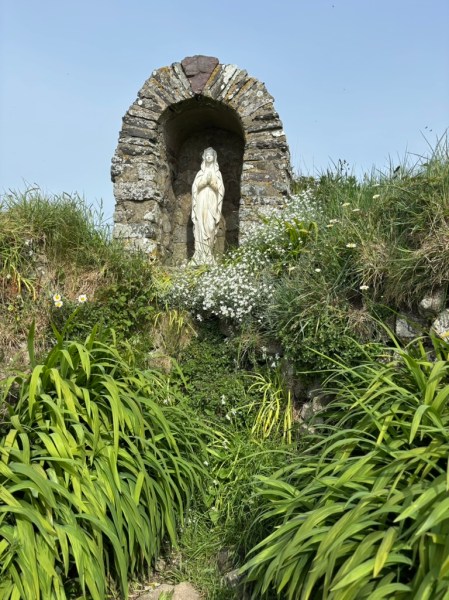
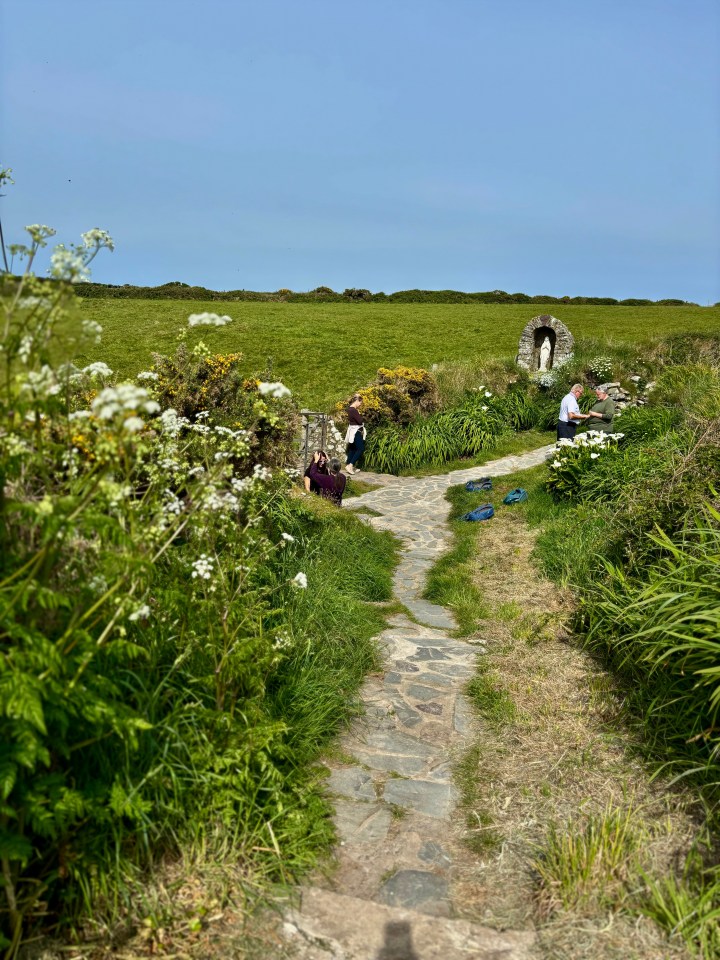
Pope Benedict XVI used water from St Non’s Well during his pastoral visit to the UK in 2010, and votive offerings are still placed there: ribbons, children’s shoes and rosaries hang near the statue of Non in the nearby grotto.(3)
St Non and her story have a resonance for all victims of violence or assault, and for all those who feel excluded from their communities.
She must have been cast out by her wealthy family – presumably the rape and resultant pregnancy would have made her an object of shame – otherwise she would not have been giving birth alone in such inauspicious conditions.(4)
And it just so happens that today is Mother’s Day.
And of course, the women among us who have children, we are thinking of them today – they are out of touch, in another time zone.
I step over to sit on a stone bench, squeezing in with two other moms, and we look at each other and we wipe the tears from our eyes.
Silently, and without knowing each other very well, we can read one another’s faces.
They tell our stories – the joys and struggles of raising our families, the labor of nurturing and guiding our kids.
The way we still worry.
The sheer effort and strain of being a mom.
The indescribable way it breaks your heart.
Today we honor one another.
And we remember our own mothers – those who aren’t with us anymore, whose legacy we carry.
There is something about Non’s Well – it seems to catch our tears, but also rinse them with a sweet renewal.
Life goes on.
And our pilgrimage resumes.
Each of us climbs down the mossy furrow and stands at the well to receive a blessing on our foreheads from our leader – and we each offer up a specific request.
What to ask for?
My heart and mind are too full.
I pray for insight and wisdom, and for the gift of community.
And for a blessing from a God that is always present and available to me, when I am mindful.
And I pray for a renewal of that faith.
And of course blessings for my daughter and son – who make me a mother in the first place.
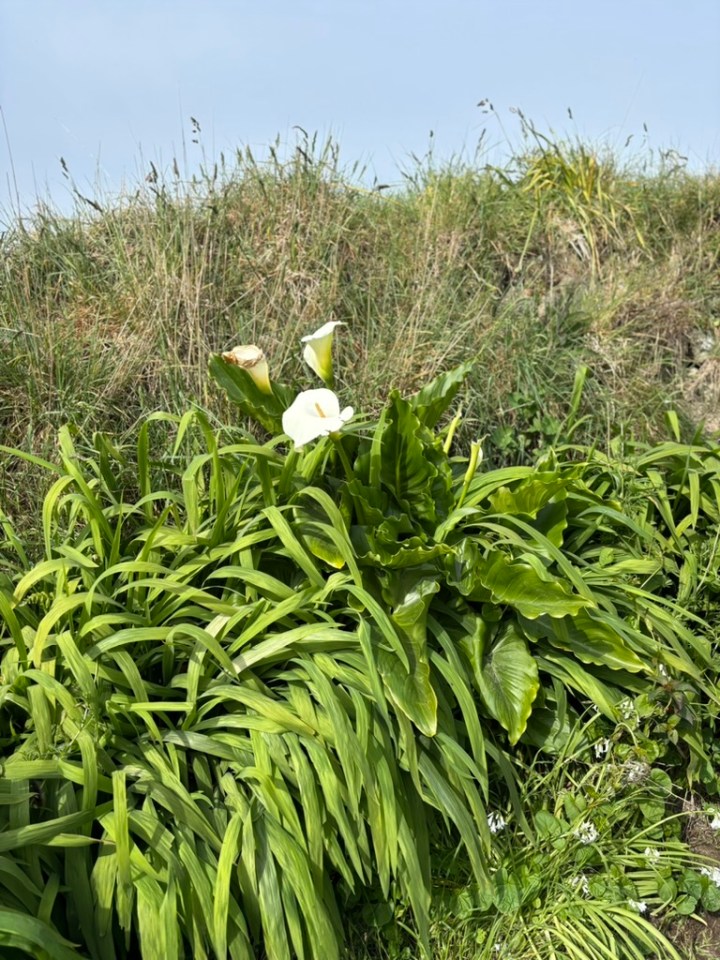
Near the well, among the giant calla lilies, there lies a rock with a cross etched into it, from the 6th Century – it is a memorial to Non and her newborn son, David.
And there are what is thought to be handprints in the ancient stone, where it is believed she held on during her labor.
I imagine her as a pregnant woman alone, in a thunderstorm, cold and terrified, exposed in this windswept field, in such very dark times.
And still she birthed her son, St. David.
On our way back, I turn to look at the tiny grotto, and if you didn’t know of it’s existence, you would see nothing at all – nothing but open pasture and a few sheep.
Like so many profound and impactful events, it takes a slowing down in the moment to glean the significance.
It requires me stopping and looking closely and bending down (figuratively) to pay attention – to cultivate a kind of reverence in my soul.
To allow a space in my heart to open up and be vulnerable – and to accept the healing that arises from the mystical deep.
Today we are traveling to Ynys Llanddwyn, the small tidal island that sits off of the West Coast of Anglesey.
Before we get on the bus, our leader Tony has given us a few instructions for the day:
He would like us to have a silent day, with ample time to walk without talking, and lots of opportunity to explore the island solo.
And we are to use our journals.
It is to be a meditative experience.
We have been told that this land is part of a Welsh National Nature Reserve.
And I have read that the island is geologically rich with pillow lava and complex aolian sand deposits.
And I read about the legend of the young woman Dwynwen, the Patron Saint of Lovers.
One of the stories says that she was another of the female hermits whom God released from an arranged marriage.
And when she was released, she traveled to the solace of this remote locale.
It is in gratitude, that she spent the rest of her life here, all alone, until her death around AD 460.
So much to think about and to take in, the stories, the nature.
Anyway, this morning’s hike will be during low tide – when the island is temporarily attached to the mainland.
We will traipse across the rocks to the very end. And once at the edge, we will see the historic Twr Mawr lighthouse, with the sprawling backdrop of the glorious mountains.
And so off we go.
Out of the parking lot we make our way through a few miles of the Newborough forest trail, a part of the Anglesey Coastal Trail.
The towering pines and silver birches line the sandy trail, as we tread silently. The breeze smells of dried grasses and salt.
I feel a gentle ease in the rythym of the pilgrim’s feet as we step out together, our little troop of spiritual soldiers.
I feel like a real member of this team.
We each tote our beliefs and queries in our backpacks like they are essentials – like our water bottles.
What weightier, more significant trek can there be?
And after several miles, when we emerge onto the hoary rock, we are met by a spectacular 360 degree panorama of the ocean.
And the stout white lighthouse in the distance, set against a tableau of the purple mountains of Snowdonia.
So, at this point, we pack up our things, and each of us set off to explore the entire island.
Some head toward the grassy space with the wild ponies, others trek to the ruins of St. Dwynwen’s Church.
And some go to Dwynwen’s holy well. This is the Medieval shrine where pilgrims would come to read their love fortunes in the movements of the sacred eels that swam in the black waters.
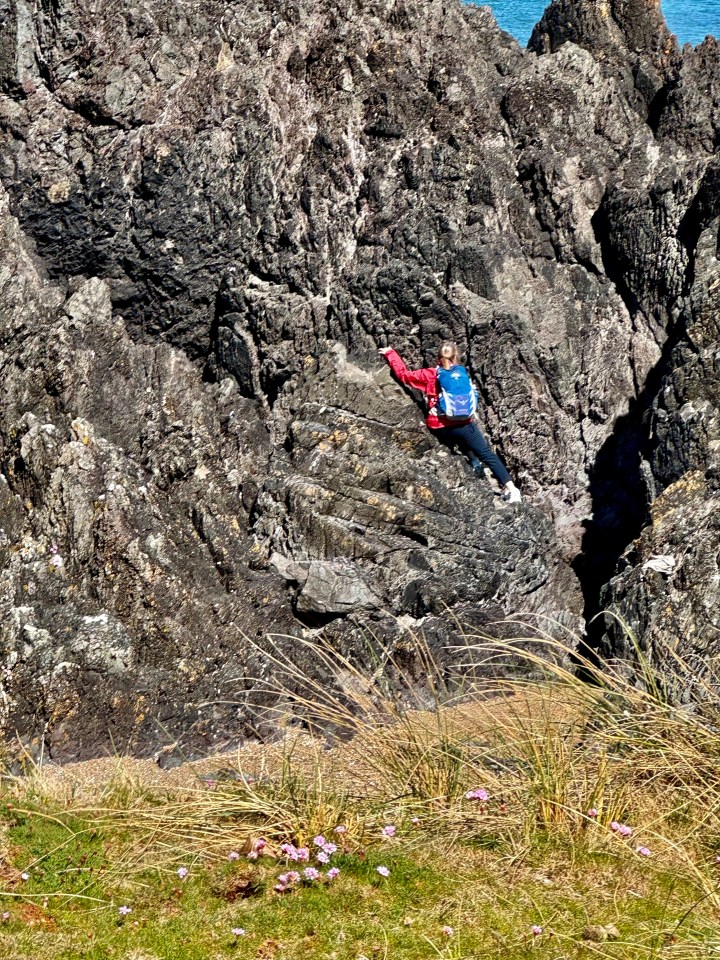
I shuffle along on the path for a while and then stop to watch my sister as she climbs down the high rocks and perches on a smooth rock, starting to journal.
Yes, journal.
That is the last thing I want to do, but I know I’ll eventually have to get to it.
Instead, I want to soak up the entire island.
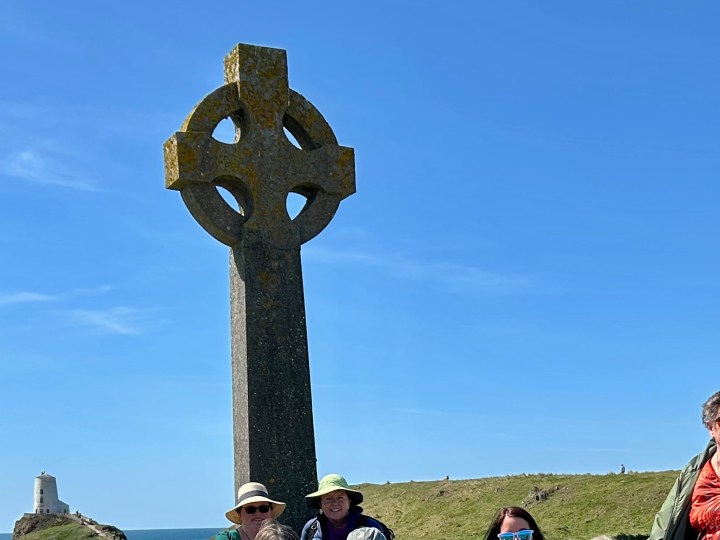
The sun glinting off of the little waves, the ancient iron Celtic cross in the center of everything.
The expanse of cyan sky.
The shaggy ponies chomping on grass.
But mostly, I want to observe my fellow pilgrims make their way as they meander.
Or as they pause and gaze out at the sea.
Some sit and write.
And some simply lie down to rest on the ledges.
Each person seems to find a safe space in which to nestle themselves, in a spot where they can take in the richness of this experience.
Where they can be alone, but not alone.
Islands but also peninsulas.
I think about how this pilgrimage has been a bit challenging for me, being the observer, introvert, non-joiner that I am.
I am more comfortable being on the outside of the circle, rather than being at the intimate center.
I was a tiny bit nervous about fitting in with these folks, yet here I am.
On this Welsh isle, with strangers, on the edge of nowhere.
And I can sense the other pilgrims also making their way – taking it all in, experiencing, and writing about who they are and how they think and feel.
And I think about the connections in my life, my friends, my family. Those who hold me close, without question, who make me feel safe no matter what.
So as I begin to journal, I only write two things:
I write that I feel empty and alone, and I want to connect with my heart, to my center.
And I write about how I long for a community. Because when I go home, I will have no church or spiritual group like this.
And I will miss the balance of silence and intimacy we have established on this journey.
Anyway, I also write that my overactive mind, this brain that is so integral to my personality and ego, often gets in the way of reaching out, connecting and sharing, with others.
And at the same time, my words, even spoken carefully, can fill up a silence that is oh so necessary for being awake to my own body, and to others.
And now, this tactile practice of quietly writing out my thoughts and emotions, feels right.
My brain quiets, I listen to the crash of the sea ebb and flow around me.
I feel grounded.
And through the silence I can feel this island in my soul, this grandeur that stretches out to embrace and claim me.
And off the coast, I spy the stout little lighthouse – Twr Mawr.
It’s glass glints in the sunshine, it is fixed – stubborn and undaunted – in the breakers.
Almost knowing, that come high tide, this entire territory will be washed clean, engulfed in water.
Still, I am like this venerable spit of obdurate rock.
I am this unyielding, yet still gracious, expanse of land, the welcoming arms that prostate travelers can come home to.
To find serenity and rest. And some kind of wholeness.
Steady and resilient, sturdy and true – I feel inexplicably connected to both this land and the sea in some primordial way.
Today, I think I am both an island and a peninsula.
 honeybees & reveries