Here is holy water
Old stone and a sky
that is limitless.

R. S. Thomas
This morning, a group of us rise a little bit early, eat breakfast, and meet up with our leader, Tony, in the lobby of the hotel.
He has told us about a sacred well nearby, and I’m eager to go explore.
St. Non’s Well lies two miles south of St. David’s Cathedral, one of the most beautiful stretches of the Pembrokeshire coast in West Wales.
It is another thin place where the spiritual world is tangibly present in the physical landscape.
And according to legend it is where St. Non, a young noblewoman who had been raped by a local prince, gave birth to St. David in a thunderstorm; it is said that she clutched so hard on a rock during her labour that the rock split in two, revealing a well with fresh water for her to drink.(1)
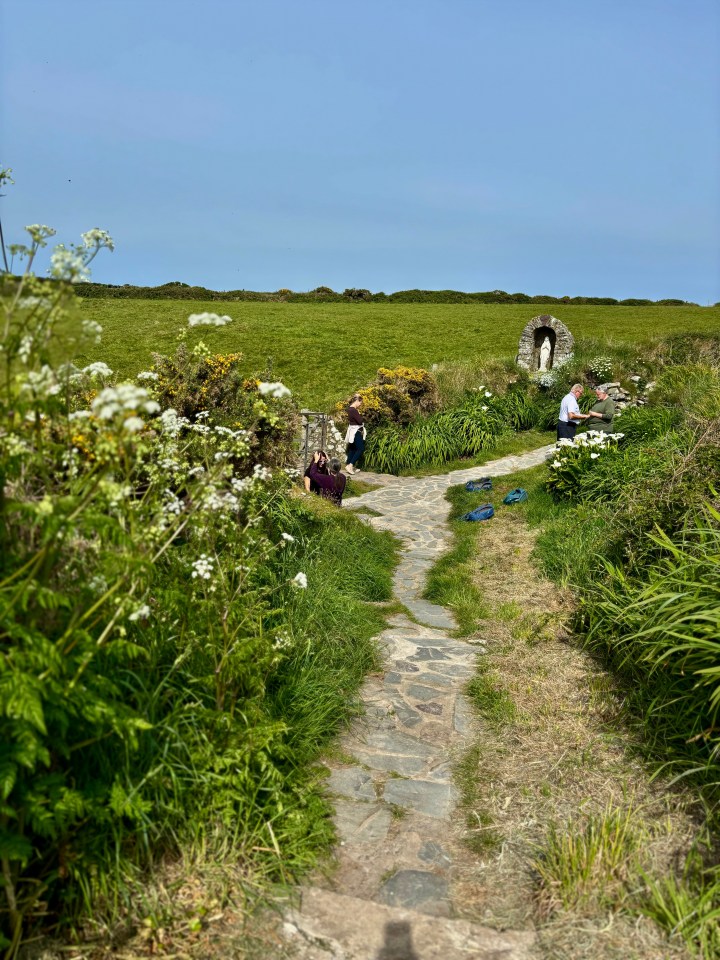
Our small group, made up of mostly women, walks quietly down the coastal trail.
Surrounding us is lush, green pasture, with buttery yellow gorse popping up here and there, everywhere.
It is a fertile May in North Wales.
And the backdrop, as always, is the ocean with its otherworldly blue and an immense clear sky.
There’s just something about a well.
You come upon it and it just naturally feels so mystifying, even cryptic.
Right there in the pasture, hidden by the thick grasses it sits, down a gully, quiet and dark.
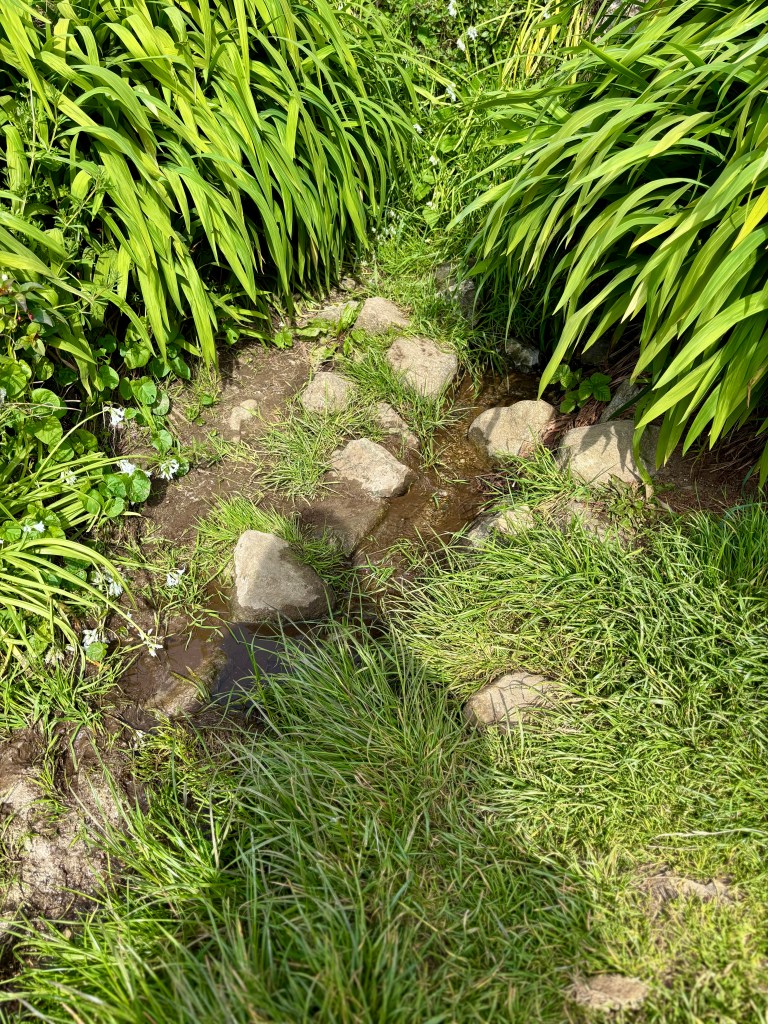
These waters are said to be among the most sacred in all of Wales, and believed to have healing properties to cure sore eyes – perhaps referring to the deeper reference of insight and wisdom. (2)
Pope Benedict XVI used water from St Non’s Well during his pastoral visit to the UK in 2010, and votive offerings are still placed there: ribbons, children’s shoes and rosaries hang near the statue of Non in the nearby grotto.(3)
St Non and her story have a resonance for all victims of violence or assault, and for all those who feel excluded from their communities.
She must have been cast out by her wealthy family – presumably the rape and resultant pregnancy would have made her an object of shame – otherwise she would not have been giving birth alone in such inauspicious conditions.(4)
And it just so happens that today is Mother’s Day.
And of course, the women among us who have children, we are thinking of them today – they are out of touch, in another time zone.
I step over to sit on a stone bench, squeezing in with two other moms, and we look at each other and we wipe the tears from our eyes.
Silently, and without knowing each other very well, we can read one another’s faces.
They tell our stories – the joys and struggles of raising our families, the labor of nurturing and guiding our kids.
The way we still worry.
The sheer effort and strain of being a mom.
The indescribable way it breaks your heart.
Today we honor one another.
And we remember our own mothers – those who aren’t with us anymore, whose legacy we carry.
There is something about Non’s Well – it seems to catch our tears, but also rinse them with a sweet renewal.
Life goes on.
And our pilgrimage resumes.
Each of us climbs down the mossy furrow and stands at the well to receive a blessing on our foreheads from our leader – and we each offer up a specific request.
What to ask for?
My heart and mind are too full.
I pray for insight and wisdom, and for the gift of community.
And for a blessing from a God that is always present and available to me, when I am mindful.
And I pray for a renewal of that faith.
And of course blessings for my daughter and son – who make me a mother in the first place.
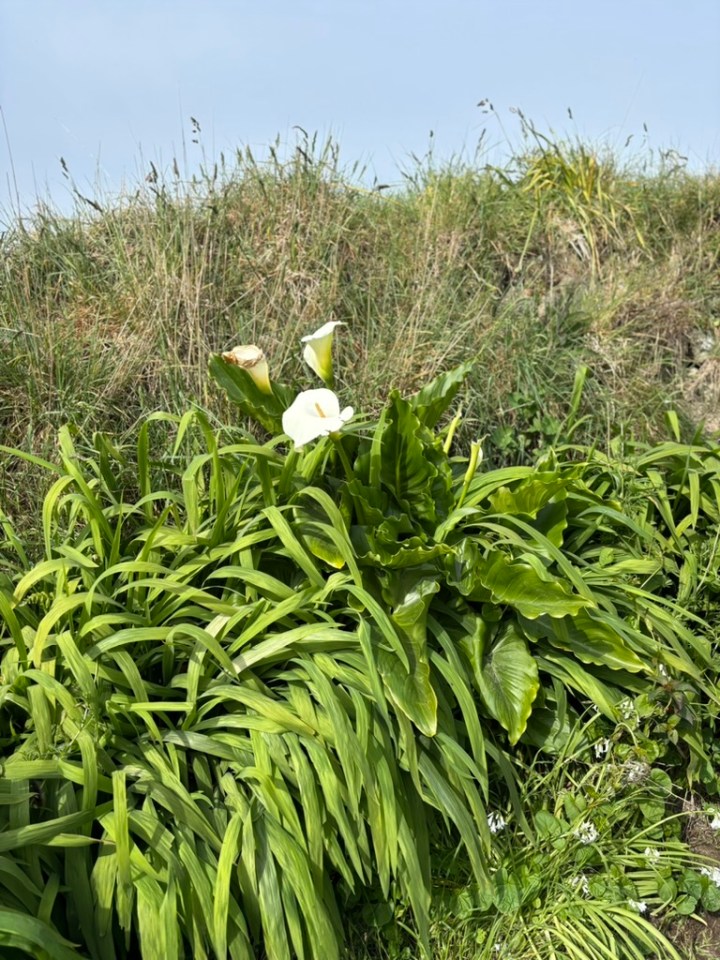
Near the well, among the giant calla lilies, there lies a rock with a cross etched into it, from the 6th Century – it is a memorial to Non and her newborn son, David.
And there are what is thought to be handprints in the ancient stone, where it is believed she held on during her labor.
I imagine her as a pregnant woman alone, in a thunderstorm, cold and terrified, exposed in this windswept field, in such very dark times.
And still she birthed her son, St. David.
On our way back, I turn to look at the tiny grotto, and if you didn’t know of it’s existence, you would see nothing at all – nothing but open pasture and a few sheep.
Like so many profound and impactful events, it takes a slowing down in the moment to glean the significance.
It requires me stopping and looking closely and bending down (figuratively) to pay attention – to cultivate a kind of reverence in my soul.
To allow a space in my heart to open up and be vulnerable – and to accept the healing that arises from the mystical deep.
footnotes: Catholic Herald, Camilla Harrison
 honeybees & reveries