beady little eyes

The interesting thing about chickens is that they are not really wild but not really pets.

They exist in some rare middle place.

They need me to keep them safe at night. If not for me, they’d be hawk food in a heartbeat, or run over by a car, or eaten by the neighbor’s cat. And they definitely rely on me to feed them and keep them free of pests and disease.

But I don’t feel the pull of emotion like I do with my dog, Huckleberry. If a predator decided to take Babs to the great rapture in the sky, I wouldn’t be devastated. Sure, she was an adorable fluffy yellow chick that chirped when I came into the bedroom, but I don’t know.

Chickens are incredibly smart though, and their instincts are fine-tuned. I’ve read that they can recognize up to 100 faces. I mean, I don’t think I can even do that.

My chickens know when it is Wednesday night – Banh’s Vietnamese take-out night, when they will get the leftovers. I mean, they pace and peck at the back door in the late afternoon, even after I’ve told them that Mac is calling the order in.

And I recognize that my girls notice me specifically in the yard – they know that I am the one who fretted over the air temperature when they were in the brooder. And that I was one who took them on field trips when they were toddlers. And I fed them grits (cooked with butter) and oatmeal, and basically spoiled them to no end.

But still, if a hawk took one away, I’d have to chalk it all up to life in the food chain, which is just a fact of being a semi-wild critter.

Why do I bring all this up?

Because I think it’s interesting that we rate animals in such a way. Clever or stupid? Wild or tame?

I believe they are all basically intelligent – way beyond our comprehension, and we humans have set it up so that we can feel okay about killing them. The one that astounds me though is the pig – we know that it is one of the more intelligent species – yet still we want bacon?

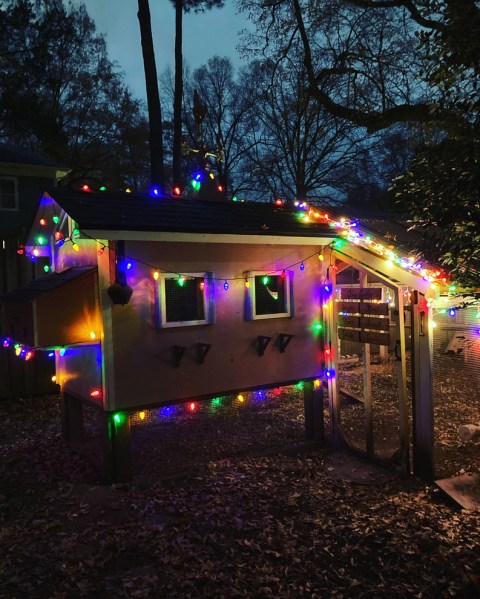
We just think these “dumb birds” are here for our taking, and I guess they are. But I’ll have you know that last weekend my husband and I set up Christmas lights on the girls’coop.

You heard me correctly.

I know.

But did they like it?

Who knows?

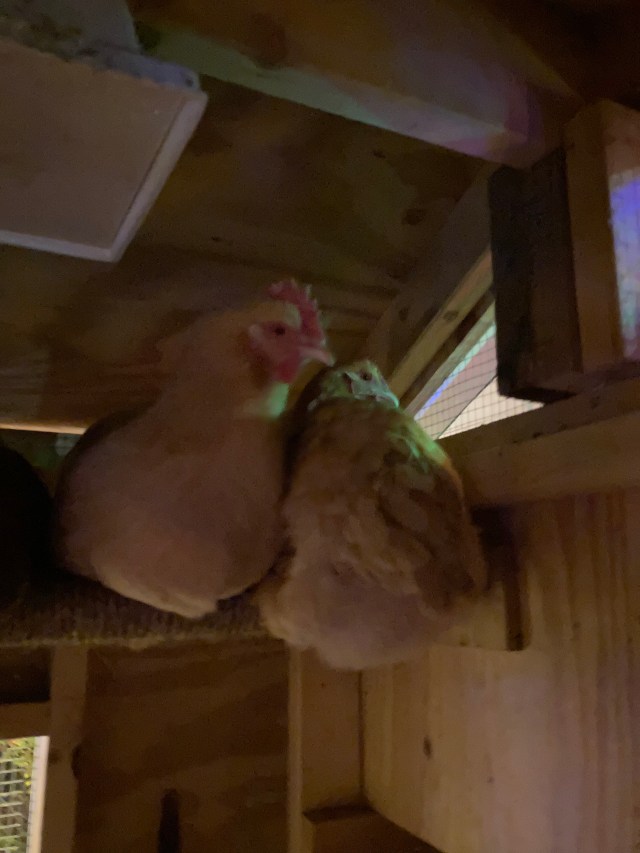
But, for me, I choose to believe that their beady little eyes had a dreamy glow in them, as they nodded off to sleep in the glow of the twinkling lights.

I think they were dreaming of mealworms and grubs and tender sprouts of next summer’s grasses, and maybe their pea brains think of me, their benevolent provider.

It’s the season of giving, and these chickens have gifted me a lot – hours of entertainment and diversion, not to mention the eggs.

And those eggs are truly miraculous to me, the expression of a not wild, not domesticated critter. And this year they have truly been a gift, a marvel, an astonishment, when so many other things couldn’t be counted on at all.

… while visions of sugarplums danced their heads.

hawk

Kicking through the fallen leaves in the dusty winter yard, I come across tiny chicken scratches in the uncovered patches of dirt here and there.

They look like they were made by a child’s tiny sandbox tool. The lines are perfectly symmetrical and speak of a methodical communication between chicken and earth. Even a syncronicity between birds.

I think about these innocent marks and they remind me of words, chicken words, but also human speech – the way we chat with one another. Pecking and nattering about trivial, everyday things. Gossip, or running commentary. And sometimes we insult, with small barbs or micro-rudenesses.

It is the language of the chicken yard.


Last week, I was in the house, reading in my armchair and suddenly a sound of rushing air followed by a thump caused me to look up at the window. A large expanse of brown and white feathers swooped past.

Of course, I ran outside to check my biddies. But weirdly, everyone seemed fine, even calm.

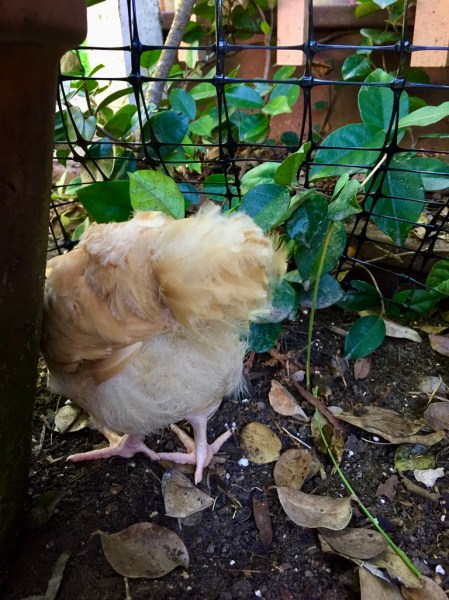
Yet as I picked up my yellow Buff Orpington (named Ginger), I gently turned her over and my hands tenderly parted the soft golden breast feathers. And there they were – deep puncture wounds where the predator had tried to lift her from the ground. So deep as to not draw a bloody mess, but they were bored into the area near her vital organs.

They were wounds that went deep, the ones that may heal but will leave a scar.

And a memory.

Again, like human communication, it seems to me that the cruel, thoughtless lashing out that we do is like an animal response.

I’ve often believed that when we say hurtful things, they end up hurting us more than the recipient. Like the jagged edge of chickenwire, they pierce our breast long afterwards. I can remember things I said, mean things from many years ago, that sometimes pop into my head. And I wish to God I’d kept my mouth shut.

And it makes me sad that someone is carrying around wounds that I inflected, and that they hide them in order to get by, move on.

And isn’t it also true that the healing, loving comments we make actually do more for us than anyone? They are like soft, protective feathers around our heart, we go to them when we feel down.

And this is where I am today, as I look up at the sky and watch for that Cooper’s hawk that circles lazily in the afternoons. The raptor is an eerie, vulnerable evocation of brute power.

A reminder of my own agency and responsibility. Of the choice I have to hurt or heal.

This fragile earth, even the deep loamy core of it, relies on careful participation

This fragile earth, even the deep, loamy core of it, relies on a call and response of careful participation. And if I can create a connection, that’s what I want to do.

And I want to be like my chickens – as they chirp and groom one another, and as they snuggle, crowded tight together on the dark roost of the coop as these winter nights grow cold.

I know that without one another’s plump bodies, the snuggle, the warmth, they don’t even have a chance.

molt

I drag my rake across the dirt, scratching the dusty brown yard. Tiny acorns crunch under my shoe, they grind to an ochre dust. I spy little chicken footprints cross-hatched in the gold.

Everything is worn down to sediment – Summer’s remains. All green freshness is gone.

The hens are losing their feathers, experiencing what is called a molt. They shake off little nests of soft, creamy feathers by the kitchen door, wistful gifts that float on the breeze and gather beneath the shrubs.

Their bodies are lean and bleached looking, their combs are a faded pink, their tail feathers are stubs.They seem a little embarrassed by this turn of events, like they’ve been caught out in their underwear.

This is the season of cold, exposed skin, wrinkles and vulnerability. When we lay Summer’s hopes on the burn pile and let gravity and the cold air leaven our spirits.

This is the season of cold skin, wrinkles and vulnerability.

A chickens’ molt serves a purpose – to slough off the old feathers filled with dirt and mites, and to have a fresh, attractive set. Natures’s way of regenerating.


It seems to me that some of my hardest periods in life have been like molts, of sorts.

Adolescence, pregnancy, menopause – major upheavals of hormones and bodily changes where I did not feel like myself at all. Transitions – times of anxiety, insecurity. Dramatic plumage fails.

Uncertainty about what will be.

When I reflect on these cycles within me and within this microcosm of my backyard, it doesn’t take much to recognize that what is fresh and young will give way. Hair loses pigment, dermis loses elasticity, sebum oils dry up.

But, like my hens, there is that new growth prickling beneath the tender skin.


During the pandemic, the Baptist church across the street drew a large labyrinth in their parking lot – a spray-painted circular path for passersby-by to meander.

The other day I saw a child meticulously navigate the spiral, one tiny shoeprint at a time. And when he reached the center, he yelled out to his dad “Now what?”

Yes indeed, now what?

The life cycle spirals of our days that become months that become years – it is a scroll of a story. We think we know the beginning and the end, but it is a question.

Worm casts, chicken droppings, loam and skin – they form a crust of fertile cake out of nothing at all. Just when we think something is at the marrow, it lays down another skin of hope.

We backtrack through the labyrinth.

And here, in the midst of a chicken molt, there is an itching, uncomfortable yearning for a cluck of reassurance.

Where are we going?

And as I rake, the hens cackle and complain, and I get it. I’m not one hundred percent sure either.

I just hope that the waiting and uncertainty won’t be for nothing and that this season’s glossy, new plumage will arrive soon.

Oh, and some eggs would be great too, always the eggs.

Prayer Hill

Being the daughter of an Episcopal priest, it would make sense that I would go to an Episcopal Church camp in the summers when I was a kid.

And I loved it. It was the perfect camp for me. No focus on athletics – no archery, no swimming lessons, no real competitive activities at all. There wasn’t even any camping.

But it was vaguely religious, in that spiritual, campfire songs – skits – and walking-in-the-woods – kind of way.

A handful of church clergy were our leaders, but they were young and never wore their collars. They were like one of us kids, joking and informal.

There weren’t many strict rules, it was a laid back place.

Except there was one thing that we took seriously – Prayer Hill.

Prayer Hill was a special space. It was a small clearing on a tiny mountain that overlooked the camp, deep in a thicket of trees. And every night, after campfire, we would process, single-file, up the hill for evening compline.

And it was understood that, as soon as we took our first step up the steep trail, we had to remain silent – not a whisper or a sound, until we were back down again.

Actually, that’s a lot to ask of pre-teens.

But each evening, after supper, the campers and counselors would take the short hike to this dense nook in the deep woods.

The chapel had rough wooden benches and a stone altar. The pews were worn and saggy from the weather. Leaves covered the benches. Bugs were biting.

There were no formal services. We may have sung camp songs, but mainly the sounds of our music were swallowed up by the screaming cicadas.

One or two prayers were offered up.

And on the last night of camp, we carried candle stubs that dripped and burned our fingers.

But for me, during the summer when I was 10, Prayer Hill was also the place of spiritual revelation.

I can close my eyes now and return there so easiIy. I was a kid who was always in my own head, I was deeply imaginative and easily led to the mystical.

I longed to believe in God, and I longed to feel his/her presence.

As I hiked, a quiet peace ran through me. My body felt light and my brain clear. As I climbed, my spine was electric with joy, unlike anything I’d felt before.

I came into the small clearing and stood to let my breathing slow, and to hear the sounds of the woods go through me. It felt like the moment at the pool just after you launch from the high dive and right before you hit the cold water.

Exhilaration and peace.

Something perfect.

And as the sun lowered beneath the trees, I felt older, as if I was a different girl in a different body.

Or maybe a girl with no body at all, just spirit, like all my seams lined up effortlessly.

Even years later, it points me to something that is constant, burning bright and true

I think the power of that place might have had to do with the wacky mixture of elements: a crucifix rising up from the gnarled bark of a maple tree, a prayer bench covered with bright moss, and the listing stone altar.

The setting was such a stark contrast to the dark, polished pews and the gold cross and stained glass windows of my Episcopal church back at home.

Anyway, that summer, after camp ended and I went home to my family, I distinctly remember feeling transformed. I was more patient with my sisters, more content with myself. I felt spiritually clear, almost as if I was in a monastic state.

But eventually the feeling faded, and I went back to being my same old bratty, junior high self.

The shine slowly wore off.

I was impatient and moody and bored being back in the fall school routine.

And now, all these years later, I wonder at the alchemy of the experience.

Yes, it was the silence that allowed me to meditate and to filter out all of my pre-teen angst. But it was also the intention.

The spark to investigate.

The yearning to open myself up to the divine.

And I think this memory has stayed with me because I haven’t written it off through the years. I’ve kept it in a small, private place.

Away from any editorial cynicism and judgement.

More than anything, our weary old world is in need of great love. Less adult smarts, more childlike wonder. Fewer certainties, more curiosity.And when I read the daily news I wonder what I can do to make a difference.

And when I feel hopeless, I walk.

And I try to pray.

I try to conjure that 10-year-old faith that there was a kind of redemption up on the mountain. Something bigger than my overactive imagination even.

These days I believe that prayer is an act of letting go. Like releasing a breath. A sigh. Like slipping a chafing backpack from our aching shoulders.

A prayer is a question for the universe.

It is a dance of imagination and risk.

And maybe the questions, even unanswered, are enough.

Maybe climbing the hill is all we have.

to my depressed friend (whom I have yet to meet)

Yesterday, my sister called and told me that you are depressed.

She said that you want to sleep most of the day, and that when you’re awake, you mostly just want to eat.

That you are sometimes angry, mostly irritable.

And she said that this has been going on for quite some time.

I’m sorry.

We’ve never met, but my sister says that you are amazing – funny and unique. She loves you.

I just wanted to say that when I heard about you, my heart ached.

Because a number of years ago, I was you, (or a lot like you, maybe).

Clinically depressed. 

I remember how my days were a fog, everything was flat and grey. And my skin was thin, my feelings right on the surface. Everyday comments could cut right through me.

And I would cry at random, even though there was nothing attached to the tears.

One time, I cried non-stop in my therapist’s office. I mean, I didn’t speak a word until I wrote her a check at the end of the session.

Sometimes we just need a witness to our pain. To feel the truth and have someone to hold onto it with us.

To say this is the worst.

It’s a confounding thing to live with a reality that can’t be explained. Something so ugly, so convoluted, so monotonous and draining. In fact, it is a nearly intolerable thing.

Sometimes we just need a witness to our pain. To feel the truth and have someone to hold onto it with us.

There is no one answer. No fix.

But people will try to help; after all you are so clearly in need of advice (right).

They tell you to exercise, see a therapist, takes meds, do yoga, meditate. Just get up and do something.

Mind over body (right).

But at the time, what I really wanted to say to my family was this:

I need you to listen. It will probably be a repetitive script of bitching, moaning, crying and feeling sorry for myself.

Still, just listen.

I need you to accept that I am trying, even though it doesn’t look like it.

I need you to accept me exactly as I am, not a better version of me.

And I would also say that I know that being around a depressed person is a colossal drag. I know because I live it every moment.

But I need you to know that this depression is in my body, just like some other disorders, like diabetes, MS, or epilepsy, the symptoms are physical.

Which is part of the problem, because I have to walk around and pretend that I’m okay when my brain is not really functioning.

It is an added burden – I carry my guilt along with your judgement and expectations – and it’s too much to handle, it is exhausting.

And so I comfort myself.

Eating takes away a bit of the pain, at least for a short time.

Sleep is my delicious, velvet escape.

But I guess the biggest thing I need right now is a simple, neutral acceptance.

Anyway, as the years have gone by, what stands out the most, are the tiny moments of feeling okay – the sparks of possibility for relief, when I could escape my own head, even for a little while.

I remember when you sat with me and told me a story, or rubbed my feet, or when we just looked out at the yard, laughing at the chickens.

I remember that you stayed with me, even though it was such a hard, hard place to be. 

And you might not have been able to imagine my suffering, but when you sat with me, I felt so much less alone.

Time passes, this is always true.

But some things remain, deep down in the bones, the hard life experiences, like depression. The pain is baked forever into the marrow.

Even so, today, what surfaces in my memory is you. Your care gave me a whiff of hope; like oxygen to my body.

Your kindness, your patience, your love – you saved me.


fluttering

We’ve had a few close calls with predators here on the backyard farm.

Yesterday I watched as a massive red tailed hawk hunkered down on the power line, its dappled chest ruffled, right above the chicken coop, lurking overhead, with a beady eye.

His tawny shoulder wings were partially spread, ready to swoop.

My flock was out of the run, free-ranging in the grass, having a great day.

But when they saw the raptor, three of my girls froze up like little chicken mannequins under the picnic table. Fiona was hiding under the deck, a little clueless.

And there was my poor Babs, standing stock still in the middle of the yard, the plumpest, heaviest and slowest (in all ways) of my birds.

Beaky mouth agape, she had a stricken look in her bright orange eye, but she was focused, not on the hawk, but on her sisters.

There was an eerie silence, a collective intake of breath, not even an insect scraping its wings.

The chickens were holding still, in suspension, for several minutes, even after I finished waving my arms and screaming like an idiot.

Later, I reflected on their response.

It was as if there was an invisible thread that linked the flock, a tensile connector between them that whispered across the line.

A bit like the yarn we used to string between tin cans to whisper across our bedroom windows in our children’s game of telephone.

In the past I have seen the flock freeze up like that, but I never saw any threat.

But of course there was, and the chickens knew it.

I marvel at the way nature interacts and moves together to protect its own.

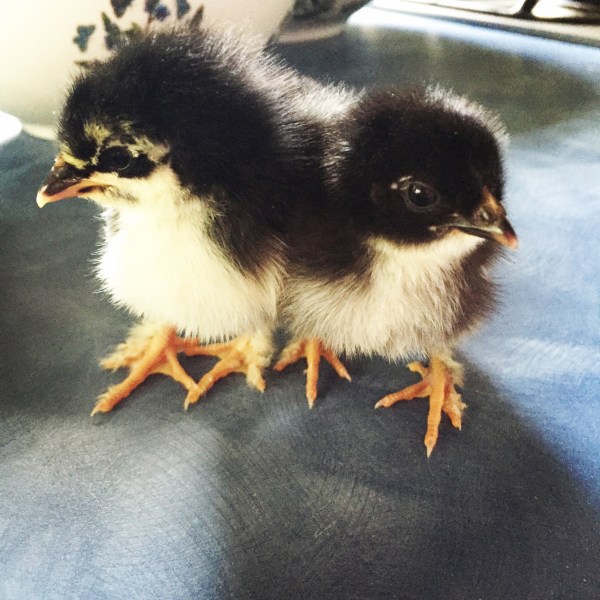
Another example came last week, when I had my two baby Marans outside to scratch around and get acclimated to the outdoors. They are my cute black copper twins; they never leave one another’s side.

I always find them wing to wing, with their little beaks together, like they’re telling secrets.

Anyway, Huckelberry the dog, chased one across the yard, caught her and dropped her, and she quickly scrabbled underneath the chicken feeder.

She had two puncture marks on her shoulders, a little blood, but no broken wings.

As I gently inspected her and placed her back in the indoor cage, she immediately ran to her sister, as expected.

But what I noticed next surprised me. Her twin, the uninjured bird, was trembling. Her soft little body shook like I’d never seen before.

And I wondered if she felt the terror, the near escape, the trauma, of her big sister.

Sometimes it is so clear to me the way that our big, wide world is connected by tiny strings.

And the way every mood we experience travels along these invisible pathways, creating ripples of emotion.

Animals are attuned, but we humans often forget this universal language of empathy.

This week, when I read about Simone Bile’s Olympic performance, and her withdrawal from competition, I watched how the world responded.

Her message was: I am human and my mental health is an integral part of my body’s athletic pursuits. You can’t separate the two, mind and body.

And, I swear, I could feel the ripple effects of her statements throughout the mental health community.

Finally, we can talk about what is real: the strength to step away, the courage to describe vulnerability, the excruciating pain of carrying others’ burdens.

And the unnecessary shame that often accompanies us when we let people down, people we love.

And mostly, ourselves.

to be vulnerable is to be strong, to be broken is to be fully human.

For me, Simone is not letting us down, she is raising us up.

She is still the world’s best in her sport, and maybe mind-body intelligence is a reason why.

Like Naomi Osaka, these young women refuse to be defined by mens’ preoccupation with stoicism and self-punishment.

The old ideal that we must subjugate our emotional life in order to succeed, needs to be retired – like mandatory white tennis skirts for women at Wimbeldon, and bikinis on female volleyball players.

Even though these moments are just whispers on the breeze, I believe the flutterings of real change are in the wind.

And I hope that we can transmit this lesson: that to be vulnerable is to be strong, to be broken is to be fully human.

Only if we have the courage to listen, to feel empathy, and to pass the word across the wire: that we’re all in this flock together, and we’ll only get by if we take care of one another.

My chickens know it and I’m trying to figure it out too.

good boy

The death of a pet is a grief unlike any other. And when the death is a decision we have made, it is cast into an ambiguous category of loss.

One that we don’t want to talk about.

We say euthanize, and sometimes that term helps. It helps to neutralize what we are feeling, and to distance us from the act – the act of taking a life.

Because, of course, what we are doing is killing a beautiful, vigorous animal.

Last week, my husband and I decided to put our dog Theo “down.” I suppose I am still in shock; I hope that writing these words will help some.

Theo was a huge, big-hearted, loyal, coon hound mix who lived for our family’s love. He was disinterested in other dogs or squirrels, or even treats – he was just partial to people – specifically me and Mac. And Lewis, always Lewis.

He waited every afternoon between five and six, pacing at every window, for Mac to come home.

He watched over the baby chicks without incident, never chased the backyard flock, and joyfully welcomed a second dog into the house.

He could hear the UPS driver from a half a mile away, and wanted nothing more than to jump, full body, onto his shoulders and lick his face.

He adored me, and sat on my lap – all 95 pounds of him – every afternoon when I read my book.

And in the evenings, he galloped, tethered to Mac’s bike, long tongue hanging to one side, with the neighbors laughing as they made way.

A perfect dog.

Except that Theo had one defect: he was a food guarder. Meaning, if anyone got between him and something he really wanted, he would bite.

Last week he bit me. He had done it a handful of times before, but this time felt like a tipping point. I researched, talked to vets, and mostly struggled with my own conscience, to decide what to do.

There was no right or wrong decision, all of it felt wrong.

There is a particular shame in euthanizing a dog. If you’ve had to do it, you know what I’m saying.

Playing God, or using our power over another creature, makes us feel guilty.

Because these animals are vulnerable, and they come to us for protection and care. And it feels like a betrayal of trust.

It is unjust – Theo didn’t even know what we were having to do. He had no voice in the matter.

Yes, he was just a dog. Just a sweet, goofy mutt.

But he had a fierce love, not unlike my own.

My own love that has been so crazy hard, so exasperating, so intense.

Loving a puppy is easy; they give you so much. The pure innocence. The need to please. The forgiving nature. The complete devotion.

But loving a problematic dog is a special kind of heartache.

Loving the not-so-perfect. Loving the hard-headed, stubborn, difficult one.

Loving the temperamental, unpredictable, even dangerous dog.

But also loving the dog who looked at me from the cage of the Durham ASPCA shelter and said take me home, please.

My friend tells me that maybe not every creature is meant to stay here on earth with us. Because maybe this world is too imperfect to truly love a complicated dog like him.

And so maybe it was never Theo’s defect, but rather the world’s inability to accommodate him.

But if I could have understood, or helped, in any other ways, of course, I would have. And, despite his biting, he was such a good boy.

Too good for me to truly understand how to love him in the way he required.

And I want to believe that in some other, more perfect world, I’d be able to love and understand him the way he could me.

I take full responsibility for his death, just as I did for his little life when I brought him home from the shelter. I told him I would care for him forever, but that time has fallen short.

Emptiness, heartache, and such a feeling of loss, that I cry a little, in the afternoon, when I try to read in my chair. I can still feel his hot, heavy weight on my legs and the way my circulation would cut off. But today my legs are light, with no silky black hairs shaking off them.

And in my heart – where there should be a doggy fullness, there is only a jagged hole.

Mac has scattered Theo’s ashes on the roadway, where he loved to run. And when I close my eyes, I can imagine that hound-dog face with the huge, drooley smile, racing alongside him.

He loved just being alive, in the night air, next to Mac. He could run forever if my husband had asked him to.

My Theo, my big sweet boy, I hope your huge heart can forgive me.

soft-shelled

I am this sort of person. The sort of person who is strong most of the time, but one who also has a thin skin.

Things my kids say, off-hand comments that can feel mean, they can cut to the bone. I take things so personally.

Am I really that insecure?

Like the egg my chicken Olive laid yesterday, I am so delicate.

Olive’s egg was no good. It was a tiny, slick, water balloon of mucous and half-formed orange yolk. Inedible, ugly, malformed, a gelid aberration.

Yet it was a weird glimpse inside the workings of the miracle, into the dark place that quivers and hides, one that’s not quite ready for full disclosure.

The egg membrane is like the private soul, and maybe we’re just not accustomed to viewing it so naked, so raw.

But I look at the egg and see the contents of a story, one that iterates a woundedness, or maybe just a vulnerability.

Nevertheless, I see a place deep inside, one that is imprinted with a fear of sunlight.

A me not quite ready to meet the world, a me that is afraid to be seen. A me that is afraid to face the violence of some kind of birth.

mermaids

Years ago, we swam, the three of us, in a heavily chlorinated suburban pool, my sisters and me.

Somewhere around the ages of nine and eleven, back when we still inhabited our bodies and gloried in what we could do with them.

With our little melon tummies and chubby thighs, we would hold our noses and pretend to be mermaids, our legs held together tightly in a thrashing fishtail. And we would hold our breath for as long as we could.

It was a different sensation to have only one leg – but a tail! In a weird way, we could swim better!

We were strong and beautiful.

And we talked to one another at the bottom of the shallow end – in a strange dolphin language. Clicks and squeaks – we would try to decipher the words and end up laughing, and swallowing water until our snotty noses burned.

Years later – middle aged now, we swim circles around one another’s busy lives.

But I think we still remember that long ago sea maiden language that we spoke, and we believe that it belongs to us still.

Swimming pool memories – diving for pennies and other water games.

Like the new app we discovered recently – Marco Polo. It has been an unlikely tool to keep us connected in these pandemic times.

Like the swimming pool version, it involves a sort of call and response. We record a message that can be viewed at any time, and answered whenever we want. A singular moment stolen from our day – from inside a closet at work, or on the bus, even out in the chicken yard.

And like the swimming game, for me it is a shoutout to my sisters – while I might be blindfolded, unable to see where my voice lands, I can still sense that one of them is close by.

And I trust that they will hear the echo of my words, that they will let me close enough so that I can touch them.

I need their touch these days.

I think it has taken many years for us to remember the mermaid language.

In the past, we were distracted by our our need to be important in the family – we were insecure, our allegiance to our parents seemed more critical.

But now, there is is this singular, plaintive song that calls across empty space, and when it does, I go back there, to that time when we were wise.

We talk – one day, one sister is burned-out and stressed – another day, another sister is just needing to vent. And sometimes for me, sometimes I’m just lonely and down.

We have come to know the pain in our silences, and that’s when we shout out.

Sometimes we practice listening even when we just want to talk. We mirror the sounds of sadness, grief or insecurity.

Sometimes we just record a silent moment of a sleeping puppy, or a clutch of fresh, brown eggs.

These are all ways that we attune our ears to hear, and really understand, who we are, and what we need.

So often we let the most important relationships slip away. We stay blindfolded, and scared – when what we really want and need is to be discovered, with full disclosure.

My sister Deb is a full disclosure kind of gal, the one who will say what the rest of us is sure as hell not going to say.

But when she called me out recently, I listened. I swam towards what was true for me, and we met again, after several years of distance.

She scares me. And she sets me free.

My other sister, Kath, the calmer one, will always lead with compassion. She has some idea of me that I really want to believe in. It’s been true since we were nine and eleven.

She sees me. And she sets me free.

I am so grateful to be that mermaid again – back with my beautiful mermaid sisters. And I know we will never lose our sisterhood. We’ve got our strength and tenacity, and most of all, our belief in this feminine triad that defines us.

It is a glittery pool of possibility – amidst love and loss, depression and illness and death.

But we are strong, and we keep swimming, sometimes even in the dark, but always alert to the calls across the deep water, and we know that we are loved.

moving days

I think about moving.

Memories of a glorious fall in upstate New York, a slight crispness to the air. It is still too soon for the freshman to swarm the quad, but we are here early today because our son plays soccer.

We spend the afternoon unpacking his clothes, making his bed, arranging his few, carefully chosen items from home. His roommate has yet to surface, so tonight Lewis will be all alone in the big, Soviet bloc style dormitory. There is not a single soul in sight. Is there even a security person on campus?

My husband and I drive back to the hotel and lie in bed and picture our son doing the same just across town.

It is moving day.

He is moving into a new home. Smaller, more intimate and more his than any other place he’s lived, in a funny way.

It is a place he will call his own, and a place he will fill up with a new version of himself, one that has very little to do with Mom and Dad.

And now, years later, I think about another moving day. My father, after living independently, has decided, at 85, to downsize. This week I will drive up to West Virginia to help him.

He too, will take very few belongings with him. A few pieces of essential furniture, books, clothing, toiletries and linens but not much else, really.

His immediate life will be much smaller. And like my son, he will have an opportunity to re-create the space, the decor, even the shadings of who he will be, in the years ahead.

My son, my father. The rites of passage. The stepping stones across the river to another shore.

Both days so full of nerves and excitement and newness – I will be tired, and emotionally spent. And there is this feeling of uneasiness that I won’t be able to shake. What happens next?

Life is always about letting go. And even with practice, it never gets any easier. There is no guarantee that what you lose will ever come back to you. It usually doesn’t.

As a mother, my son leaving home felt like a tearing away of something in my chest. An ache, a soreness, that would come and go. I thought it would never heal. I spent the rest of that fall nursing the hurt, probing the source, confused at the severity. Humbled by grief.

Of course, our son did return home, but it was a bit like the cicada who shucks the protective exoskeleton and crawls out with fresh features. He was reconfigured in an awesome new way. Bits and pieces of who he is now were formed in those 4 years of college.

Often I wonder at the fact that maybe it is not time, but place, that molds us.

Often I wonder at the fact that maybe it is not time, but place, that molds us.

A seed pod, a shell, a womb, a hospital room, a prison cell, a trailer, a garden plot, a starter home. We take on the shape of our surroundings.

Anyway, my father will leave the home that my mother spent so much energy and joy crafting and tending. Where she lived and died. Only now it’s so apparent that the decor was really all her taste, not his. So what my dad leaves behind now is more of her and less of himself, I think.

And like the hermit crab, he will carry away what is his. His home is his own body, really.

His new apartment is lovely. It is small, but has an extra room for an office where he will be able to write. Maybe having a smaller space will allow for less distraction, more focus. I think he will expand and fill these corners.

And my dad will be a different man, because spaces change us. And I will think of him, from my own home in North Carolina, with the knowledge that the next space he inhabits after this one will be beyond walls.

And I think that’s why this letting go is such a painful deal. Ultimately, we can’t follow. We can only help with the transition and desperately wish for a postcard that will never come.

So going back to that night in Ithaca, once my husband and I had held onto each other and sobbed and finally settled into bed, my phone lit up on the pillow with a text. It was from Lewis and it said: You both did a great job.

To this day I choose to think he was thanking us for all of it, the rearing and the nudging forward.

But I know that that’s the other part of this loss: I believe we want to love with all our hearts, to love so hard that it hurts, like it will break us. Because to let go when we would rather cling is the hardest thing of all.

So traumatic that, in the end, we want to be told that we have done a good job helping to transport the burden when it was needed. And we want to make sure someone will do the same for us.

So thank you son, and thank you Dad. I am grateful to have shared a part in your moving days.