The Mirror

The river dawdles to hold a mirror for you
where you may see yourself
as you are, a traveller

R. S. Thomas

How do you talk about a pilgrimage?

It feels like uncovering a sacred relic, or like exposing something too personal, too tender.

If I write about it, will the sweetness fade – like a plucked magnolia blossom that bruises within hours?

I’ll try.

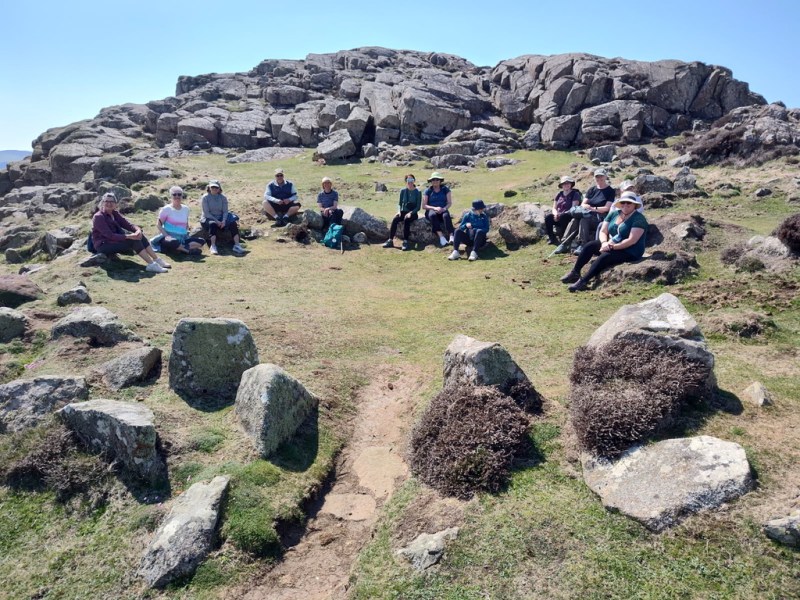
The route we are traveling on this tour will be following the ancient pilgrim’s path from the coast of North Wales to the stunning Llyn Peninsula. We will visit ancient churches and various holy sites.

These sites will be hosted by local guides. From them we will hear some of the old Celtic legends and we will visit sacred shrines and wells. And we will finish our journey at the venerable St. David’s Cathedral.


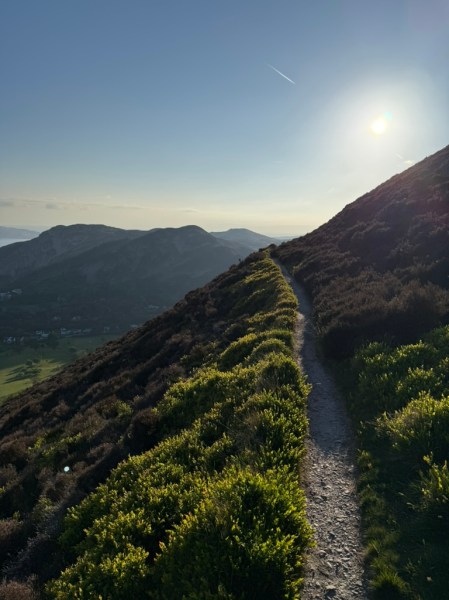
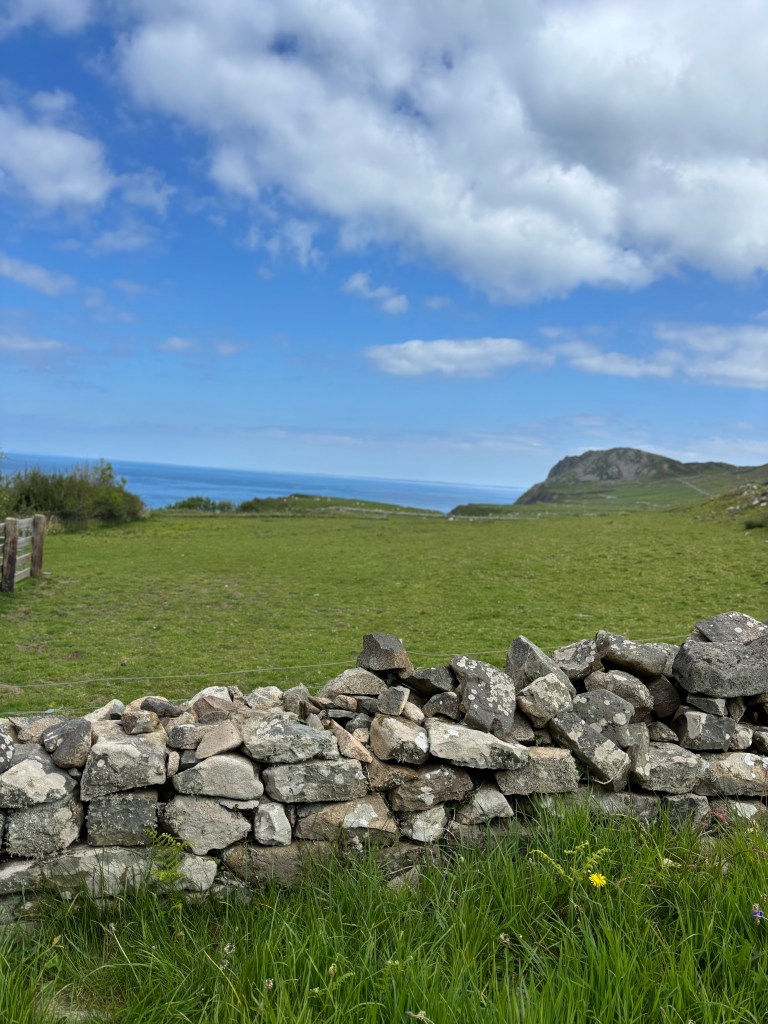
Today, on our drive, bright yellow gorse lines the pathway across a landscape that is rugged and windswept. But the flowers are thriving – so many varieties – who would think they could survive this harsh environment?

Stone walls divide the fields everywhere, keeping the sheep with new baby lambs safe within. Ancient divisions of properties.

The roads are crazy – just narrow cow-paths, really. Our driver, Steve, has to back up and give way constantly along the winding drive.

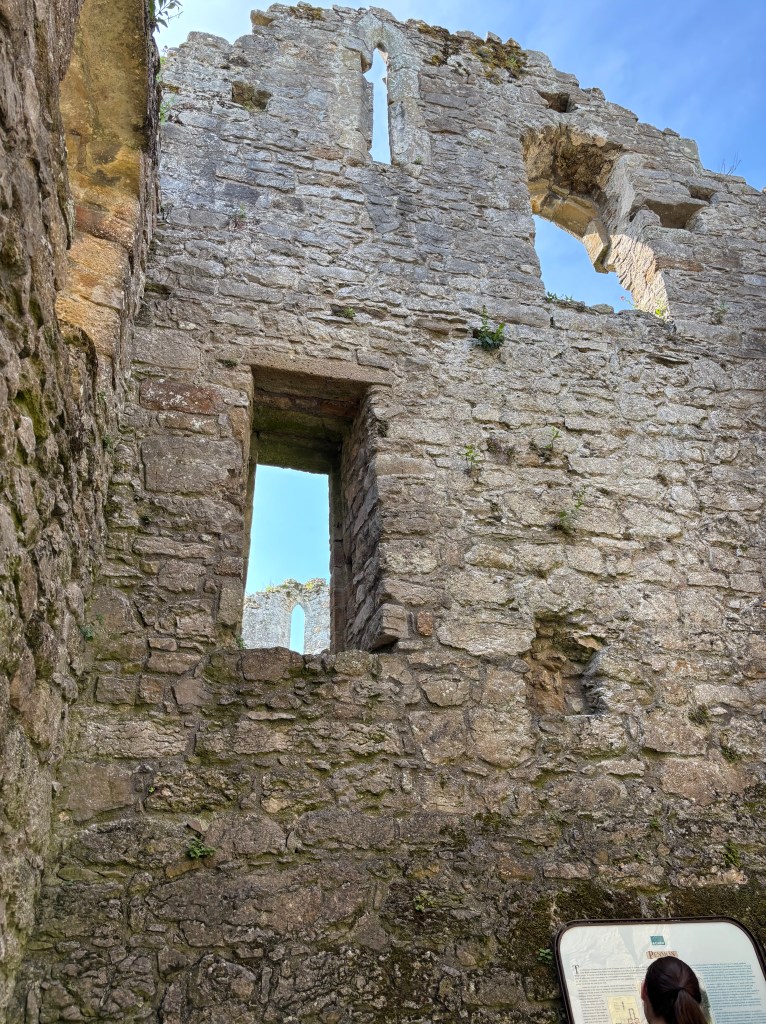
This afternoon, we are headed to the Island of Anglesey to visit the Roman fort town of Beaumaris, where the church and monastic ruins of St. Seriol stand.

When we arrive, we meet some church members, and have a brief prayer service. Then we are free to explore the 12th century ruins.

These rocks, this old church foundation, it is so ancient it blows my mind.

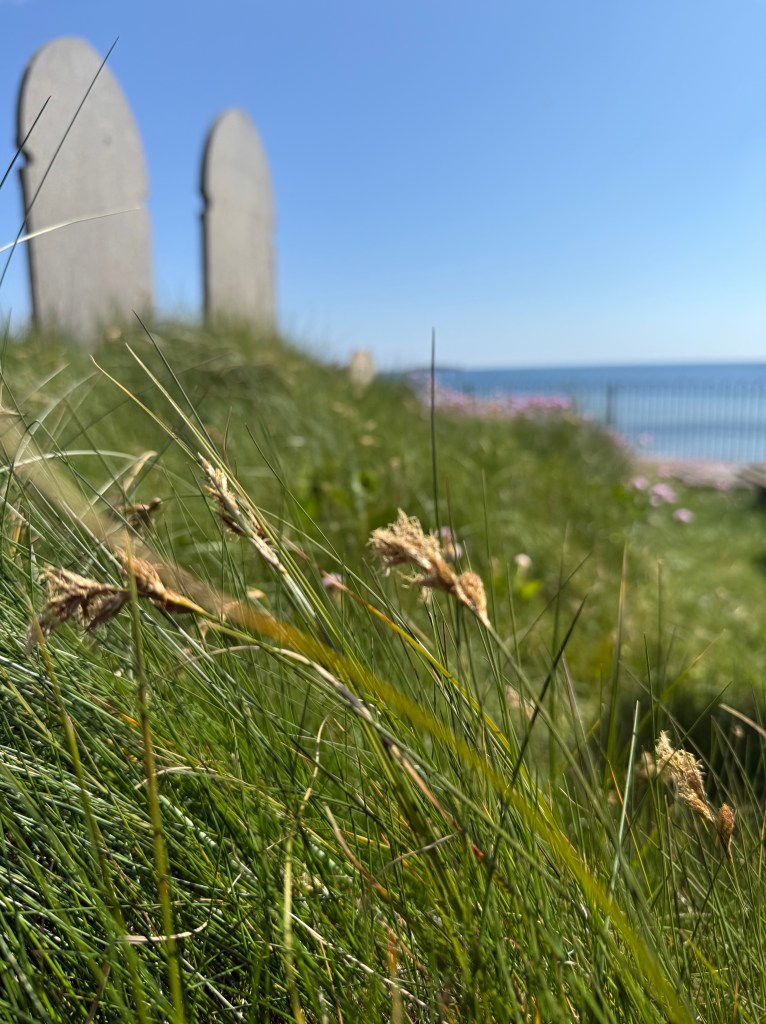
Some of us meander across the medieval cemetery, others take sips from the well. No one speaks.

The wind gently tousles the grasses and wildflowers in the courtyard. I feel the spirits stir – whispers from either a pilgrimage made centuries ago or maybe just yesterday?

What is this place?

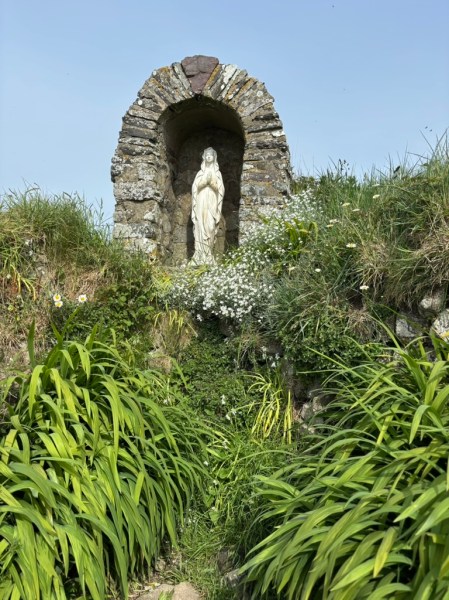
I follow my sister across the timeworn path to the healing well. Under the rock archway, the black water sits in a deep pool – it is shiny with bright green moss, and very still.

I ask her to offer a blessing.

So she pours a cupped handful of the cold water on my head, and she sprinkles a little on my hands.

My head and my hands, to heal my addled brain and my insecurity.

Then she dips her own sore ankle into the deep, icy cold water.

My eyes fill up at her reverence and care. I feel such grace – a lightness, and a shining.

She is a mirror.

And today, her presence reflects the sunlight from the churchyard, the bright stones, the buttery yellow gorse.

Her gentle way allows me the space to breathe in deep and to open up my chest.

I pull back my shoulders and find my balance on the cobblestones.

Today I feel solid and steady, like the timeless yew trees pushing up their roots beneath the graves here in the churchyard.

I feel free.

There is something to this place, something about unburdening, something about letting go.

The limpid well, my tired brain – all things muddled just want to run clear.

photos: Ann Carda

Pilgrimage ~ Intro


In April the sweet showers fall,
And pierce the drought of March to the root,
And all the veins are bathed in liquor of such power
As brings about the engendering of the flower.

Geoffrey Chaucer, The Canterbury Tales

One schedules the family reunion. The trip is planned for the summer so that they can watch the loggerhead turtle eggs hatch.

Drawn by the moon’s light, the hatchlings will struggle from their nests and toddle towards new life at the ocean’s dangerous edge.

One muses through an ancient graveyard looking for a relative that no one really knew much about.

One journeys to a far-flung Celtic island to see where her ancestors began a family.

One makes the effort, every Sunday, to put on nice clothes and greet her church family. She makes her way with a cane, to the Communion rail, to receive a blessing and some validation for her effort.

One walks the overgrown labyrinth that is paved with gravel and scraggly herbs. She pads quietly over the wide outer circles that curl into the tight inner nucleus.

Once inside, she holds her breath and makes a wish and begins to cry, then blurts out an apology to no one.

What is this?

She quickly retraces her footprints and exits the garden.

One travels to a hometown high school and gathers with a few friends. Over 40 years of remembering depression and trauma, she now finds a communion with her fellow pilgrims who have brought complicated burdens and bittersweet joys from the past, too.

She feels the healing of this reunion.

One visits a columbarium where a brother’s cremains are kept. What is this pilgrimage? What healing is she seeking?

Unknown.

One hikes on the famous El Camino Trail over many long miles and rough terrain. But oh, so many exotic birds!

Binoculars at his chest, he is alert and ready. He ticks off the new species with relish, and wakes each day, excited to add to the years-long list.

One jogs the urban trail, trying to get fit. She fights the repetitive voices in her head that tell her she is too old, too big, just too, too much. She takes another lap and heads back to the car.

One drives cross-country to camp in the National Parks, but is waylaid by a horrific accident on the highway. She seeks to recover, to heal, so to plan other camping adventures without fear.

One makes a journey to and from a retirement home.

It is a loop, and a twist in her gut, a car trip on a road that has no beginning and seems to have no end.

But she knows that there will be an end.


All of us are pilgrims.

Whether by plan or intention, or naturally, in our regular tasks and routines, we each make pilgrimage.

On our daily rounds we meditate on our predicaments.

Sometimes we count out the rosary beads of anger or anxiety. Or we tally the happiness and pray for more abundance.

We worry over the past. We think of our children. We obsess. We mourn.

And in doing this, I think we simply crave to slow down and to simply feel.

To listen to the ache in our hearts and ask why?

We want to be healed. And in the end we long to thrive.

We want permission to open up our tender senses to the sweet showers of the natural world that is spurring us on.

And we want to bloom.

And so we make pilgrimage.

And so we hope.


Earlier this month I made a pilgrimage to Wales. I want to share some of it with you … more next time!

The Thread

When one tugs at one thing in the universe, they find that it is attached to the rest of the world

John Muir

I lead a little life. A little life that I love and one that fits me just right.

But I try to pay attention to the wider world around me. I try to see beyond my own backyard.

And like you, I scroll through the unbelievable hellscape of news on the internet. Sometimes, I get angry. Often, I am disillusioned. Mostly, I feel disconnected to the larger social problems that feel impossible for me to fix.

Still, I run my errands. I do the laundry, fix meals, and I exercise. I try to stay positive, I try to see the good.

But today, I was anxious and teary and couldn’t stop looking out the kitchen window.

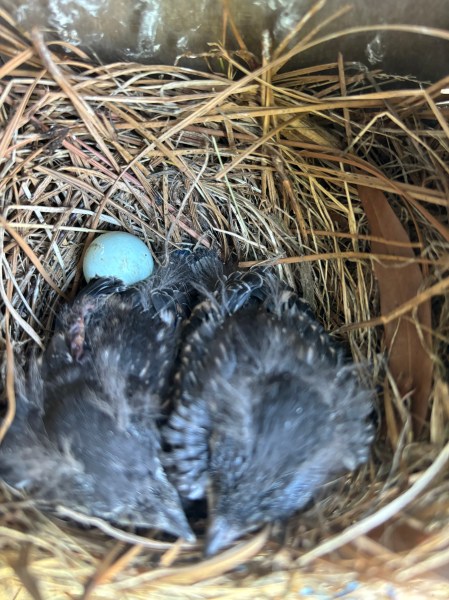
Because deep in the yard is our bluebird house. And for the past 3 weeks I’ve eagerly watched a pair of them build their nest in it, and fill it with five perfect eggs. And yesterday they hatched.

But overnight the male and female abandoned them. They just flew away and never came back. And today, the babies are slowly dying.

So I’m obsessively watching and waiting for the mother bird to return to save them. I can’t stop hoping that she will fly back home to nurture the hatchlings.

I’m fixated on this, I’m anxious, and I’m unable to concentrate on anything else. Even though I know it’s futile.

And I am heartbroken.

Eventually, I curl up on the bed with my cat, hoping the little things die quickly.

And then, I think it’s crazy that I am grieving so deeply over these tiny birds. And I feel a tiny bit of shame in this. Because in the scheme of things – with all the rest of the world’s suffering – what does it matter?


In the Celtic world, they believe that there is a specific sacredness to all of Nature. And they believe that humans exist in a seamless universe, bound together through every rock and tree and human and wild thing – as if by an invisible thread.

But the challenge is that we have forgotten this interconnectedness – we are alienated from one another and from the natural world.

We have failed to honor and nurture the relationship – and we fail to recognize the sacredness in one another.

And I believe that it is this rendering that is destroying our world.

But the thing is, we are all connected.

To the refugee, the trans person, the poor, the outsider – they are all me. And the bluebird in the yard, it is me, too.


I remember one time my father saying that, pain is pain, it doesn’t matter where it comes from. Whether it’s the death of a pet or a loved one, we experience the grief and loss all the same.

In other words, human pain is indiscriminate – it touches each of us, individually and collectively. For big things and for little things.

And I think mostly we don’t want to linger on this pain – the suffering that we witness all around us – because it’s too hard, too excrutiating, too incomprehensible, or too close to the bone.

But I feel as if the whole world is grieving right now. And our planet is crying out for healing. And our hearts are breaking at the destruction we’ve allowed to happen.

An El Salvadoran, waiting in prison, the bleaching of the coral reefs, a neighbor struggling with bone cancer, and a small bird calling out in the backyard.

Yet, we are all one. And we all hold the thread.


And so, later tonight, I will dig a hole and bury the perfectly woven birds nest, and I’ll place it deep into the cool dirt of the backyard, and maybe I’ll say a prayer.

Perhaps I will pray to find answers, answers to the questions of the Spirit. And pray that I might open my heart to the universe.

Maybe I’ll pray for how I might feel the Divine force that wants so desperately to hold me.

And I’ll pray to find ways that I might awaken my senses to the sacred in everything, in all of creation.

Simply, how I might find the holy thread, and hold it tight.

For, as the great environmentalist John Muir once wrote, “In God’s wildness lies the hope of the world”.


I dream of chickens

“Spring, summer, and fall, fill us with hope; winter alone reminds us of the human condition” — Mignon McLaughlin 

Ah, February.

February is my little black cat, draped across my chest like a furry scarf. He is like a weighted blanket, holding me down, keeping me swaddled up tight.

February.

February is gravitating to the sunny windows in the house and trying to call up the feeling of the unrelenting heat and humidity of our summers.

February.

February is my UV lamp, propped here next to my laptop, and fantasies of a tropical beach somewhere.

February is rolling over in the morning, after a deep sleep, for just a few more precious minutes.

February is wondering what the hell to write about.


These days, the grey sky outside my window casts a thin light on my bed, but, like my spirits, it is weak and insubstantial.

I think in life we have this balance of levity and gravity. Darkness resting and sunshine rising. We can’t spend too much time in either arena, it is always a balancing effort.

It is the lesson of the seasons.

And in February, I need to believe in something bright and cheerful.

In February, I need to dream.

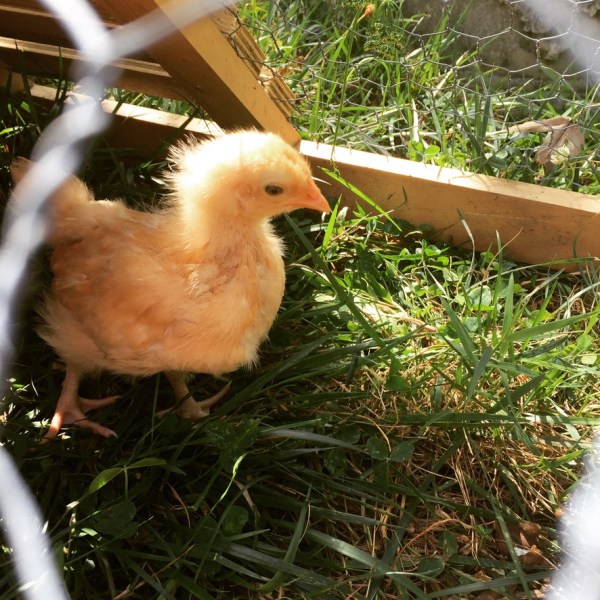
And so I dream of chickens. And on cold February nights, I lie awake and think of them.


My backyard chickens provide a silly kind of optimism to me. They are a daft distraction on a boring day. They can make me laugh, they can make me wonder.

And they keep their promises – to deliver a perfect egg – every single day, without complaint.

They follow the seasonal tug, molting and laying and just pecking about the yard – all in concert with the year.

And the care and keeping of them is an unexpected joy for me.

In my dreams, I am a sturdy Cornish countrywoman on a big farm, with acres of space for my hens. I sling chickenfeed from a huge gingham apron and I gather up the most perfect eggs.


So, the days are getting longer now, and here the temperatures are occasionally in the 60s. There’s this weird kind of double take we do – is it winter, or is it spring? Whatever – we’ll take the sunshine when we can get it.

But I still wonder if I am missing out on some true winter wisdom, as described by McLaughlin, above – the reckoning with the human condition, with all of the sadnesses and angst (you know, the things Minnesotans feel).

But, as it is February, I will put off these thoughts for another day (maybe July!) and simply keep looking for that earlier sunrise that is arriving every morning.

It’s the human condition.

It’s me in February.


And you?

What do you dream about in February?

Do you have dreams for the year?

glean

I ran two miles today. It’s not that far, but I’m proud of myself because it’s been awhile since I’ve gone out. I’ve mostly been walking.

I think the thing that running teaches you is that no matter what distance you cover, the effort dissipates overnight, and the next day you are back to building up the distance you’ve lost.

It’s truly a Sisyphean activity.

But then this amazing thing happens – a few days or a week go by and you notice you feel better – your rear end is tighter and your thighs feel stronger.

It’s as if your body is saying, just be patient and the benefits will eventually catch up with you.

But mostly running builds mental fortitude in me. And it gets my creative juices flowing.

When I plod through the neighborhood, my mind is usually casting about for new ideas.

It’s poking around for something to look forward to, or just some little thing to get excited about.

It seems I have to do this in January.


This weekend, my husband and I drove down to the North Carolina coast. We were on a mission to scope out the perfect beach house for our yearly family get-together.

The landscape was a bit depressing.

We passed acre after acre of forgotten farmland, weathered farmhouses, and tiny, tottering shacks. There were rows of limp, muddy collards in the fields, and some rickety vegetable stands.

Tractors were stalled indefinitely in the deeply flooded trenches.

There were no people about – the only traces of life were farm tools and the children’s toys that lay abandoned in the front yards – and the Christmas lights that were still strung.

And I think, these people know patience and planning more than anyone. Because they, too, are fervently looking to the future.

Anyway, down the road, I noticed an entire field full of crows strutting about. With their jaunty heads cocked, they nimbly gleaned the leftovers from the past season.

And that is me, I’m looking to snatch up the one shiny thing or new idea that might kick-start my year.

Are you the same?

We look back on the past year and decide what can be dismissed. We sift through old activities and events – to see what to let go of, and what to expand upon.

We plan what new crops to grow.


Anyway, my husband and I finally met up with the realtor and we chat for a bit. She tells us that she loves this time of year – and I get it. No tourists like us.

But as she talks, my mind is already on fast forward:

I listen to the gentle waves of the October tide, and I picture my son napping under the beach umbrella.

I imagine my grandson, digging in the sand with his shovel, or maybe in the pool, kicking his little froggy legs.

I see a glass of white wine, sipped on our private deck. My eyes are closed, but I’m aware of my family all around me, making noise two floors below.

I watch the apricot moon dip into the water and disappear.

I am a lucky woman, this I know.

But in January, if often takes some imagination to see it that way, to see the coming year in full. To look ahead and believe.

To take the dry pits and plant them.

waiting

The sky is puffed grey, pregnant with the possibility of snowfall.

On my walk, all around me, there is a sense of pause, of waiting.

The dogs in the yards are silent, waiting for me to pass.

Neighbors venture out, stepping carefully to avoid the slippery rime that has coated the black places on the road.

They wait for the forecast and the possibility of time off from work.

The children wait with their sleds, as they practice on the dry, grassy hill.

Even the birds are silent, waiting for the storm to pass.

And when I look up at the sky there is a blankness, with no mood or transience. Only a dull sameness.

The grey threatens to blanket my mood, too.


When my son was home, over the holidays, we went for a walk on a trail in Hillsborough. We were casually birdwatching and he showed me an app on his phone that helps identify bird species by their calls.

This particular day, there was a cacophony of birdsong – it was so loud I couldn’t differentiate a single bird. But that was the beauty of it – the phone could pick out one solo voice and identify it.

It was a dream for me, a person who gets overwhelmed with sounds. But I came away thinking of all the individual species that cross our ears, that we never identify. They are everywhere, thousands of varieties.

I think about this on my walk today, how easy and even necessary it is to sometimes block out the beautiful things in life. How easy it is to succumb to the vast grey, when there is something beautiful that can’t be heard.


For me, January is a month of waiting.

Waiting for the year’s schedule to flesh out.

Waiting to plant a garden, after the ice clears.

Waiting for the start of a home renovation.

Waiting for positivity and purpose.

Waiting in anticipation of what new things I can create this year. I don’t want to stagnate, I want to keep creating – to keep writing.


Life is about waiting, it just is.

And somewhere between the question and the answer is everyday life. As grey and dull and unremarkable as today, sometimes.

But today, it doesn’t bother me so much. I can pull the one birdsong from the sky.

I feel hope.

And now heading home, I am careful of the black ice on the sidewalk that could easily upend me.

A bird titters loudly in the frozen branches. I can’t see it, but it is so clear, so dissonant, that it pierces my thoughts.

The sky has darkened, and still the mood comes back to me, like a birdsong:

What will be? What will be? What will be?

To go

This year, my son comes home the week before Christmas. And first thing each morning, we walk a mile to the neighborhood coffee shop.

One small oat latte, to go, please.

On the way home, he sips the hot drink as we talk. About nothing, really, just everyday bits and bobs. But I feel close to him during this simple ritual.

I know these walks will stay with me for a while.


Later, I FaceTime with my 89-year-old dad, and he is bright and upbeat. He tells me about all of his political activities and the goings-on at his retirement home.

His face is nearly unchanged to me, his energy is timeless, and his eyes are twinkling with humor.

I try hard to slow down and really listen, and to be present to the moment.

Because always in the back of my mind is the realization that these visits are finite, and I wonder how many we have left.


On another day, my daughter calls to tell me that her entire family has come down with a nasty stomach virus, and could we please come by and take our grandson out in the stroller.

So we bundle up and pull into their drive, making the transfer from house to stroller very carefully.

I notice how the rosiness in his cheeks is gone, and he seems a bit listless. But he brightens up when we put Bing Crosby’s music on the cell phone.

Then he starts to sing Jingle Bells, with a wide-open exuberance in that sweet toddler voice.

And then we are off – taking in the neighborhood lights and decorations. He is transfixed by the reindeer with mechanical heads that move side to side with beady, life-like eyes.

And when we take him home, he cries and says, go back!, meaning he wants to keep strolling. And who can blame him for not wanting to return to the boring, sick house.

But he finally succumbs to his mother, and goes inside, but not without a teary wave from the window as we drive away.

I want to remember the expression on that little pink face, and recall this whole, sunny afternoon, forever.


And finally, on Christmas Eve, my grandson insists that I pick him up to examine the creche on our fireplace mantle.

He is fascinated by the animals and the wee baby carved out of wood.

I let him play with the pieces on the floor. He has the donkey talking to the fox, and the angel hiding behind the barn, and little baby Jesus riding the sheep.

Watching him play makes me realize that these pieces were meant for this – they were meant to be brought to life by a little 2-year-old.

And so I savor this little scene of scattered mayhem on the rug.


Later that night, all my chores done, I lie on the couch, exhausted, with my little black kitty nestled on my blanketed legs.

It’s been over a year since we found him at the shelter, half-starved and with a cone around his head. And now he is my shy, but attentive companion, especially through these winter nights.

He stretches, then darts beneath the Christmas tree, making me laugh as he corners and chases a small bit of fragrant evergreen.

This past year I have loved his entertaining antics.


The holidays go by in a whirl.

In January, I always find myself wondering where the past few months went.

If you’re like me, you think in big strokes – cleaning and decorating the house, and putting up the tree, or trying some special new recipe for Christmas Eve dinner.

Choosing the right gifts, writing the annual card – all of these things are meaningful, but they don’t really leave an indelible mark.

Rather, it seems to me that it is the small act – the coffee run, the long phone call, the kiss of a tearful child – that will stay with me the most.

It seems to me that it is the small act – the coffee run, the long phone call, the kiss of a tearful child – that will stay with me the most.

So, I want to catch these ordinary moments as they fly by – because life moves so fast, and I want to pay attention to these small things that I love.

These poignant fragments of time, they are like the soapy bubbles that my son waves in a huge wand for my grandson to catch on Christmas Eve – they are so exquisite, so fragile, and so fleeting.

Ghosts of Christmas Now

I lie awake in bed, with obsessive thoughts scrolling through my head.

It’s been a long two hours of this:

Was I a good mom?

Can we afford the big remodel of the house?

Why didn’t I ever have a career?

When should I have that hip replacement?

Oh my God, when my grandson graduates from college, I’ll be 82.

I wish I had been better about using sunscreen.

Whatever happened to Mike, my boyfriend from high school?

Sleeping pills are a crutch,

maybe,

maybe not.

Does my dog know that I love the cat more than him?

My writing is stupid.

Why don’t I have a yoga practice?

I hate yoga.

How much longer does my dad have?

Will I get to say goodbye to him?

My upper arms look fat.

I should do yoga.

I love yoga.

I think I see a cockroach crawling on the door frame.

Better call pest control tomorrow.

Is it too late to save the planet from global warming?

How can my husband sleep through all of this?


Anyway, these nattering thoughts unspool, one after the other. And now I need a break, so I get up to get a drink of water.

And after climbing back into bed, the snarled skeins of worry seem to have come loose, and there is space to untangle them.

First off, I can’t undo the sunscreen thing – it’s just too late.

Second, the parenting issue – that’s too late, too.

Also, I may be around to see my grandson graduate, and for that I will be lucky. Let’s hope that happens.

Next, boyfriend Mike definitely broke up with me, so whatever – what a jerk.

And no, I never had a career, it just didn’t happen, get over it. I’m on my path.

And I’ll call my dad tomorrow.

It’s interesting to me that these ghosts periodically haunt me, but usually with the exact same set of grievances. And I can almost hear them coming when they enter the room, they are so familiar.

They come when I feel anxious, or insecure, or overtired.

I’ve tried to meditate them away, but the scripts are baked in. Simply the consequence of an overactive mind.

In A Christmas Carol, Ebenezer Scrooge faces his mortal demons and becomes enlightened by what he encounters.

After grappling with the years he has wasted, he is finally gifted with a conversion.

I kind of want something like that for me, for some kindly Spirit to guide me through my life and make all things clear.

To absolve things I’ve done wrong, to erase my insecurities.

But really, I am certain that the answers will never come from a ghost. The answers reside within me.

And in the end, I look to the words of the same Charles Dickens, who wrote:

A loving heart is the truest wisdom.

And so, I’ll take these words, simple and pre-packaged and ready to absorb into my restless being.

These words are the answer to my questions. They are the answer that helps quiet the late night voices.

They are the answer that soothes me – more than yoga, more than sleeping pills, even more than a talk with my sister.

The answer is easy: the answer is love.

Stringing the lights

Each season, it seems we have a distinctly different relationship with our outdoor Christmas lights.

When we had babies, the lights were a fun way to introduce holiday symbolism. And through their shining eyes, we travelled back in time to our own childhoods. There was a joy in creating a new tradition.

And then, with the school aged kids, we strung the lights together and helped them learn the ins and outs of de-tangling, and showed them how to drape them just so across the branches.

And then there were the high school years when it just felt like a big chore. With the kids busy and our schedules packed, who really cared about the outdoor lights? What a hassle.

And then, after our son and daughter went off to college, it fell to just the two of us, and it almost felt like the lights were more important than ever.

Our way of saying, so much in your lives has changed, but this stays the same.

Then there was the year we returned from living in Switzerland. Coming off of a pared down living situation in Bern, we were dazed by the excess of decorations and light in the U.S.

And driving down the street, coming home from the airport, we marveled at all of the neighborhood decorations, a little sad to think that our empty house would be bare.

But no, our son Lewis had climbed up on the roof (!) and draped thousands of tiny lights outlining the entire house.

A tear came to my eye, it was like we’d been visited by Santa. And it was like the passing of a torch.

And this year, now that we’ve downsized our house, the temptation is to give up on the Christmas lights – to minimize our traditions altogether.

But I think there is a longing at this time of year, a yearning to bring optimism and light into the cold of Winter. I mean, what a year we have been through, and who knows what 2025 will bring.

But when I walk around the neighborhood I see hope. I see light transforming the night. We are saying no to the darkness and yes to joy.

And now, the thing about having a grandchild is that no matter how depressed and cynical you might be over the state of the world, you can’t stay discouraged for very long.

You see his eyes light up and the excitement rubs off on you. The wonder is huge. Young ones see the magic and only the magic.

And so, today, back at home, my husband heads out to the hardware store with an elaborate plan to construct lighted mesh balls to hang in the tree in the front yard.

And it lifts my spirits. I’m excited for our grandson to see them, to look up and point at the branches, and to tell him that his Poppy made them glow just for him.

In the end, I think the Christmas lights are a reminder to connect with a positive spirit, if I can. But if I can’t, then maybe my sadness can earmark something sweet and rare – the fact that I kept going, and I persisted, even at the darkest times.

Parts of this past year were tough. I look back to the Spring, in the long weeks after COVID, and how hard I struggled to stay hopeful, desperate to hang on to some kind of positivity.

How now, how easy it is, to forget the bad times, when I am well. How hard it is to recall exactly how difficult a day, an hour, even a few minutes was. And how that unique pain of depression can chase all optimism away.

So I guess that this is my hope for the holiday season – not for an erasure of negative thoughts, or an ending to all sadness, but for being grateful that I simply made it through the year.

And that I found a bit of ease when things felt hard, that I kept going even when making an effort seemed futile. That I held on when dark depression was pulling me down.

And maybe this season, as I gaze upon the Christmas lights, I can appreciate both the light and the dark in my year. And that, even for just a moment, I might take the opportunity to remember to feel alive, to feel loved and to feel whole.

Happy Holidays

xoxo B

Bird

It feels like I’m hungover today on my morning walk through the neighborhood.

The fog has settled in, it hovers and hides what is in the street right in front of me.

The election placards on peoples’ lawns are limp and dripping from the rain. I can’t stand to look at them.

A bicyclist passes me and it makes me think of being 10, flying though the streets of my hometown, without much of a care. Is that when all of this started? When I let my hands off of the handlebars?

When I took for granted that things would go well. That government was good and democracy was forever.

I still want to believe that all of us in this country want similar things – clean water, good schools, enough resources for everyone.

But somewhere along the way, I stopped paying attention. Maybe I hadn’t noticed that the Dream wasn’t really big enough to include everyone.

And how we’ve been more divided than apart.

My generation was the Reagan years, full of the gluttony of consumerism and gross military might. We were selfish and we took too much.

And now what do we have to offer our own kids – no affordable housing, an insecure job market, negligent healthcare.

I paint things simply.

But last night, having dinner with friends, it was like a solemn wake, only one without a body. And what were we mourning? And to whom could we offer our condolences?

And now, this afternoon, my grandson is teaching me to be a bird. At the park, on the swing-set, he wants me to push him higher and higher, like he has wings – soaring to the top of the sky.

And with his chubby arms extended. He says “cheep-cheep”. And he says, “Look how high” and “birdie is so high in the sky”.

Over and over.

He laughs and I want him to feel like this forever.

A bright baby bird, with auburn hair flying – fragile, but brave.

I’m free, he says.

I’m free.