dispatch

Let me just say that there is no affirmation like the affirmation you get from your psychiatrist.

When he says you look great and you are doing great.

And isn’t it fortuitous when your psychiatric appointment coincides with a “good” day!

But mainly I just want to tick off the box that indicates that everything is just fine and to get my drugs, thanks.

Anyway, after my appointment today, I took the dog out to walk in the neighborhood. And we saw a little girl with a huge backpack waiting in front of the elementary school.

There was a little bit of eye-balling, but I liked that she wasn’t doing the stranger danger thing and all that.

She was pensive and serious, like a little droopy plant. She was maybe seven.

I asked her how her day at school went.

She went on a minor riff about math class and how she was the clear winner at solving math problems at the white board. I commended her.

Then the family minivan pulled up, the door opened and she bounced up into the backseat.

The tinted window scrolled down quickly and she shouted – what’s your dog’s name?

Huckleberry, I replied. And there was a huge six-year-old belly laugh as the van sped off.

It took me back to the long after school moments when our kids were in grade school.

How they would drag their sweaty little bodies up the porch steps, with shoulders sagging under bulging backpacks.

Like they had been roughed up. Or been to a war.

And any pep from the morning was long gone. Their energy packs depleted, they’d left it all out on the field.

And I felt a little sad that school was so hard, so demanding, of such small tender beings.

But that’s what the world does – we take our energetic youth and wring them out for all they are worth.

Yet, there was that de-compression time that had to occur every day – the flushing of institutionalization from their systems.

And I never knew where the release valve would be exactly.

But I knew I could never simply ask how was your day or how are you, even. That would be lame.

Yet talk was all I could think of to do.

Because I think we all have a need to report in to someone, preferably on a regular basis.

Pep-talks and positive words and all that.

A back rub, a bowl of mac and cheese. And sometimes a mom who is conveniently available for an argument.

Someone to listen at the other side of a slammed door.

In a deeper sense, it is vital to good mental health.

Like the conversation before bed with your husband, when you inquire about his job -the most incomprehensible, boring job you could ever conceive of, but still, you ask.

Because each of us want someone to notice us, to observe our days, to commend our small moments.

To get the scoop about all of that time we spend out there away from home, away from our people.

It’s as if we have been dispatched and are reporting back from some foreign country.

To know someone at home is waiting. Like the ellipses on the text message.

. . . . .

Someone is patiently waiting to hear about that crap day. Someone wanting to help you metabolize the rough spots.

We wearily tap out signals to check on one another. Texting coffee cup emojis and memes, slipping a carton of bright eggs into a friend’s back door.

Yesterday I got a text from an old friend who I haven’t seen in a very long time. She is struggling with the death of her younger sister. We texted a little.

I think I had sent her a sympathy card, but that was it. I had felt remiss, like I hadn’t done enough. But she remembered.

Sometimes small acts can transmit energy – like a virtual hug, a laugh or an ugly cry.

And so, after getting that A+ from my doctor, I will totally stuff that report in my backpack and run free every time.

And I may say that it doesn’t matter, but it does.

It means everything.

It means I’m good, heavy backpack and all.

And you?

we ran

It was the late 1970s, and like everyone else, we ran.

We were teenaged girls and we ran cross country and track.

We ran for fun, we ran to escape.

We ran to get in shape, sometimes even to compete.

Mostly we ran to simply adjust to our changing bodies, to feel proud of our muscled thighs and chiseled calves.

We ran to give the finger to the boy’s gaze, to their judging comments and sexist jokes.

My sister could stay up with the boys pack. In fact, she often beat them, she won medals in the track and field distance events.

She ran the mile, that uniquely rigorous feat that proved both physical and mental strength. She ran the brutal 400, the event that required an explosive speed.

She was a faster runner, but still I ran too.

I ran from the fat jokes, the insecurity, the fear that I would never be good enough, thin enough, that I’d never be seen for who I was – for my brain, my sense of humor, my kindness.

Junior year, my sister placed second in the West Virginia State championships. What can I say but that she was simply amazing.

But after that she gave up running. Running took her to a dangerous place. Things happened and she lost her running for a while.

Flash forward to the 1980s. She and I were pregnant with our firstborn, and still we ran.

We ran to take a break from the household, get a chance to recalibrate, to put the pieces of our selves back together.

We were still young and resilient. We felt instinctually that our bodies were made for this, we ran while weaning babies and chasing toddlers.

And then the children grew up. And we ran with an urgency, a striving need to reclaim the strong thighs and hard abs gone soft.

We both struggled with depression, eating disorders and marital problems. She divorced and moved to another town. We both did lots of therapy.

And many years later, I still ran slow miles on the trail in my neighborhood.

I ran to bolster my midlife self esteem. I ran to keep my moods in check.

And sometimes I would think back to our long runs from high school, the way my sister and I would talk and make sense of what we thought were the big problems.

And we thought we knew what those were.

Still we thought we were smarter and stronger than the men in trucks yelling crude obscenities at us. Smarter than the leering assholes who scanned our legs and breasts. Smarter than the boys pressuring us to have sex.

But still we owned this: the gentle pounding of our shoes and our syncopated breath. Our shoulders grazing, lungs puffing – there was an honesty that only the running together could give us.

And we thought we could somehow outrun the cultural messages all around us.

But still we owned this: the gentle pounding of our shoes and our syncopated breath. Our shoulders grazing, lungs puffing, there was an honesty that only the running together could give us.

Those days there was no #MeToo movement, there was just a lot of girls running to stay ahead of the sexism.

In reality, every girl I ever knew faced down some kind of sexual harassment. It came with the territory of being a girl.

All we wanted was a real coach, not a driver’s ed teacher. And we also wanted our own uniforms.

All we wanted was a real coach, not a driver’s ed teacher. And we wanted new uniforms.

And finally the #MeToo Movement was the oxygen that brought our memory back.

I think it allowed us a chance to revisit the toxic running culture we carried with us.

It’s funny how you can be so incredibly strong but so vulnerable at the same time.

Because our pride, our guts on the running track, kind of gave us a misplaced idea of power. We fell into a catch-22 of eating disorders and distorted body image.

And our vulnerability, our sex, was never protected by the insensitive coach or the groping boyfriend.

The boys never had to go through this, they owned their bodies, they were free to use and abuse their autonomy.

Looking back, I think we believed that equality would come with time. That we would outgrow the insecurity, like bell bottom jeans and big hair.

That things were moving forward.

But really the remembering is the only path back to healing, the acknowledging of the shame housed in those long ago locker rooms.

I think I can finally understand, not just cognitively, but on some physical level, that we were never to blame.

We just ran. We didn’t ask for the harassment.

To heal is to expose, to laser-cut the pain, and to hold it up to our families, to our communities. To call out and lay bare our shame.

And today I see that years ago we ran for so many complicated reasons.

We ran in fear, we ran confused.

We ran with and against the abusive climate of the times. We ran, all the while fighting against our own selves when we didn’t even know it.

And we ran to escape the systemic truths we were never built to understand at that tender age.

We ran because on some level we thought our bodies could withstand the abuses of men.

We thought that the world was changing, that the world was finally made for us.

But our endurance gave us the false belief that our running would protect us.

And now I recognize how critical it is to know what we know– to put the pieces of memory back together. So that my sister and I, now almost 60, can finally let go.

Because the trauma from the past is buried in our bodies, muscle memory. The beautiful runs, the jagged pain. All of it, is still with us.

And until we stop pushing it down, and tell our stories, that hurt will never completely heal.

But my sister and I are doing the work and we are healing. We’re in this together, like when we slogged through those killer 10 milers along the Kanawha River.

Those runs were so tough, but just when one of us would want to quit, the other would push.

We were, and are, stronger together.

And finally, the truth was this; we are women and we run, and that is enough.

hive mind

My beekeeper friend Ryan came by yesterday with bad news.

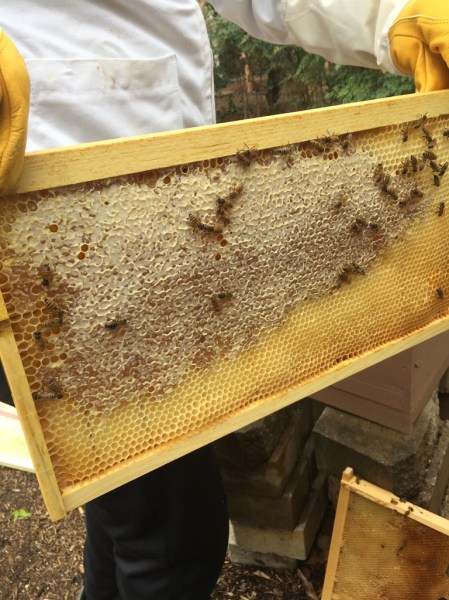
The hive in our yard is not thriving, it is infested with parasites. And the old queen has become ineffective – she is aging, and not producing new brood.

We were optimistic earlier this year – the box looked beautiful – it was teeming with the perfect ratio of larvae, brood and honey.

And then something changed. And really, its anyone’s guess what went wrong.

But it strikes me how something can look so active and robust and at the same time be quietly rotting from within.

Everything seemed healthy, we pulled the frames out and saw the brown, ravaged comb.

In contrast, last summer it had the perfect thin, white casings over the amber globes – all of it glowing like a gold treasure. The puffy pregnant pockets bulged and dripped with the sweet honey.

The healthy wooden frame was like a progress report showing us how well we had cared for these little bees, how attentive we were to what threatened to kill them off.

Alas, this year tells a different story.

It tells of a season of neglect (maybe we didn’t treat the mites early enough).

Or too much rainfall at the wrong time. Or an old queen who refused to secede the throne. Or maybe some rogue drones who flew off in search of better things.

Of course, it is a folly.
It is such a small thing.
But such a small ache in my heart.

Of course, it is a folly. It is such a small thing. But such a small ache in my heart.

I used to believe that our years were like these hives – the rewards and failures could be measured one season to the next. Learning would cancel out any possibility for error. Our success would be linear.

And the failure was just that, a failure.

And I still look at things that way, sort of. But I also have to acknowledge the unpredictabilty of the entire venture.

And I imagine my brain as a honeybee comb.

The way it has these connections and also these unpredictable synapses. And it buzzes along, happy and productive most days, but dormant on other days – dark and inert.

And all of that sweet, golden potential within – stored and ready, but sometimes painfully difficult to extract.

Human and bee – with crenellated corpuscles that link to one another in a system that is ever-changing and alive. Channels of energy metabolized like sunshine to honey. Electric currents controlled by who knows what.

For the bee, each hexagon of the comb is where an egg will be laid (and who knows why it chooses that place?) and then larvae and then food will be produced to service the entire organism.

And all of it works together in a symphony

And it works so often. Unless it doesn’t.

The little honeybee – so perfectly programmed, like a robotic drone with a singular destination with no deviation in flight map.

And yet. To see the hive in the shank of summer, it is a glorious riot of chaos.

A drunken house party with bee bodies bumping against one another, crackling and popping in the heat.

Chaos and order. Random insect movements, and an orchestrated dance of pure joy.

So today, I raise my glass to last year’s crop (how did we ever take you for granted?) And I quietly watch the erratic and clumsy parade of bees.

It’s a little like Times Square on New Year’s Eve for bees, the desperation. But really more like a death watch.

But if the honeybee hive mind is anything like my own, I’ll hope for the repairs to come swiftly and with as little cost to the whole comb as possible.

And the sweetness?

It will come (I hope).

Or not.

the thing with feathers

Hope is the thing with feathers
That perches in the soul
And sings the tune without the words
And never stops – at all

Emily Dickinson

When I’m feeling depressed, but I am still able to write, I feel a tiny bit of hope stir.

The depression swims deep, like blue veins in my arm, invisible, beneath the skin.

I want to tap my wrist to bring them to the surface. To expose the root of this sadness.

To see the disconnect, the defective wiring, the source of this pain.

So I try to rewire the circuits between body and brain. I go for a run and I percolate, and I ruminate.

And some days I play with ideas and words and images. I etch, erase, and edit.

It is a good day when I can write any of it down.

But as my jogging body stretches and unfolds – hips like cement, calves straining, my movements are stiff, slow and plodding. I’m hardly moving forward.

I have to breathe deep, loosen into the cadence, trying to knit the loose ends from the trauma back together.

And returning home, I am spent.

Later, doing chores, up and down the steps, my feet are heavy, I sometimes forget the task at hand.

In the kitchen, scrubbing the pots, the dry, cracked skin of my hand feels tight and sore as it pushes the yellow sponge, catching the the crumbs as it glides across the countertop.

The cool water rinses through my fingers at the tap as I lift and turn the lip of the scratched old pan, to rinse over and over.

Each task, done a thousand times.

But yesterday, after a hot shower, as I was drying off with the towel, my eye wandered to the framed watercolor hanging on the wall.

A soft pastoral scene of the West Virginia mountains, the New River Gorge near where I grew up. I’ve glanced at that picture nearly every day for years.

But today I saw it.

And I felt a tiny shift, a slight lift, in my mood. And I simply thought: I would love to have a notecard of that print to send to my friend.

And that was all.

I think that sometimes the best I can ever do is to keep moving up and down, I can’t always move forward. There won’t always be any actual progress.

But maybe this is what healing looks like.

Maybe healing is simply being able to notice. Maybe, for even just a moment, it is seeing color.

Maybe it is a glance of the mountain’s horizon through smoke. Maybe it is the memory of an old friend.

Maybe healing is squinting my eyes at an imagined vanishing point – not seeing an ending, but being curious about a possible beginning.

Maybe healing is this tiny flutter deep in my brain – a lightening, a levity, a curiosity, a question.

Maybe healing is writing these words, my restless rustling, like a thing with feathers.

Maybe it is hope.

vow

It is late afternoon and through the nursery’s gauzy drapes I can see the shadows dusking across the lawn.

It is Spring, but it could be any season, any year.

It is Spring but it could be any season, any year

For me it is this chair.

My tailbone aches from sitting, wrenched forward in order to maintain a hollowed out abdomen for my grandson’s head as he naps.

He is warm, almost sweaty, and breathing so lightly, so smoothly, he sips the air in the nursery.

I know that I am here for the duration. Let the minutes tick, the hours wind down.

There is no getting up to get a glass of water, no trips to the bathroom.

We are here, in baby time.

My body is now the concave version of my pregnant self when I supported my own daughter.

I would contort into any position to keep this child’s head safe.

Patience comes with age. There is no better thing outside this door, only distraction. Only the messy world that threatens the napping of my wee one.

To give in, to surrender to the shape that is required to love and to support, is no weakness, it is like the strongest tendon in the body, a ligament that can stretch to bear the weight of unbearable things.

Sometimes the body rests easily when the mind wrestles and strains.

Today I let my thoughts sift away on the mountain air. Being here with this child inflates the old bellows from motherhood, the muscle memory kicks in and inflates my old lungs.

My old heart.

And this child will break this old heart, of this I am sure. It’s what happens when you allow yourself the opening to love.

And this child will break my heart, of this I am sure. It’s what happens when you allow yourself the opening to love.

When you surrender everything – your judgements, your opinions, your petty hurts of the ego – when you offer up the soft underbelly.

When you risk to conform to this new shape. This safe new nest beneath an expanding breast.

Now he smiles, pupils still rolling beneath thin blue lids. What does he dream about? Does he see the light and stars from his placental galaxy?

Or is it the giant moon of his mother’s gaze on this bright new planet?

Where my daughter nestled, now my grandson rests.

Looking back, I recognize that so many moments with children demanded a choice: whether to stay firm, or to take a breath and give in.

So much harder to give up the spinal rigidity, but in the softness lies the trust.

When my mind slips back to worrying, I think of how the modern digital world moves at such a furious clip and I’m anxious that I won’t keep up.

Will he still want to read with me in a few years?

But for now I sigh and pull the chunky board book out from under my numb backside.

I Will Love You Til The Cows Come Home.

My daughter has memorized the lyrical lines of this book and I can almost see his small belly relax and pulse when she repeats the rhyming phrases.

For the words live in the body. Like memory. Like my love for this boy. And my body’s hammock wants to imprint upon his recollection in the same way.

But his memory is no one’s but his own. And I have to trust that as he grows he’ll recall that in some way that his Gigi has a space, a hollow, a safe cave for him to run to.

I’m so grateful that my daughter trusts my cradling care. For some reason she hands this child to me without much of a worry.

Today I am sworn to this vow – to protect and defend this child or at the very least, to always be a soft place where he can land.

salt

He’s made a salad. And I am grateful because making the salad is the part I hate.

Too much intention, too fussy, too much effort in pulling out the sticky drawer to search for a fresh vegetable.

But I won’t eat.

Or, more correctly, the plastic spinner bowl will sit and condense and grow warm. So neither of us will eat.

Because we are fighting.

___________________

The argument starts small, and days later neither of us knows what it is about really.

Yet we do

because the emotions after the fight still cling,

like the white salt that limns my lips after a swim in the ocean.

___________________

A crusty buildup from hours in the surf.

It sticks, and dries and cracks the corners of my mouth.

And on my torso, it chafes under my sticky armpits and wedges into the elastic ruching of my swimsuit.

_________________________

Residue

small price I pay for adventure

Or at least for wanting it.

To swim in the sea that is.

__________________________

In the tide

I flirt with the current,

cresting the shallows.

How far do I dare?

_________________

Quickly I’m nervous

and people wave frantically, from the shore.

Swim, swim

swim towards the danger,

not away, they say,

(defying any logic and intuition).

Let it take you.

________________________

Later, at the hottest spike in the afternoon, I surrender to the outdoor shower

to sluice the brine away,

but I never come completely clean.

My shoulders prick and and sting.

__________________________

And tonight, the heat will radiate and pulse along my entire body,

and the grating scratch grows incessant and insane, and I yank the sandy bed sheets to the floor.

My anger still radiating off of me

in the thick night air.

____________________________

You would think the sun, the ocean, the sky would sift this mood,

but like errant grit in the shag carpet, it’s impossible to sweep away.

The afterburn never breaks the skin, so the repair will be quick,

but tonight both of our backs are throbbing,

angry remnants

as if from a lashing.

__________________________

We sleep (finally),

and dream of silently swimming away from the hurt,

alone or together,

giving up to a salty blue balm of forgetting,

or senselessly letting the riptide drag us away.


gone broody

Once again, this aberrant behavior is back.

And it is always the same hen.

Olive.

She’s the only chicken in the yard that does this. This senseless ritual of sitting in the egg box, pretending to lay, and taking up permanent residence. For hours, and then days. Catatonic.

Eventually I push her out. She shrieks, with her orange prehistoric eyes glaring.

She gathers her feathers around herself like a shawl. She is appalled, mortified that I would remove her from her throne in such a way.

And when she gets like this, her body swells and she appears larger. If I try to lift her out and she puffs up and hisses. Stay away, leave me to crochet my silly thoughts.

She will rest in the darkness for two or three days. That’s what the chicken textbook says to do. To break her of this broodiness, this irrational tantrum.

I’m sorry, Olive. You can’t stay in the box. So into the garage you go, into solitary confinement – imprisoned in a dog crate, with a handful of cedar shavings and a toss of grain.

So I give her what she craves. I let her give in, give up, give over to the base instinct.

Like a nun in a cell to do penance.

But I feel you. I understand. This maddening instinct to sit in the dark, and stare. To plump down onto imaginary thoughts and worries. No desire to go into the light, to be with the others, to participate in the daily grind.

This is depression.

Rumination on an endless loop, my brain is also hardwired this way too. Like Olive, there seems to be no root cause. But my world is shrunk down to the size of a box.

Last night, before bed, I go back to check on Olive and she is huddled in the corner. She sleeps in the darkness, as if she were back in the roost with her sisters – no anxiety.

And tonight, her feathers are smoothed, her neck droops, beak tucked down beneath her delicate speckled breast.

And isn’t this the way for me too.

I can see the cracks of sun at the edges of the bedroom window, but something inside of my body becomes weighted. It feels like a familiar place, a place I’ve been to, but nevertheless always catches me by surprise.

It’s a madness and a part of my genetic nature.

And I don’t want to be pulled up, given advice, or remedied. This is something bigger, like the pull of the moon, a tide curling through my veins, swimming with salmon, desperate to reach some dried-up synapse in my skull.

It is like the worn dirt path beside the fence where the hens pace back and forth all afternoon long, craning their necks and yearning. For what?

Why aren’t they happy?

They have everything they need to survive.

And I do, too – family, friends, food, healthcare, a beautiful home.

And yet there is this dark thing, this black dread that I carry around from my childhood, a ponderous breast beneath the plumage – it mostly leaves me be, but now and again it rises and swells up, grotesque in the dark.

My primitive brain, some faulty wiring, a disconnect within myself. Like my little hen who is frantic in response to absolutely nothing at all.

Like Olive, I simply have to wait it out.

the cruelest month

Where I live, Spring comes in with a flirty, jagged edge.

On my run today my shoe crunches a perfect pale blue eggshell on the cold sidewalk. The air is moist and cool, the ground pulses.

There are blushing pink cherry buds that cling to grey, shivering tree branches. Frilly daffodils tremble with their heads hanging low, dejected.

This season is a contrast of energies. There is the bright hope to unfurl and reveal a delicate tenderness, even while the stubborn cold wishes to blow it all away.

How can such tender things survive?

And like the closed up bulb, I’m also a bit wary of the lengthening days of sun.

I swirl my fuzzy scarf twice around my sternum to warm my throat.

In the way that I have always felt wound up in a skein of delicate fibers, all bound together, protectively, snug.

I’ve always been sensitive. And I used to see that as an insult, or a criticism, anyway.

How wrong I’ve been, to accept that, to hide myself.

It was always in my softness that lay my strength.

I’m annoyed at the world’s insistence that we move so quickly from the seed to the flower. That we stuff down the tenderness that pulls at the seams, sometimes with a rendering that really hurts.

That we define the world as one thing or another. Strong or weak.

But it is this melancholy of springtime that lays it all out. A reminder to me of the scratchy discomfort that means I am alive. The delicate egg poaching from the bubbles of the pan.

The seasons are always a blend. I’m a grandmother and I am the little girl who pulled up all the buds in the neighbor’s yard.

Middle age is a reckoning with the culture that insists we must love cleanly, without confusion or regret or any mess.

For me, the love is all the same.

These days I really miss my kids, who aren’t kids anymore. The complicated longing inside me is the melancholy at work.

It’s in the season, every season.

Grief, side by side with the buttery yellow chicks.

lifeboat

The bed is a lifeboat 
wide, buoyant 
impermeable

or a skiff, or squat kayak,
something to be kept afloat.

It does, indeed, hold your life
and his,
your life together-
lashed.

It is the place for love-making,
tussling and dreaming.

Often, very often
it is the place for words that will be repeated over time
you will learn by heart.

And underneath, always a
shadow, 
skimming like a shark,
The lack of belief that it will hold.

That we will hold.

The raft is a safe mooring
a place to bundle onto,
to find relief,
gratitude
and fervid tears. 

It is stout, 
but naturally sways off-kilter 
with the tide and errant winds.

and so impossible to fully trust,
to one hundred percent believe in.

Because the boat belongs to you,
you yourself must right it.

One or the other of you.

The easiest way to balance -
four hands clasped, 
eyes locked,
standing slowly to find ballast.
There is no way to do it solo,
at least not for very long.

Still, I have sea-blindness
and imagine the surf is meant for me alone,
which it may be but it will never be.
My brain is battered by
grief, rage, and the blinding shame of sun.
But that solitary craft
built for two,
there is no way off, 
only salty spits off coastal rock,
and a riptide that will kill you.
And silken Sirens who echolate my fantasies
of what this voyage should have been,
could have been.
Still I crave the bracing cold, the roiling
wildness 
and the effervescent risk, 
and the perfect golden hour,
limning the sea's vanishing point.
It is a watery specter,
untethered, based on nothing at all.
Because alone
adrift,
I churn and fight the froth, 
forearms shaking, weak.
Panicked. 
I beat at the current, inhaling brackish water.

Even with ribs light and heart strong,
this is the ocean after all.

But when you hear their lilting promises,
you swear you will die - 

you will die,
to be off that goddamn boat.
Still
hard hands pull you back,
gentle croon
and a solliloquy of sleep takes you down,

a forgetting and a remembering.
A kiss of flannel,
a leg thrown over a furry thigh,
a dry, cracked sole of your foot snaking into the warm crook of his knee,
Anchored to the familiar.

Still, I will never stop leaning over the hull,
drawn
to the dark shimmer,
who wouldn't want that?

To be free.
But this gentle night, we lie
and scan the zodiac sky for darkening violence,
and we pray for a zephyr breeze.
Hands held.
Survival is this mattress,
our salvation only
to nod beneath the mantle that exists between our bodies.
So let the salt spray sting the cuts, 
blind my eyes senseless
even more,
bind me to this ridiculous chimera of air,
even when I drown,
especially then.
The bed is a lifeboat.

skylight

A plain brown box, delivered by UPS.

A surprise, she told me.

My very pregnant daughter, waiting, waiting, for her labor to start. Waiting, waiting, to have her baby.

And finally today she is headed to the hospital.

And I am waiting for the mail.

On the outside of the packaging is the brand name Skylight, and wrapped inside is a small digital picture frame.

The instructions say that, once connected to WiFi, the device will allow her to send us bunches of photos quickly and easily.

A new email address for a new member of the family.

Quickly, I plug it in, fire it up, and there she is, my beautiful daughter who lives in the mountains.

On the screen I see that she already has added a test photo. A shot of her walking her dog, Daisy, on the city park trail.

Hugely pregnant, bundled in fleece, she stands with thin rays of winter sunshine filtering through the pine trees, backlighting her thick, chestnut hair.

What streams from the frame is simply joy.

It is in the sun, the grin, the perk of the dog’s ears, and in the cast of light on her upturned face.

This present from her feels like a beacon for me, at a time when everything is distant, obscure, remote.

____________________

Remote.

Over the past three years, the word has been re-purposed – rebranded – to suggest flexibility, access, and even freedom.

But the term as adjective is actually defined as faraway, distant, removed, inaccessible, unreachable, marginal, and even lonesome.

____________________

A few days after the delivery, my daughter emails the very first birth photo, an image of her cradling her new baby boy.

I tap her face.

And, from the blurry background, I use my fingers to enlarge the fluorescent-lit hospital scene.

Nurses and neon green monitors. A jumbled bed, a nightstand with a water bottle, snacks, lip balm.

My son in law in the center.

A newborn, deep in flannel under his mama’s chin. Just a profile of ruddy cheek.

And my daughter.

I zoom in on the glisten of tears behind her glasses.

My heart squeezes tight with so many things.

_____________

I long to hold.

To smell the deep crease in the newborn nape. To grasp my girl’s shaking arm.

To be absorbed into the vivid room that is miles away, but more human and real than where I am.

The ache of being near, but unable to touch.

____________________

Later, I drift through the house through mindless chores.

Up and down the stairs with laundry, swiping the sponge over the counter, sweeping the deck.

Let the dog out, let him back in.

Forgetting what I am here for, in which room, at what task.

Still, the scroll of endless routine is different, charged, electric.

____________________

And I keep rounding back to the kitchen, where the rectangle of light, refracted and streamed across the miles, pulls me like a tide.

His bright little plum head, with crown of silken, russet hair.

Like a portrait on an easel, a masterwork of art that can be cherished but not touched.

But still he is here. His tiny pink arms folded inward, like he’s holding a secret tight to his heart.

He is my waxing moon.

____________________

Early morning, I shuffle to the kitchen and touch the skylight, bringing it to life.

It wakes as I sip my coffee and pause in the transparency of dawn. I push the pause button and study the new close-up.

Shiny black, opaque eyes, he stares out at me like he sees my face. He gives me a pouty scowl.

I examine his features.

______________

Overnight, I missed so much activity – he was busy waking and feeding, fussing and sleeping.

His dad vigilant, his mom full of every color in the printer.

I try to read her face, so pale with wonder and exhaustion.

I smile at Daisy’s square head, protectively resting on the nubbly blanket.

I study the round newborn face, again and again.

_____________________

My daughter’s little gift has illuminated my kitchen counter, my entire house, my heart, to my core.

It lights up my brain in the dark spaces that didn’t exist before COVID.

It fills the holes of distancing and loneliness.

I hold the entire gallery in my mind as memory, played on a loop, to keep, to savor, to absorb, like rays of sun on skin.

I am an archivist, a lover, a grandmother.

Read more