the cruelest month

Where I live, Spring comes in with a flirty, jagged edge.

On my run today my shoe crunches a perfect pale blue eggshell on the cold sidewalk. The air is moist and cool, the ground pulses.

There are blushing pink cherry buds that cling to grey, shivering tree branches. Frilly daffodils tremble with their heads hanging low, dejected.

This season is a contrast of energies. There is the bright hope to unfurl and reveal a delicate tenderness, even while the stubborn cold wishes to blow it all away.

How can such tender things survive?

And like the closed up bulb, I’m also a bit wary of the lengthening days of sun.

I swirl my fuzzy scarf twice around my sternum to warm my throat.

In the way that I have always felt wound up in a skein of delicate fibers, all bound together, protectively, snug.

I’ve always been sensitive. And I used to see that as an insult, or a criticism, anyway.

How wrong I’ve been, to accept that, to hide myself.

It was always in my softness that lay my strength.

I’m annoyed at the world’s insistence that we move so quickly from the seed to the flower. That we stuff down the tenderness that pulls at the seams, sometimes with a rendering that really hurts.

That we define the world as one thing or another. Strong or weak.

But it is this melancholy of springtime that lays it all out. A reminder to me of the scratchy discomfort that means I am alive. The delicate egg poaching from the bubbles of the pan.

The seasons are always a blend. I’m a grandmother and I am the little girl who pulled up all the buds in the neighbor’s yard.

Middle age is a reckoning with the culture that insists we must love cleanly, without confusion or regret or any mess.

For me, the love is all the same.

These days I really miss my kids, who aren’t kids anymore. The complicated longing inside me is the melancholy at work.

It’s in the season, every season.

Grief, side by side with the buttery yellow chicks.

lifeboat

The bed is a lifeboat 
wide, buoyant 
impermeable

or a skiff, or squat kayak,
something to be kept afloat.

It does, indeed, hold your life
and his,
your life together-
lashed.

It is the place for love-making,
tussling and dreaming.

Often, very often
it is the place for words that will be repeated over time
you will learn by heart.

And underneath, always a
shadow, 
skimming like a shark,
The lack of belief that it will hold.

That we will hold.

The raft is a safe mooring
a place to bundle onto,
to find relief,
gratitude
and fervid tears. 

It is stout, 
but naturally sways off-kilter 
with the tide and errant winds.

and so impossible to fully trust,
to one hundred percent believe in.

Because the boat belongs to you,
you yourself must right it.

One or the other of you.

The easiest way to balance -
four hands clasped, 
eyes locked,
standing slowly to find ballast.
There is no way to do it solo,
at least not for very long.

Still, I have sea-blindness
and imagine the surf is meant for me alone,
which it may be but it will never be.
My brain is battered by
grief, rage, and the blinding shame of sun.
But that solitary craft
built for two,
there is no way off, 
only salty spits off coastal rock,
and a riptide that will kill you.
And silken Sirens who echolate my fantasies
of what this voyage should have been,
could have been.
Still I crave the bracing cold, the roiling
wildness 
and the effervescent risk, 
and the perfect golden hour,
limning the sea's vanishing point.
It is a watery specter,
untethered, based on nothing at all.
Because alone
adrift,
I churn and fight the froth, 
forearms shaking, weak.
Panicked. 
I beat at the current, inhaling brackish water.

Even with ribs light and heart strong,
this is the ocean after all.

But when you hear their lilting promises,
you swear you will die - 

you will die,
to be off that goddamn boat.
Still
hard hands pull you back,
gentle croon
and a solliloquy of sleep takes you down,

a forgetting and a remembering.
A kiss of flannel,
a leg thrown over a furry thigh,
a dry, cracked sole of your foot snaking into the warm crook of his knee,
Anchored to the familiar.

Still, I will never stop leaning over the hull,
drawn
to the dark shimmer,
who wouldn't want that?

To be free.
But this gentle night, we lie
and scan the zodiac sky for darkening violence,
and we pray for a zephyr breeze.
Hands held.
Survival is this mattress,
our salvation only
to nod beneath the mantle that exists between our bodies.
So let the salt spray sting the cuts, 
blind my eyes senseless
even more,
bind me to this ridiculous chimera of air,
even when I drown,
especially then.
The bed is a lifeboat.

skylight

A plain brown box, delivered by UPS.

A surprise, she told me.

My very pregnant daughter, waiting, waiting, for her labor to start. Waiting, waiting, to have her baby.

And finally today she is headed to the hospital.

And I am waiting for the mail.

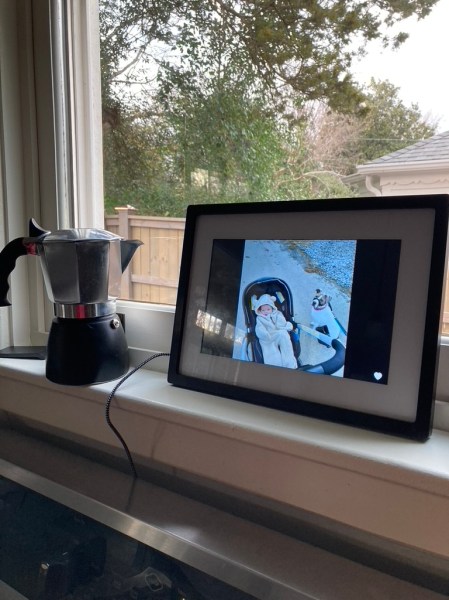
On the outside of the packaging is the brand name Skylight, and wrapped inside is a small digital picture frame.

The instructions say that, once connected to WiFi, the device will allow her to send us bunches of photos quickly and easily.

A new email address for a new member of the family.

Quickly, I plug it in, fire it up, and there she is, my beautiful daughter who lives in the mountains.

On the screen I see that she already has added a test photo. A shot of her walking her dog, Daisy, on the city park trail.

Hugely pregnant, bundled in fleece, she stands with thin rays of winter sunshine filtering through the pine trees, backlighting her thick, chestnut hair.

What streams from the frame is simply joy.

It is in the sun, the grin, the perk of the dog’s ears, and in the cast of light on her upturned face.

This present from her feels like a beacon for me, at a time when everything is distant, obscure, remote.

____________________

Remote.

Over the past three years, the word has been re-purposed – rebranded – to suggest flexibility, access, and even freedom.

But the term as adjective is actually defined as faraway, distant, removed, inaccessible, unreachable, marginal, and even lonesome.

____________________

A few days after the delivery, my daughter emails the very first birth photo, an image of her cradling her new baby boy.

I tap her face.

And, from the blurry background, I use my fingers to enlarge the fluorescent-lit hospital scene.

Nurses and neon green monitors. A jumbled bed, a nightstand with a water bottle, snacks, lip balm.

My son in law in the center.

A newborn, deep in flannel under his mama’s chin. Just a profile of ruddy cheek.

And my daughter.

I zoom in on the glisten of tears behind her glasses.

My heart squeezes tight with so many things.

_____________

I long to hold.

To smell the deep crease in the newborn nape. To grasp my girl’s shaking arm.

To be absorbed into the vivid room that is miles away, but more human and real than where I am.

The ache of being near, but unable to touch.

____________________

Later, I drift through the house through mindless chores.

Up and down the stairs with laundry, swiping the sponge over the counter, sweeping the deck.

Let the dog out, let him back in.

Forgetting what I am here for, in which room, at what task.

Still, the scroll of endless routine is different, charged, electric.

____________________

And I keep rounding back to the kitchen, where the rectangle of light, refracted and streamed across the miles, pulls me like a tide.

His bright little plum head, with crown of silken, russet hair.

Like a portrait on an easel, a masterwork of art that can be cherished but not touched.

But still he is here. His tiny pink arms folded inward, like he’s holding a secret tight to his heart.

He is my waxing moon.

____________________

Early morning, I shuffle to the kitchen and touch the skylight, bringing it to life.

It wakes as I sip my coffee and pause in the transparency of dawn. I push the pause button and study the new close-up.

Shiny black, opaque eyes, he stares out at me like he sees my face. He gives me a pouty scowl.

I examine his features.

______________

Overnight, I missed so much activity – he was busy waking and feeding, fussing and sleeping.

His dad vigilant, his mom full of every color in the printer.

I try to read her face, so pale with wonder and exhaustion.

I smile at Daisy’s square head, protectively resting on the nubbly blanket.

I study the round newborn face, again and again.

_____________________

My daughter’s little gift has illuminated my kitchen counter, my entire house, my heart, to my core.

It lights up my brain in the dark spaces that didn’t exist before COVID.

It fills the holes of distancing and loneliness.

I hold the entire gallery in my mind as memory, played on a loop, to keep, to savor, to absorb, like rays of sun on skin.

I am an archivist, a lover, a grandmother.

Read more

bones

November and the month where nature is laid bare. The trees cast off garments of dry leaves and the earth’s bones are showing.

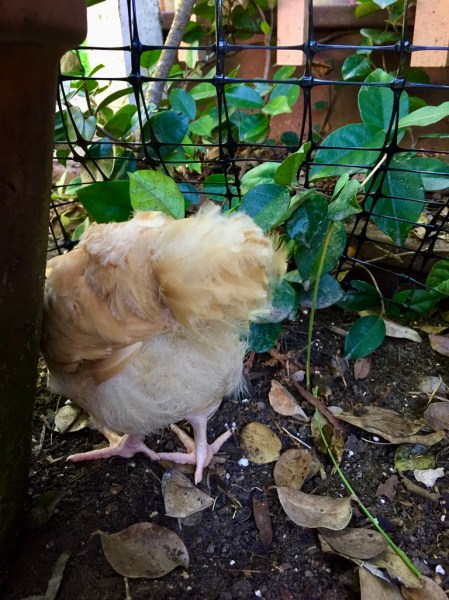
My chickens are into their hard molts, meaning that their feathers are coming off in huge tufts. Clumps of fluffy undergrowth blow up against the back door. Beneath their night-time perch lies thick piles of long pinfeathers in dusty, dejected piles.

Asleep in the darkness, they must fall from their shoulders and waft gently to the ground like snow.

All except for Juliette, who managed to change her wardrobe out last month – she alone is plump and shiny and ready to rumble. And she does – she’s the queen now. She moves among the flock with a regal air. Beauty is power and chickens know it.

To see a chicken molting at first you think it is in a final stage of death.

There is a ragged, beaten-up look to them – chickens lose at least half of their plumage, and what remains hangs by bits from their meat, looking ashy and grey.

Their listless combs are pale pink and they droop to one side with scant blood supply to pump them up.

They are pitiful, unable to assert themselves, off their game.

Vulnerability is death, of course.

And it is most startling to observe their faces (if they let you), especially around the eyes. The plucked white skin around them makes them appear elderly.

You swear they are not long for this life.

Reading about this situation, I learn that the feathers are actually bones, and that it is mighty painful when they are shed. And even more so when they are regrowing, which takes very little time considering.

I used to dread the molt – the few times a year when the girls look so unhealthy, and when they get picked on and the pink, tender skin gets brutally exposed down to their undercarriage.

Each chicken, on its own miserable cycle, would skulk around the edges of the feeder, hide in bushes, make do with the dregs – the picked over grains, the freshest sips of water.

But as with old age, you take a breath and look closer.

What first looks like frailty is just the glimpse of the architecture. A rare look at the pins that gird the bird. It’s the sturdy wire that makes the whole thing hold together. Even fly.

And so I look at November this way – with the stripping down of the birch bark, and the plucking and blowing of cones and spores. As a glimpse of the grit, the nut, the essence.

Nature always makes way for new growth – ready or not – but only with a ripping away of the summer’s wet green.

This only hurts like the old torn-off band-aid, I have to see it like that.

Death is here, always, in the seasons.

In our family, in my body.

When my dad dies, the pain will cross the seasons, the sting will never go away.

But when I talk to him every week on Face Time I can telescope his eyes.

And there is the same kind of tenaciousness I see in my hens. But with a humor and mental cleverness and a twinkle that is all Dad.

And I witness a brutal honesty that is strong, even supple, which, of course, has always been there to see.

But now it’s almost an expression that says, here we are, old body, it’s just a season like the others.

His clear blue eyes are remarkably the same, it’s just the feathering that is changing.

But whatever I observe, I know that it is best to take the time to look. To note the eyes, both my father’s and my flock’s.

So today in my yard, I assess the dry, flaking (repellent) poultry faces.

Catching them when they are low is a rare window. The hens are easier to grab, and to hold, and so I pretend that they need me more.

I stroke their breastbones full of the pebbly grain, and they startle and tremble, but remain composed in my warm clutches.

Believe it or not, I see them as proud creatures. And I treat them that way.

I think I am the one that sees sadness where there is actually hope.

2 marathons

Almost before I wake, there are tears in the corners of my eyes. It’s like the emotions from dreams, or even empty sleep, are squeezing my body’s container and must find the release valve. Like my air mattress here in the NYC guest room.

Deflate me, God. It’s a lot.

I’ve sometimes wondered how any person can go though a regular day without hot tears behind the lids ready to spill. For me, it’s always an easy access route – my cheeks are near perpetual puffery.

I just want to live the day to the full.

____________

There are two times in a woman’s life where she must go it alone – rely completely on herself, her own body, with singular pain and endurance, to achieve the goal. Both journeys are mental, physical, and emotional – and are basically solo.

Two marathons.

Birth and death, you can shuffle them up and place them on the table in any configuration.

My daughter is in the final stretch of hers – in the 38th week of pregnancy. If she asks about specifics, I want to be articulate when I attempt to describe the experience of giving birth, but I can’t. I don’t remember that much.

And it doesn’t matter anyway – it was a solitary pain, custom-fit to my own body. But what we will share is the birth narrative, and her experience will be the notes of her own book.

An account about a rugged trail that is never short (not really), is never a breeze and is almost always a gruel.

But then there is the finish line, thank God.

_______________

Last weekend I went up to NYC to watch my son run the NYC Marathon.

It was a vivid swirl of colorful bodies – wheelchairs, workers, police motorcycles – so many blew past me that I couldn’t identify the faces. 50,000 runners flew, ran, jogged, walked, stumbled and collapsed along the 5 boroughs of that city.

And even though it was a crazy mass of humanity – packed tight, jostling and elbowing – each runner was still alone. Even though they were cheered on by the deafening multitudes of family, coaches and strangers, each one had only an individual body to see them through to the finish line.

For me the marathon is the clearest metaphor I can find today for life – from birth to death – the practice, the struggl, the pain, the transcending of all of the body’s physical, mental, and emotional limits.

That’s why we’re drawn to it. We watch even if we’ve never run around the block.

It is a display of bare-faced human grit and steel will to keep going, to keep living.

When things are so hard, when days make no sense. When negativity fights to block our airways. When we feel no strength in the legs, when we can’t see any road markers or even get a sense of what we’re running towards.

When we doubt we’ll ever want to run a race again. Or run at all.

And always there is the question, squinting toward the blurry finish – why?

________________

Last night, back home in my own bed, I wake to the weird conclusion that I am all alone.

And that both of my kids are alone too, even as they live their full, active lives with partners.

But in the best way, we each sit in the stands and we cheer for this growing, changing family to keep on going.

I take deep breaths in the quiet kitchen, I cry into the bath towel.

No words, just a fullness in my chest that I honestly believe can rise and coalesce and take flight – and travel like a runners legs sprinting across a dirty city street, or like the tremor of a muscle contraction that builds and lengthens and brings a child.

________________

My enormous emotions swing and catch and blow across the autumn yard, into the sky.

I see the Cooper’s hawk circling above the near naked oak tree.

And I think about the backyard honeybees.

They are packed in the hive, one atop another, and their tiny lace wings rise and fall in a quiet cadence as they brush against one another.

All winter, they will converse and socialize, and develop, even in that tiny home.

And they wait.

And come spring, the delicate new wings will power them for miles and miles to do what they must.

The raptor and the insect, so different, but alike in a way, too.

Each will traverse on the jet stream of nature’s migration, alone, but also part of a huge dance, one that’s too complex and mysterious for me to fathom – but one that sweeps me up nonetheless.

________________________

I buried the rat

I buried the rat today.

The one that lay belly-up in the yard next to the chicken feeder. I knew it had been skulking around the coop at night. I’d noticed the hole it had carved out with its cunning paws, and I wanted it gone.

And now it is.

But it still gave me a start when I found it. Seeing the bloated belly, covered with the soft fawn colored fur, I felt sad and a little ashamed.

His tiny fists were raised as if to curse me. His yellowed, bucktooth mouth, having tasted the poison, was a rictus of agony.

I grabbed the shovel and moved the body next to the driveway. My husband would bury it later, in the place we lay the dead critters beneath the evergreen tree in the front yard.

This is our marriage: tacit agreements to share the grim tasks. Often in silence. Always with questions.

My job is to transport the corpse closer to the burial site. His job is to dig the hole and do all the rest. I stand by as witness.

I don’t know why we do this, but I’m sure I’ve worked out the better ends of most of our marriage deals. Especially the unsavory ones that involve stink and dirt and bodily mess and even death.

But a few days later I discovered the little carcass was still there – it had dried up and shrunk, flattened down and thin, like a smelly fruit leather.

No kind of resting place.

So I marched inside and interrupted hubby’s Zoom meeting with the slash-across-the-neck gesture and an aggrieved look. He got off the computer pretty quick.

Anyway, I have always been an orderly person, obsessively tidy, sorting and sifting through my surroundings. I seek balance, but I also can’t really thrive without some controlled chaos.

These days, I chase after a clean perfection, an impossible control of my space. I boss everything within earshot, mostly outside in the disobedient yard full of wild and semi-wild critters.

And because my brain’s neurotransmitters are semi-wild too, I work hard, really hard, to adjust myself to the world around me.

The past 2 years have been an experiment in letting the backyard go to seed and allowing the chickens and the bees to free range.

And me?

In the end, I can’t say I’ve really made my peace with the wildness. Some of it is just gross.

The chicken lice, the bulbous egg that gets stuck in the hen’s butt vent, the nasty poop trekking into the house. And the mind numbing repetition – the lock-step sameness of it all.

The prison like routines.

Morning: let the dog out, the chickens out, feed, water, watch for pests and disease. Try remedies for disease and pests. Afternoon: feed, water, watch for trouble. Stimulate the bird brains with treats. Stay on high alert to keep birds cool so we don’t have “broilers”. Evening: lock up biddies, run predator search, confiscate dangerous contraband, eliminate escape routes. Plug in fan for bedtime cooling.

Worry.

And the bee colonies. Feed, treat for parasites, provide fresh water. What to do about hive infestations in the hot tub? What about the swarm?

Often there seems to be more imbalance in this co-existence, and mostly on my end, I’m sure.

And it’s been a challenge to keep this blog going during the COVID time. I guess some people’s art thrives in tough situations, but my writing has not.

Maybe I strive too much for symmetry and beauty. Hosing down the coop and trying to find the inspiration. But I ruminate too much, despair often.

Still I have to say that things are off. I notice the sick little clues. Things aren’t right on the planet.

The stifling heat and strange migration of the songbirds. The manic cicada at my screen door last night, buzzing in drunken spirals at my feet. Just one, blind and lost.

Sometimes I think my bipolarity mirrors the environment – patterns of mood and migration, but random acts and intensity too.

And I feel a kind of vertigo: My view is magnified, but also seen in panorama. A crisis of ecology and my own uneasy conscience.

And I think in annoyingly binary ways; that what I write is okay or chicken poop.

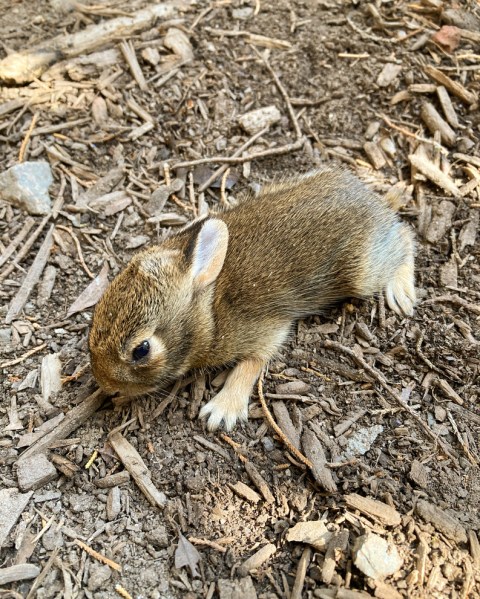
As I grab the old splintery shovel with a death grip and drag it to my tasks. And I caress a newborn rabbit’s tiny ears, the mother torn open and abandoned by the neighbor’s cat.

Day by day, I count off nature’s struggles with my own. And I experience her joy.

Writing has the ability to feel like empowerment and impotence, even in the same paragraph.

Still I know that this is my task – to notice things, to reflect. To sometimes do nothing but stare into the hole while someone else covers up what I don’t want to look at.

To be alert to the flash of cerulean feathers at the nest box.

To hold the question of why an ancient beetle lies in wait to crawl out of the soil only once every 15 years.

To know that most questions never get answers.

Still I try.

To understand these things in the dirt, things dug up and things buried – the necessary, the injured, the bountiful and the simply unlucky. The rich mineral, the insect, the rodent, the perfect pale green egg, the sweet lavender honey, all of the living and all of the dead.

I buried the rat this morning.

Well I discovered it, really.

Dead.

I could only glance at the soft brown bloated belly and yellowed teeth

a rictus of agony,

tiny fisted paws raised to curse me.

The wooden handle of the rusty shovel left a splinter in my hand

as I tipped the metal blade underneath the bush,

letting the small body slip into the shade.

it was heavy but the rat was not.

And then I imagined the dark hole that you would dig later tonight

I wouldn’t look down, but

I would sift the loose soil across the mound with the flat of my hand

and slide it towards yours,

careful not to let the dirt touch the stinging sliver in my palm.

for William Carlos Williams


snow globe

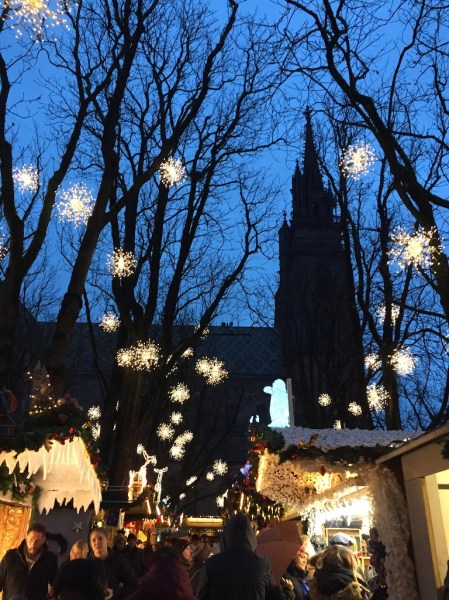
A sugary sweet fragrance cuts through the crisp air – not beer, not wine – but a seasonal swill of glugwein, which seems the perfect word for this drink, German or not.

Like many of the faces in the crowd, the grog has a rosy shine in the mug and reflects the merriment of the Christmas season.

My son has wandered up ahead of me, across the ancient cobblestones, and waits in line to get a cup. My husband is eyeing the bratwurst on sticks.

For me, I simply stand and look up at the stringed lights, blurring and spinning. Far out beyond this small circle of my vision is a cold, German nightscape and we are many miles from home.

The steaming cup my son brings to me is a real ceramic one that we are allowed to re-fill and return throughout the boozy night.

A small detail – but somehow it signifies a larger sentiment from a bygone time when folks offered wassail on the honor system.

As ex-pats we have entered a wonderland of good cheer, almost like time travelers posed under a self-contained dome, something like a snow globe.

My brain shakes the snow globe and the snow flurries and falls, and finally settles.

It is 1973 and I am 10 years old, living in West Virginia, and it is Christmas Eve.

My grandparents from upstate New York have come for their yearly visit and they are sleeping in my brother’s twin beds down the hall.

Which means he is camped out with me in my double bed. But I don’t mind.

We stay up late and listen to the little transistor radio he has smuggled under the covers. We tune the dial to pick up The Guardsman’s Snoopy vs. The Red Baron, a song we just can’t get enough of, and we laugh and sing along to Alvin and the Chipmunks singing carols in their funny, high squeaks.

And even though we are beyond the age of believing in Santa, there is a magical quality to the night. For me, it is mostly that I am with my brother. He is a teenager now, and I don’t often get to be close to him.

He has strung big-bulbed Christmas lights all over my bedposts for me – he was always like that – coming up with the good ideas and thoughtfully letting me in on them.

In this scene he is young and alive and full of wild dreams. And there is no place for motorcycle accidents or chronic pain, or addictions or jail time, it’s just me and him in our pajamas.

I shake the snow globe again.

I see my mom in her plaid wool maxi-dress, worn with a creamy, ivory blouse, and an apron over the whole ensemble. She manages the kitchen, the elaborate Christmas Eve meal. She’s a perfectionist, a stickler for the details and I stay out of her way.

Anyway, I’m sixteen and kind of tired of the whole routine, but not ready to give it up just yet. Still I itch to escape the rectory and to ditch the Midnight Mass.

My boyfriend comes over and we finish off my parents’ wine. We make it to the communion rail a bit tipsy, just in time to add the Blood of Christ to top things off.

Looking back, I see how my mom and I were always so different and truthfully, it will be many years until we grow close.

I shake the snow globe again.

I am in bed with my husband, trying to sleep on my side and not on my back. My belly is huge and the baby rests quietly in a cradle of ribs and muscle and fluid. In two weeks she will be born.

And I am not afraid, because I am 27 years old, and in the way of that age, I am confident. I believe that my body is a safe haven for my child and that the short distance from that nest out into my arms – and then out to the wider world – is something I can do pretty easily.

I will welcome my daughter into a safe, loving home. A peaceful place.

And now my two babies are adults and I have failed in a basic promise. I’ve tried to protect them, but what world have they inherited?

I shake the snow globe.

It is a balmy North Carolina afternoon and our family of four is walking the perimeter of a pond. The water is brown and murky and has logs and debris (even a deer carcass) sticking up from the depths. But the walk is pretty – the pines are sweet scented and there are geese flocked to one side.

The kids are in college and it’s been a struggle to assemble everyone. We are picking our Christmas tree, a tradition I love, but this year feels different. My Mom is gone, after a long-term diagnosis of cancer.

My kids are amazing but if I’m honest, I’m not sure who they actually are. I can’t stay up with their digital world; I can’t even keep track of their conversation.

And I worry about what memories they will have of me when I’m gone.

I shake the globe again.

Christmas Day and my husband and my son and I are sitting on lawn chairs in the backyard. It is an unseasonable 70 degrees outside. There are no decorations, no tree, no crowded table with coffeecake and stollen. No stockings. No cheeseball with Wheat Thins and no craft beer.

I want to re-shake the globe.

I want to transport back to that original scene in Germany

But no, here we are. There are no bustling crowds, no toasting with glugwein, no hugs even – never mind kisses beneath the mistletoe.

It is a pandemic and the reality of illness doesn’t fit into a snowy, nostalgic scene. The globe is supposed to hold us all close, protect us in an idyllic place and time. To reflect a joy, a poignance, a promise of what is possible.

But we all know that outside this globe is a place of poverty and war, violence and famine. And we know that even the bubble of atmosphere itself is overheated and volatile. There is no pure, crystalline stage left on which to play out our memories.

And so I grasp the globe and wonder what will be this year.

The world has slowed; we’ve been shaken and sobered.

During these past months I have spent time with my son; he’s taught me how to make kombucha and sourdough bread. He’s built me a chicken coop and taught me to tend honeybee hives.

I can’t remember having this much focused time with him.

He and I have had hours to watch episodes of Succession and Premier League soccer, and to eat take -out dinners on the front porch swing. I’ve watched him patiently and methodically build a bed out of local cherry wood.

And I’ve been able to see him up close, clear eyed, with no filter.

His jaunty stride as he unexpectedly runs past me on the Duke trail, where he calls out nice pace! with his shameless flattery.

His face lit up when he writes his stories on his laptop, late at night in the kitchen. Glowing partly from the digital screen, but partly from his own energy and Lewisness.

Later I watch him pack his stuff and head to New York City, carefully wrapping baby succulents, sourdough starter and a full kombucha jug, by hand, in blankets, for the long drive. My heart melts.

Tonight I picture him in Manhattan, bundled up in a down coat, walking on the streets with no gloves. Underneath the skyscrapers that reach to the black sky – no stars, just dirty city air. No sparkling dome, but maybe a dusting of snow.

Next week he’s back for the holidays.

And today, I turn the globe upside down, yet again, and shake it. And I watch the flakes of white settle gently over the magnolia trees and Carolina pines in my imagined scene.

And I listen as the tiny music box plays a tinkly version of Silent Night.

And I wonder.

beady little eyes

The interesting thing about chickens is that they are not really wild but not really pets.

They exist in some rare middle place.

They need me to keep them safe at night. If not for me, they’d be hawk food in a heartbeat, or run over by a car, or eaten by the neighbor’s cat. And they definitely rely on me to feed them and keep them free of pests and disease.

But I don’t feel the pull of emotion like I do with my dog, Huckleberry. If a predator decided to take Babs to the great rapture in the sky, I wouldn’t be devastated. Sure, she was an adorable fluffy yellow chick that chirped when I came into the bedroom, but I don’t know.

Chickens are incredibly smart though, and their instincts are fine-tuned. I’ve read that they can recognize up to 100 faces. I mean, I don’t think I can even do that.

My chickens know when it is Wednesday night – Banh’s Vietnamese take-out night, when they will get the leftovers. I mean, they pace and peck at the back door in the late afternoon, even after I’ve told them that Mac is calling the order in.

And I recognize that my girls notice me specifically in the yard – they know that I am the one who fretted over the air temperature when they were in the brooder. And that I was one who took them on field trips when they were toddlers. And I fed them grits (cooked with butter) and oatmeal, and basically spoiled them to no end.

But still, if a hawk took one away, I’d have to chalk it all up to life in the food chain, which is just a fact of being a semi-wild critter.

Why do I bring all this up?

Because I think it’s interesting that we rate animals in such a way. Clever or stupid? Wild or tame?

I believe they are all basically intelligent – way beyond our comprehension, and we humans have set it up so that we can feel okay about killing them. The one that astounds me though is the pig – we know that it is one of the more intelligent species – yet still we want bacon?

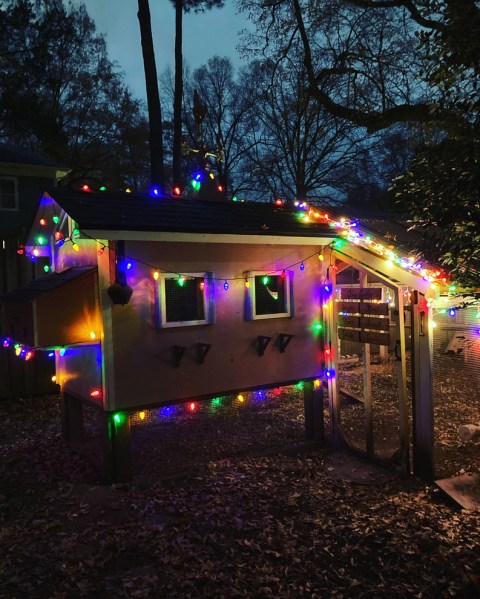
We just think these “dumb birds” are here for our taking, and I guess they are. But I’ll have you know that last weekend my husband and I set up Christmas lights on the girls’coop.

You heard me correctly.

I know.

But did they like it?

Who knows?

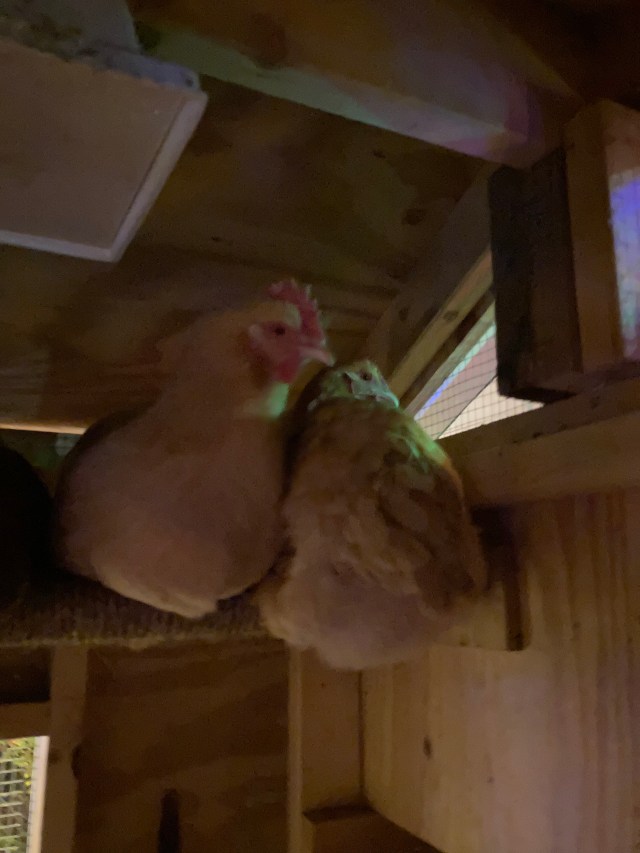
But, for me, I choose to believe that their beady little eyes had a dreamy glow in them, as they nodded off to sleep in the glow of the twinkling lights.

I think they were dreaming of mealworms and grubs and tender sprouts of next summer’s grasses, and maybe their pea brains think of me, their benevolent provider.

It’s the season of giving, and these chickens have gifted me a lot – hours of entertainment and diversion, not to mention the eggs.

And those eggs are truly miraculous to me, the expression of a not wild, not domesticated critter. And this year they have truly been a gift, a marvel, an astonishment, when so many other things couldn’t be counted on at all.

… while visions of sugarplums danced their heads.

hawk

Kicking through the fallen leaves in the dusty winter yard, I come across tiny chicken scratches in the uncovered patches of dirt here and there.

They look like they were made by a child’s tiny sandbox tool. The lines are perfectly symmetrical and speak of a methodical communication between chicken and earth. Even a syncronicity between birds.

I think about these innocent marks and they remind me of words, chicken words, but also human speech – the way we chat with one another. Pecking and nattering about trivial, everyday things. Gossip, or running commentary. And sometimes we insult, with small barbs or micro-rudenesses.

It is the language of the chicken yard.


Last week, I was in the house, reading in my armchair and suddenly a sound of rushing air followed by a thump caused me to look up at the window. A large expanse of brown and white feathers swooped past.

Of course, I ran outside to check my biddies. But weirdly, everyone seemed fine, even calm.

Yet as I picked up my yellow Buff Orpington (named Ginger), I gently turned her over and my hands tenderly parted the soft golden breast feathers. And there they were – deep puncture wounds where the predator had tried to lift her from the ground. So deep as to not draw a bloody mess, but they were bored into the area near her vital organs.

They were wounds that went deep, the ones that may heal but will leave a scar.

And a memory.

Again, like human communication, it seems to me that the cruel, thoughtless lashing out that we do is like an animal response.

I’ve often believed that when we say hurtful things, they end up hurting us more than the recipient. Like the jagged edge of chickenwire, they pierce our breast long afterwards. I can remember things I said, mean things from many years ago, that sometimes pop into my head. And I wish to God I’d kept my mouth shut.

And it makes me sad that someone is carrying around wounds that I inflected, and that they hide them in order to get by, move on.

And isn’t it also true that the healing, loving comments we make actually do more for us than anyone? They are like soft, protective feathers around our heart, we go to them when we feel down.

And this is where I am today, as I look up at the sky and watch for that Cooper’s hawk that circles lazily in the afternoons. The raptor is an eerie, vulnerable evocation of brute power.

A reminder of my own agency and responsibility. Of the choice I have to hurt or heal.

This fragile earth, even the deep loamy core of it, relies on careful participation

This fragile earth, even the deep, loamy core of it, relies on a call and response of careful participation. And if I can create a connection, that’s what I want to do.

And I want to be like my chickens – as they chirp and groom one another, and as they snuggle, crowded tight together on the dark roost of the coop as these winter nights grow cold.

I know that without one another’s plump bodies, the snuggle, the warmth, they don’t even have a chance.

molt

I drag my rake across the dirt, scratching the dusty brown yard. Tiny acorns crunch under my shoe, they grind to an ochre dust. I spy little chicken footprints cross-hatched in the gold.

Everything is worn down to sediment – Summer’s remains. All green freshness is gone.

The hens are losing their feathers, experiencing what is called a molt. They shake off little nests of soft, creamy feathers by the kitchen door, wistful gifts that float on the breeze and gather beneath the shrubs.

Their bodies are lean and bleached looking, their combs are a faded pink, their tail feathers are stubs.They seem a little embarrassed by this turn of events, like they’ve been caught out in their underwear.

This is the season of cold, exposed skin, wrinkles and vulnerability. When we lay Summer’s hopes on the burn pile and let gravity and the cold air leaven our spirits.

This is the season of cold skin, wrinkles and vulnerability.

A chickens’ molt serves a purpose – to slough off the old feathers filled with dirt and mites, and to have a fresh, attractive set. Natures’s way of regenerating.


It seems to me that some of my hardest periods in life have been like molts, of sorts.

Adolescence, pregnancy, menopause – major upheavals of hormones and bodily changes where I did not feel like myself at all. Transitions – times of anxiety, insecurity. Dramatic plumage fails.

Uncertainty about what will be.

When I reflect on these cycles within me and within this microcosm of my backyard, it doesn’t take much to recognize that what is fresh and young will give way. Hair loses pigment, dermis loses elasticity, sebum oils dry up.

But, like my hens, there is that new growth prickling beneath the tender skin.


During the pandemic, the Baptist church across the street drew a large labyrinth in their parking lot – a spray-painted circular path for passersby-by to meander.

The other day I saw a child meticulously navigate the spiral, one tiny shoeprint at a time. And when he reached the center, he yelled out to his dad “Now what?”

Yes indeed, now what?

The life cycle spirals of our days that become months that become years – it is a scroll of a story. We think we know the beginning and the end, but it is a question.

Worm casts, chicken droppings, loam and skin – they form a crust of fertile cake out of nothing at all. Just when we think something is at the marrow, it lays down another skin of hope.

We backtrack through the labyrinth.

And here, in the midst of a chicken molt, there is an itching, uncomfortable yearning for a cluck of reassurance.

Where are we going?

And as I rake, the hens cackle and complain, and I get it. I’m not one hundred percent sure either.

I just hope that the waiting and uncertainty won’t be for nothing and that this season’s glossy, new plumage will arrive soon.

Oh, and some eggs would be great too, always the eggs.