Hope is the thing with feathers – That perches in the soul – And sings the tune without the words – And never stops – at all –
And sweetest – in the Gale – is heard – And sore must be the storm – That could abash the little Bird That kept so many warm –
I’ve heard it in the chillest land – And on the strangest Sea – Yet – never – in Extremity, It asked a crumb – of me.
Hope. The thing with feathers.
The brilliant poet Emily Dickinson wrote this. And it is a poem that most people know, but one that could be dismissed as quaint, or naive.
This morning, a day after the election, I think these words are meant for me.
A simple metaphor, yet perfect.
As the urban chicken farmer, I can see this thing that Dickinson describes. A small bird, that flits and flies – is here and gone, within a moment.
Flighty, inconsistent, mostly wild, hidden.
Yes, it is so easy to let cynicism and rationality overtake the mood. But I think it the braver thing, the harder thing, to consider the birds, the feathers.
To let this moment rise.
The bird may never be the strongest animal but it is here and now, for this day. And as the poet says: it asks not a crumb of me.
Because really, what does it cost me to put aside my tired cynicism?
We are all trying to believe in a new promise for our country. And today, as I walk the stone path through my backyard, back to the chicken coop, I know that this hope is a light, gossamer thing.
If you know birds, you know the nature of fragility and outcome. Faith, and lots of scattered feed, and then a prayer and a letting go.
And so, today I choose to let my heart lift with the birds – yes, they are inconsistent and flighty – but what’s the point otherwise?
It seems to me that negative thinking and critical analysis only clips the wings of a creature that wants to ride the thermal winds to see a distant ocean.
To be free.
Oh, to see that world from where I perch!
And to imagine another distant shore, another place to lay my head and fold my wings.
Sitting on the front porch swing, sipping a glass of white wine as the sky darkens. A crispness to the air on this early November evening.
Across the street at the Methodist church, a lone figure is setting out paper bag luminaries along the sidewalk, preparing for some kind of ceremony.
A wedding? A funeral?
The ritual and the wine warm me. And as the man moves down the neighborhood block, it strikes me that we are all setting out our little lanterns these days – we light a spark in the direction of some sort of hope, to keep up our positive energy, to keep going.
And we watch and wait.
From our darkened porches and near-empty houses, we wait.
The row of white paper bags line up crisply, in a direction not always mapped out. Whether it is an ending or a beginning, it’s often uncertain, not always so clear.
My son turned 29 yesterday, on Halloween. At our small gathering, I was a tiny bit misty, and wandered around in the backyard, carrying the photo album, sidling up to people to point out the pictures of his birth.
I know, I’m that mom.
Anyway – no one was nearly as interested as I’d hoped – but for me it was all in the details. Those tiny remembrances that, if left unacknowledged, would go missing.
Like the fact that he was a scary shade of blue when he came into the world. Or that he had a golden halo of fuzz around his soft, perfectly-shaped head. Or the way he felt so light, but also solid. And how he radiated confidence from the very beginning.
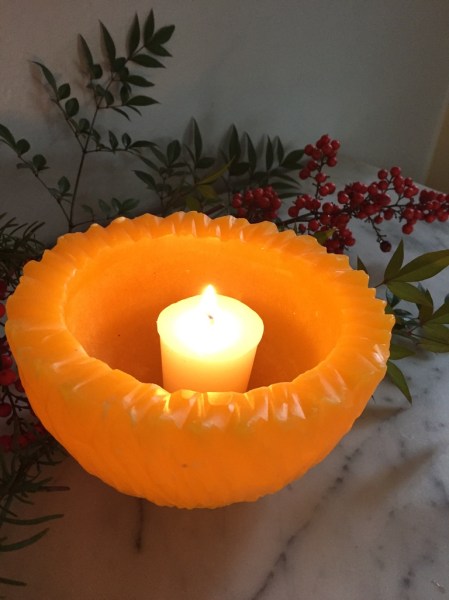
The memories are mine to kindle. My little candle in the paper bag.
The memories are mine to kindle. My little candle in the paper bag.
And tonight I set them out there on my little patch of front yard, to say, this is the light, this is the goodness in the world.
And so, block by block, along the cracked sidewalk, I imagine striking another match to a candle in the neighborhood procession – the birth memory, a poem, a love letter, a kiss – just a small yes, in reply to the darkness that is so hard to see beyond.
Four of them swooped beneath the trees in the backyard, looking for worms.
Their cerulean blue wings were otherworldly and a startling contrast to the browns and oranges of the leaves in the rest of the yard. I like to think they were our own baby hatchlings from last summer, come to check in.
But they were gone in a moment, off to fairer fields.
My son also came by to visit in the backyard too, and like the bluebirds, it was a brief, but sweet, sighting.
And now, I cling to the tiny details: his newly long hair, his crinkly smile. In bed tonight my husband and I will dissect every morsel, like birdseed in our craws – did he say what he’s writing right now? Did he mention travel? Did he tell us when he’d be back?
Little crumbs, oh how we live off of them.
And I guess it will have to be enough, for now.
the small things become big things. I savor every contact.
I want to believe that I am appreciating life even more these days – the small things become big things. I savor every contact.
If this pandemic has taught me one thing it is this: I cannot control the larger forces that dictate the health of the world, but I can take things as they come.
We’re only here for a little while, and our mouthfuls have always been basically parting tastes of the gifts we will leave behind.
And for my chickens too. It occurs to me that they already know the truth of the crumbs – they hunt and peck for each tiny grain one morsel at a time. They realize that they can handle only one bite, not the whole yard.
These crisp fall mornings bring a sharp clarity to memory.
My daughter is about 4, and she is playing in the backyard of our old house. The trees are mostly bare, the leaves gone brown. They lie in damp mounds around the yard and we scuff our feet through them.
She is in love with the pecan tree, or rather, the fruit that falls from it. The nuts lie huddled in nests in the grass, partially hidden around the fence line. They have striped shells, like tiny rodents, oval and hard.
Her little baby teeth can crack the shells, and so she does. Bits of pecan splinter away from the innards. She can never wait for me to crack a nut properly, her small pink tongue probes the meat before I can grab it away.
Her cheeks are pink, her skin a perfect cream, they are a palette they will never be again.
Her cheeks are pink, her skin a perfect cream, they are a palette they will never be again.
Her eyes so bright, her face clear of any emotion, except maybe a simple, lazy contentment.
I imagine that my child is a bit like the pecan itself, a soft, symmetrical outer shell with dark, yet tender insides. Curious, complex, at times tricky to access, but oh, so worth the effort.
But my daughter’s carapace was not fully hardened and tough back then, time alone would take care of that.
Anyway, I now see that we took those trees for granted. We thought just about every family had pecans like ours. That every yard was home to them.
In our new yard there are lovely trees, a poplar, several pin oaks and even an ancient mulberry that might offer up fruit for jam, if I weren’t so lazy.
But no pecan tree.
And this time of year, I think of my daughter and remember her love of nature – bugs, kittens, butterflies. And her relationship with the special tree that surrendered its seasonal gifts to her.
And, as I am thankful for the memory of that old nut tree, I am filled with gratitude for that long ago child.
I have plumped these girls up with special feed with added nutrients. Lots of good grains and herbs and mealworms and healthy fruit and veggie snacks.
They have basked in the vitamin D rich sunshine in the afternoons. I’ve even added scented lavender to their dust bath.
But these freeloaders haven’t given up a single egg. They need to pay the rent.
To me, the idea of an egg is a promise of a delectable inner richness, a fertile little bundle of creative ingenuity.
Something complete within itself. Something unique, self-contained, even elegant.
But, in reality, an egg is simply a vulnerable, fragile, inexpensive and throwaway thing, to most people.
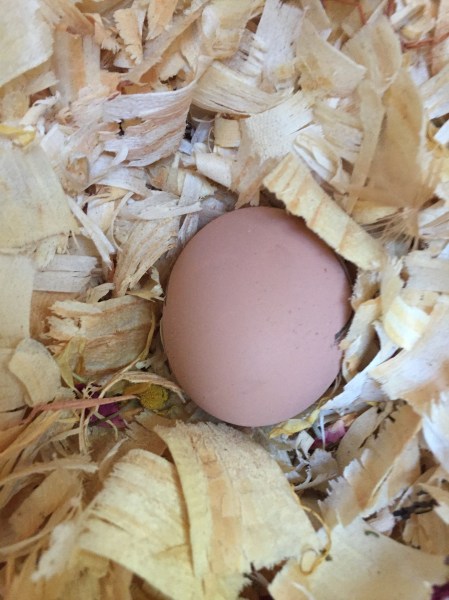
In my research on chickens, I learned recently that when an egg is being laid, as it exits the hen, it is briefly coated in an invisible substance called bloom. The bloom seals the egg’s pores to protect the thin shell from bacteria and germs.
I like this idea, this way that nature contrives to send its most precious commodity out into the world with a built in safety seal.
The ordinary egg, but crafted with an almost magical elixir.
During this pandemic, I’d sure like to have some of that stuff – a little reassurance of protection. But a mask will have to do.
Our bodies are vulnerable to disease. Even so, I think of how perfect they still are. And how most of the time we are able to fend off as much as we do.
Sort of like a chicken egg, we have these permeable pores and scratches and even open cuts, where life reaches in. And nothing is certain. To live in these bodies we have to recognize our weaknesses yet stay confident in our strengths.
And so I try to come to terms with these feelings of ambiguous loss during this pandemic situation, knowing that there is no clear resolution to the problem.
Like the fact that I haven’t seen my daughter in 9 months.
the pores and cracks are also where the light comes in
Experts say I should grieve the losses of everyday life: being with family, friends, getting out into the world, hugging, touching.
And I have read that I should embrace the “both-and” way of thinking: that is, the situation is terrible, but it is also doable. Or, this situation is crazy, but I am not.
I should maybe lower my expectations a bit, and adjust to things being graded with a C – just okay, but good enough. Band-aids.
And maybe not be completely satisfied right now, but know that there are still simple joys that can fulfill, even heal me.
For me that is writing this blog. It is not great literature and I often don’t have anything at all to write about, but that’s okay.
I mean, chickens?
But still, it’s the writing part that brings me back to center.
To where I can feel more myself, and even a bit stronger.
Life is not perfect, my skin is sensitive, I get sick, I like to complain. But the pores and the cracks are also where the light comes in, as they say – where I am allowed the rare glimpses of wholeness, tenacity, even grit.
Anyway, I’ve had a long day today and my “surge” capacity is dimming – I’m sure you feel the same.
But I’m gonna keep on trying to write, trying to release some dopamine, and to attempt to feel like a competent human.
And to stay safe, not perfectly intact, but healthy. Healthy in the way of “both-and” – both grieving and coping patiently, in the same breath, and maybe even managing to be hopeful, every now and then.
In the morning, even before my cup of coffee, I palm the three tiny white pills and toss them back with a gulp of orange juice.
They’re like my chickens’ daily scratch feed – chock full of essential ingredients, but more than anything, for me, they are a dollop of hope. My antidepressants.
In a way, I see them as a power boost, it’s not that I’m sick, I am the furthest thing from it – I am healthy.
Yet my days without these micro-ingredients are unmanageable.
As the years have gone by, I have grown into the basic awareness that having a mental illness is not a weakness, it is a strength.
Of sorts, because it is not something a lot of people can see, or understand.
For me, it is who I am, wild, creative, emotional, sensitive – in touch, more of the real me.
And I know that my body is whole, even the days I feel messed up and broken.
Lately there is a lot of talk in the media about “fighting” COVID19 and being “strong” in the face of this illness.
This is wrong-headed thinking.
The metaphor of disease as an enemy or a weakness that can be conquered by positivity is magical thinking.
I do not believe that we have that kind of power. There is no mind over matter.
Having an illness is actually a part of being whole.
This is what I think.
We’re only here for a little while, and not because of anything we have done, necessarily, but because we are loved.
I feel the need to say this because it is sad that there are so many people fighting all kinds of illness out there, and they are being told to just have a positive attitude, rise up, fight the battle.
As if our bodies were battlegrounds.
As if things weren’t hard enough.
I know about those days where just getting up with the black heaviness pressing down on my body, is my own personal success.
And often even our best efforts will disappoint.
But it’s not because we haven’t tried hard enough, or been more positive, or we haven’t fought the good fight.
Some of us will get COVID19 and for no apparent reason, will die. While others, less healthy, will survive.
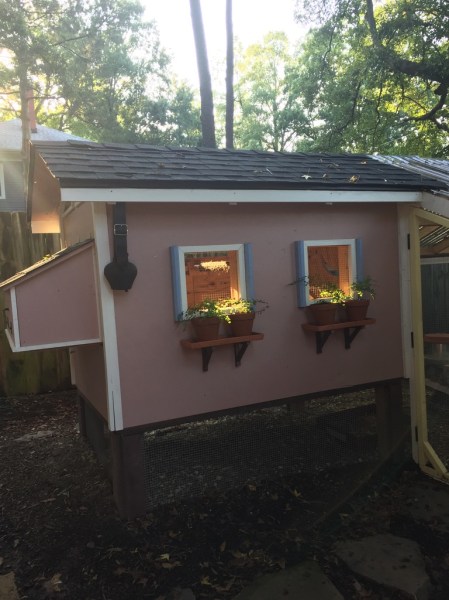
So anyway, with these sobering thoughts and coffee mug in hand, I walk out to spend time with the gals.
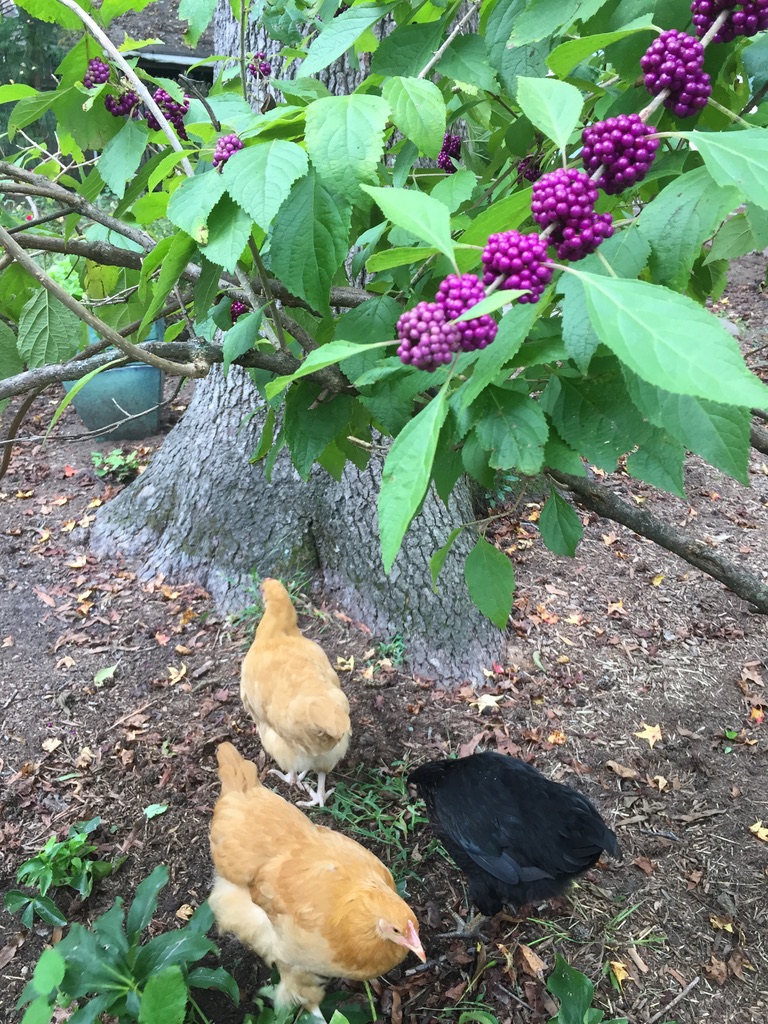
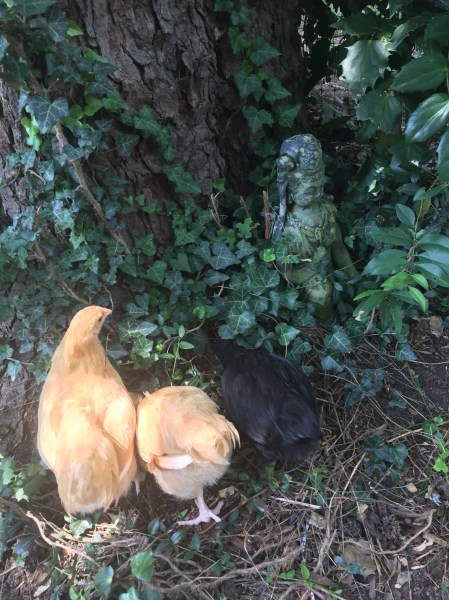
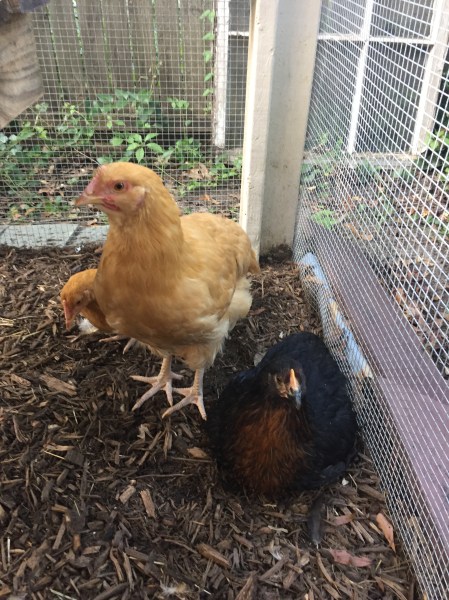
There is a light rain falling, and I see my three fluffy girls huddled underneath the coop. They manage to stand and stretch their scaly legs and bustle over to the feeder.
It will be a cloistered day for them, no free ranging in the yard.
I can’t say why exactly, but these silly birds distract me in the most meditative kind of way. Watching them, I feel close to these creatures who are not human-like at all, but are rather a link to a shared, ancient past.
And now, as domesticated critters, they depend on me for everything. And, like them, I too am a dependent creature: my warm home, my sustenance, yes, my drugs. These things I need. These things keep me here on this spinning planet, to greet another morning.
Another kaffeklatsch with my girls, time to cluck and play and to remember that we’re only here for a little while, and not because of how hard we have fought, or anything we have done, necessarily, but because, in some way, we are loved.
I want to love my chickens, I really do. They are so funny and sweet. But they are so very shy and stand-offish.
They tease me with their little pecks at my shoelaces, and occasionally one will jump onto my lap for a brief spell. But soon they scoot off and scuttle away from my hands.
I simply want to hold them to my chest and win them over with my maternal instincts.
But by and large, they are not cuddlesome. They don’t want to snuggle.
When I reach for them they huff and SQUAWK and run away.
And so I must observe them quietly, appreciate them from a distance. Like the soccer mom I used to be, I must hold back, and not rush in to hug my son after the game.
Lately, I think loving my chickens is a bit like loving my grown up children.
They have both left the nest, independent adults now – out from under my wing and away from my beady little eye.
we relish the sweetness, savor the transitory
Mothering has always been a story of letting go. Even back then when they were small, I understood that there was a shelf life on those childhood snuggles. I always knew the time for wide-open intimacy was finite.
So for now I leave my lap empty, but ready, my arms open for hugs. Waiting for a smile, an embrace, a big kiss if I’m lucky. A visit in the backyard with my son, a Face Time with my daughter. They are thin substitutes, but I’ll take them.
I think it’s just life for all of us these days.
We monitor the distance between our bodies, and try to make up the difference in our hearts – we squeeze a little tighter, hold on a beat longer. We relish the sweetness, savor the transitory.
And we imagine the fullness of a love that transcends the body – is that possible?
A place where memory and imagination must fill in the blanks.
And I wonder: How much of love is in the intention rather than the actuality?
I bend down and kneel in the garden’s damp mulch, and take a closer look.
Partially hidden beneath the leaves is a fully formed bird, a beautiful wood thrush.
Its creamy breast is thrust upward as it rests on its back in the undergrowth, with its head buried beneath.
The plump belly is dabbed with brushstrokes of soft black, so vivid against the white.
Its tiny feet are rigid wires, curled as if wrapped around a perch.
The eyes are tiny, dried peppercorns.
Perfectly intact, no puncture wounds, no blood.
Just dead.
After grabbing my gloves, I lift its weightless body and take it across the lawn to bury underneath the shade of the cedar tree.
Theo trots over quickly, wanting to paw the dirt, curious, intent. I hold the little bird up to his nose and tell him not to mess with it. I wait to let the lesson sink in.
After a bit, I cut a rose from the rugosa bush and lay it across a rock that covers the loose dirt over the tiny grave.
Crouching in the morning cool, a moment, a peaceful prelude.
Death, unexpected.
Some days, the lawn feels like a prayer rug, rolled out for me, requiring my bare feet, my steady attention, my silence.
the lawn feels like a prayer rug, rolled out for me
A bow to the humility of not knowing anything really, about Nature, about bird species or bird calls, or migration patterns.
But today, a tiny wood thrush’s broken bones, with its soft breast pointed skyward, it feels like an offering.
I am witness, a kindred animal.
A simple garden task, to remove the detritus from the yard.
But still, the reality resonates, the little bird and me. We share this garden, these hopes for a little life, this small time on Earth.
I roll up my sleeves and tuck my hair behind my ear. It’s just a bird, I think.
I’m just a single animal organism myself, I think.
The grass flattens as I walk across it towards the house. My mind sifts through the material. What makes me think that I could ever be separate from this bird life, this animal, this beautiful creature so ingeniously created with such care?
It blows my mind that I am a piece of all of this, but that I habitually forget that fact, and that forgetting comes at a cost.
I am 10 years old. I sit at my small wooden desk that nestles under my bedroom window.
It is chunky, but solidly built, a bright lemon yellow color. My mother painted it for me.
Two drawers that pull out smoothly and one at the bottom that is deep. That’s where my really secret stuff will go.
There is a matching wooden chair that fits my bottom perfectly and nests underneath the lip of the long top drawer at my chest level.
The creamy finish is smooth – that cheery, shiny yellow motif of the smiley-face 1970s, and my mommy got it just right. It matches my smiley-face bank and the smiley-face patch sewed on the back pocket of my favorite jeans.
I love the desk to be neat, with pens and pencils lined up in the drawer and lined notebook paper tucked inside it, along with my Holly Hobby diary.
And even a box of wax seals, lined up like sticky gummy candies. They wait for my note with a fancy handle with a stamp that makes a smiley-face design.
I rest my elbows on the sturdy wooden top and stare out the window.
My babysitter Sarah lives next door and her bedroom window desk also looks directly at mine.
Sometimes at night I wait until dark, when I can see her light come on. Her room is wrapped in a gauze of purple, I can just make out her slim body moving around her room.
I want her to stop and sit down and look over at me. She is so beautiful.
I love writing letters more than anything. I write my mom and my dad and my grandparents. I leave notes everywhere – on pillows, under doors.
When I sit at the bright yellow desk there is order and completeness and clean possibility. Optimism. Even greatness!
I am yellow, like joy, like a daffodil. I want my words to fly like the pollen that is deep inside the blossom, just waiting for a breeze to whisk them into the sky. Just like that – easy – I want my words to make me a famous author.
I want my words to fly like pollen …
So I wrote that memory a long time ago, and unearthed it from boxes in the attic in a recent pandemic cleaning frenzy.
What stands out so brightly to me now is not the desk. It is this: my mother.
My mother gifting me the perfect thing, the desk. She saw how I loved to spy on people and scribble in my journal and pretend to be a journalist.
I don’t have many memories of my mom slowing down to sit with me, to just be, to simply listen. She was an ADD type and I learned early on that her focus was generally elsewhere.
But it is only now that I can fully appreciate that Mom really did see me, in her way. She saw the yellow in me.
And maybe it’s not too late to savor the tiny grain, the intention. I think of the yellow desk and how she did love me.
How much of our childhood is essentially a grasp for attention. It’s as profound, yet as simple as that. We aren’t grabbing for a thing, a gift, or any object at all. It’s a craving to be the center of the gaze.
We long for someone to look us full-on in our little faces, to stop the grown-up world for just a moment, because nothing eclipses this love.
Listen to me. I am important, I have something to say.
It sounds tiny, but when you experience it, you know it. Time slows down. There is a texture.
It is the thing that you will remember. Like the wax to the seal, the moment imprints on your heart.
This is what I mean about moments. My chicken moments.
Looking deeply at a thing. Listening, absorbing the gaze, or gazing deeply at someone else.
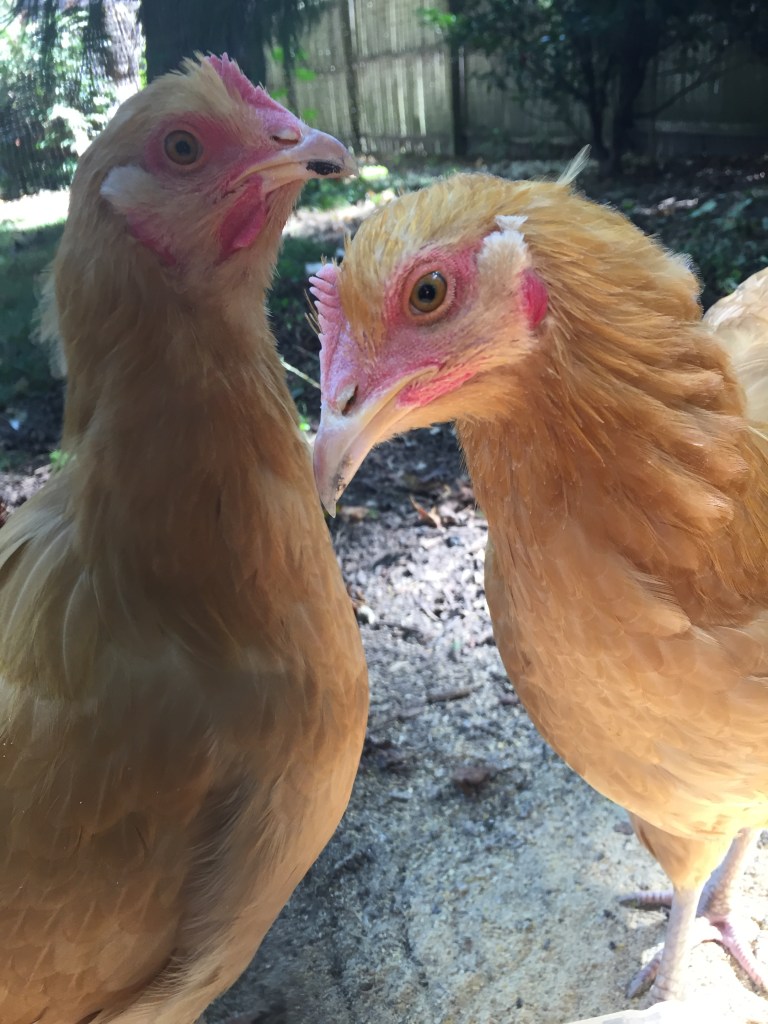
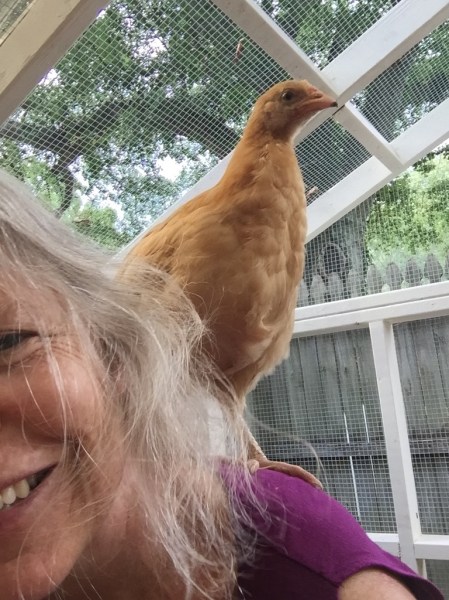
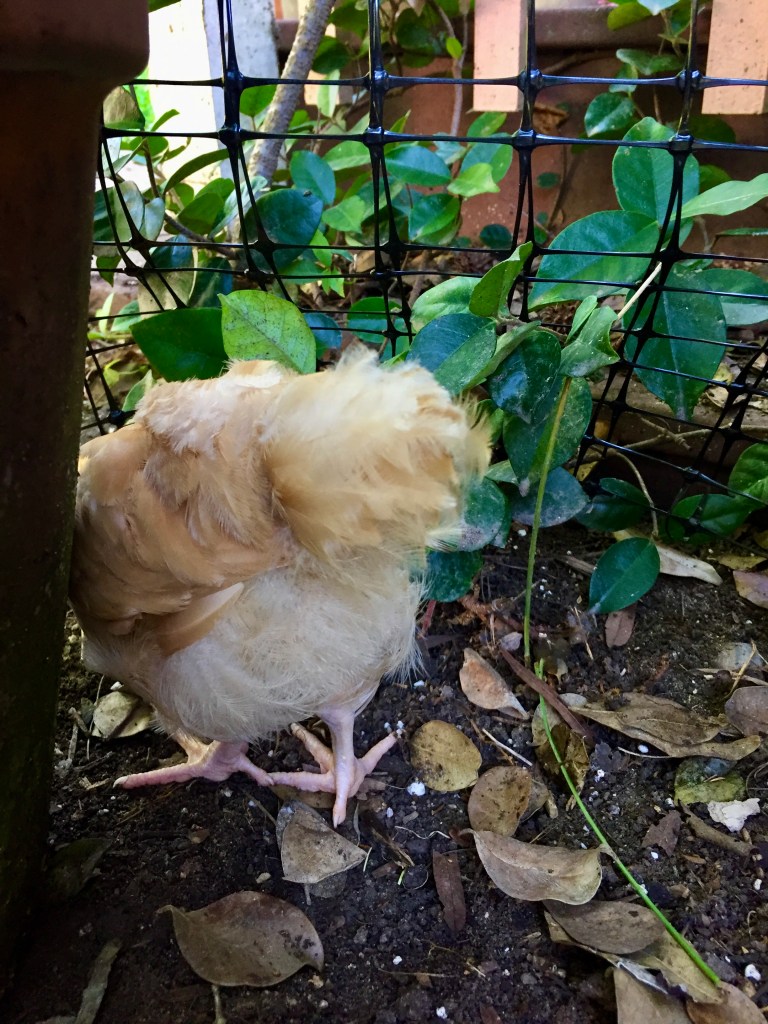
Anyway, this morning I watch the buttery yellow pullets make a run for the yard after the nighttime roost in the coop. I love their happy clucks and chortles of surprise, like its a brand new world out here.
They seem to forget that they know this place – and what happened yesterday. I wonder if they have a memory.
I wonder if they dream?
Maybe they dream of a long ago forest, and of an ancient time when they were free to hunt and scurry and lay eggs. When they would plump down underneath mother’s thick breast into soft grasses, when darkness covered the deep thickets at dusk. When they were vulnerable but still safe from predators.
I wonder if they dream of what it felt like to be wild.
In the mornings I splash milk into my coffee mug and walk, barefoot, across the stone path to the chicken coop.
I sit on an upended clay pot (my throne) and watch as the young pullets kick and scratch and poke their beaks into the same old dirt.
For months I’ve found myself doing the same, going over and over tired ground.
Since the pandemic, I’m like my chickens. Stuck inside, I find myself sifting through over-picked brain material, my thoughts ruminating, enclosed in a singular pen, my own cramped hen house.
Last night the rain brought a deep drench to the run. A leafy chicken mulch smorgasbord. The water brought new material to the surface for the girls to mull over. A bright grain of corn, the squiggle of a green worm, the measured drink of brown water.
It blows my mind how content they are to retread the same small patch over and over. They see the miniscule changes to the earth, fresh bugs, mildewed straw, whatever gets churned up. A cicada!
I love that these fluffy dunderheads are so simply satisfied and able to keep a gimlet eye on the moment.
It’s nothing truly new, or interesting even, it’s just a focused gaze.
But the single grain is nourishment, a kernel of sustenance. A cluck, a breath, a hustle into the morning sunshine.
It’s like my writing. There’s this inward and outward vista, always a choice, always available.
There are days I can go so deep in memory and reflection, one nibble of detritus at a time. Other days I’d prefer the nesting box, a nap, a forgetting.
But chickens remind you of survival, they’re little dinosaurs. And I share this too – the inherited instinct to keep scratching, to keep hunting and pecking. I’m built to cluck and fuss and find my little strut.
My sister says chickens are stupid – “bird-brains” – after all, and in a way she’s right. But they’re prehistoric, built to survive, which is more than I can say about our species at the moment.
Anyway, it’s not Man against Nature out here today, but it’s what I do. I write. I pick at the neglected patches of dusty yard, weedy and dry.
I tell myself, this chicken yard has just enough wildness and disorder to make stuff grow, even chickens.

 honeybees & reveries